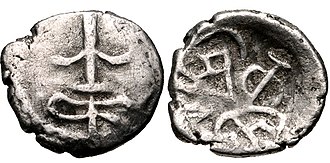
Taking a break from the Vijayanagara Series, Andhra Portal delves into the antecedents of the many Kshathriya heroes who featured as Emperors of that great Karnataka Empire. It was not just the all-India Aandhra Braahmanas known as the Satavahanas and Pallavas or the Soodhra Reddi Raajas that coloured the kingly polities of Trilinga desa, but there was also the Suryavamsa Telugu Cholas, the Agnivamsa Eastern Chalukyas, and the Chandravamsa Turvasu Yadavas (who founded Aandhra desa itself).
Indeed, Bhaarathavarsha today is faced with many false narratives, amongst the greatest of which is that there are no Kshathriyas South of the Vindhyas. This has served kapalikacharya bureaucrats and their useful idiot kalamukha kings of petty kingdoms quite well. Nevertheless, the ancient Dakshinapatha featured the full chaathurvarna. The most obvious proof of this is the illustrious Kalachuri Dynasty, more universally known as the Haihayas, the topic of today.
Introduction
That history is written by the victors is an all-too-known dictum. Bhaaratiyas naturally ignore this at their own peril as they do the more famous one: “Those who fail to learn from history are doomed to repeat it“. Santayana aside, the greater irony of course is that today’s Bhaaratiyas are overly read in selective history, and use it to advance one-sided narratives. So it is with one particularly famous (or infamous) dynasty known as the Haihayas.
That caste supremacism plagues the dialogues between so-called Upper and Lower castes is well-known. Less studied is the dynamic between the top two varnas, and how one-sided narratives and corrupted dharmasaastra (continuing even as we speak) has not only polluted the civic discourse but Rajadharma itself.
At ACP (and ICS in general) we make it a point to give all communities due credit, including of course, Scheduled Caste communities. But as discussed in a recent article, certain trends by specific sections of more privileged communities can not only vitiate public dialogue, but also hamstring a Civilization’s ability to protect and preserve itself. How can a civilization even get out of the stall, if a particularly group of vakrabuddhi vyaapari kautilyas is constantly colluding with foreign invaders, because “Chaanakya!”. Make no mistake, there were traitors in every community—but most simply admit this and focus on their heroes—not so a particular bunch. In Telugu this is called, “memu chesthey vyaapaaram…“, well, you know the rest.. A fitting point given the name of some segments of this section.
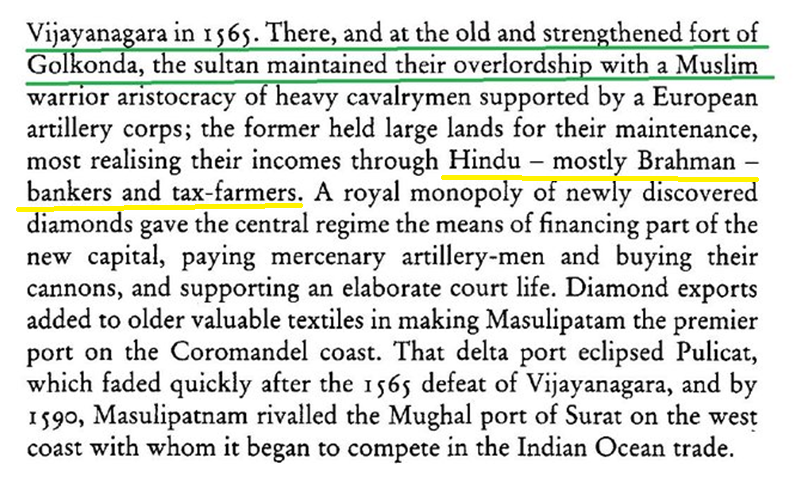
Even a famed Sankaracharya of Kanchi expressed disgust at the denialist, gaslighting antics of “so-called” caste brothers—many of whom are in fact Yavan Pandiths with no qualifying status in orthodox Vedic Ritual Society. Their ancestors had long since been thrown out by venerable Maharishi Vasistha and mighty Maharaja Sagara, but they managed to skulk back in during the great invasions. Even more ironic with respect to today’s topic, is that they claim ancestry from the very Bhargavas said to have been defeated and expelled by the Haihayas. These (self-proclaimed) descendants of Bhrgu then called themselves Parshvas of Parashu fame and became the Paaraseekas of Persia.
Their successors can be seen amongst a section of so-called “Saraswats” who openly worship “Dada Raavan“. Such Raavan-bhakths have no place as Vaidikas, let alone as Aasthika Braahmanas. Such revilers of Vibhishana (yes, they actually insult this beloved Vishnu-bhaktha) and stealth Raam-dhrohis are ipso facto dharm-dhrohis, and must be called out and cancelled by all who claim to be dharmic and “sattvic”.
The great tragedy is that actual Vaidikas are getting blamed for the antics of this bunch. That varnashrama dharma is severely imbalanced today is all-too-known by careful observers. But the trope and blame-game is always the same: one side responsible for everything, all members of it are bad (even those who write against “their own”), and marxism is apparently the only way. However, in such subtle times a more supple critique and analysis is required.
Real men are required to face up to hard times, and that means not only studying real history but also really introspecting one’s own. After all, to those whom much is given, much is expected. It is easy to ridicule and reserve blame upon “reserved classes“, it is much harder to realise that that the 2 varnas responsible for educating on the one hand and ruling on the other, are much more responsible for the debacles of the past thousand years.
The study of the Aandhra Kshathriya (Raaju) community, and its antecedents North of the Vindhyas, helps us understand this dynamic and the general breakdown in varnashrama dharma. It is not for nothing that it was the Telugu Film Industry (TFI) that celebrated the city of Mahishmati, and its second most famous son (albeit celluloid). Less understood is the reality of its most famous son, Karthaveerya Arjuna, and how he is the progenitor of a dynasty that not only achieved fame in Aandhra, but also that was steeped in valour on the blood-soaked fields of the Palnati.
Background
“The Telugu Coda princes of the Kaasyapa gotra, the Undirajas of the Haritasa gotra, and the Vatsavayas belong to the Solar race, and the Caalukya princes of Elamanci, and Veni belong to the Lunar race. It is, however, interesting to note that the Caalukyas of the Manavyasa gotra, who ruled coastal Andhra country for nearly four hundred years, from the seventh century A.D., and left many collateral branches behind”.[ 3, 267]
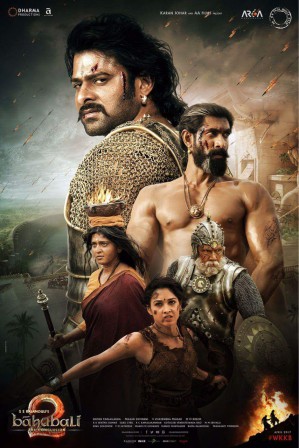
Though erroneously referred to as Lunar, the Agnivamsa Chalukyas left a massive imprint on Aandhra desa. It is the Raajus of this background who are originally credited with Kondapalli. What is not known very much throughout India is that the title-star of the movie Baahubali himself hails from the community.
“According to this verse [from the Ksatriya-gotra seesamaalika in Telugu] which has come down to us from generation to generation, the Raacavaaru of the Telugu country were the descendants of four major primary ksatriya houses, namely, the Kaakateeyas, the Kotas, the Parichedis and the Varnatakas of the Kaasyapa, Dhananjaya, Vasistha and Kaundinya gotras respectively. Inscriptions of the twelfth and thirteenth centuries confirm the fact that the Kaakateeya and the and the Kota kings belonged to the Kaasyapa and the Dhananjaya gotras and had their respective capitals at Warangal and Dhanyavati. They state that the former descended from Karikaala Cola, and the latter from Dhananjaya.
Karikaala Cola, from whom the Codas of the Telugu country trace their descent, was, according to tradition, contemporaneous with his bitter enemy, Trilocana Pallava. Besides the Kota kings, the Paricchedis, the Caagis, the Haihayas, and the Velanaatis were some of the feudatory families that flourished in the centuries mentioned above. Of these, the princes of the Caagi family ruled on the banks of the Krshna with Gudimetta and Vijayavaada as their capitals. The later members of this family became Vatsavayas as stated before. The dominion of the Haihayas, another feudatory family of the same period, who trace their descent from Kaartaveeryaarjuna, was the Konamandala. The territory of the Parichedis also, like that of the Kota princes, lay in the Guntur district. Very few of their inscrip-tions have come to light” [3, 267]
The 2015 Film Baahubali features the ancestors of the Aandhra dynasty, who hailed from the city of Chandramahavamsi Yadhuvamsi Haihaya Kaarthaveerya Arjuna.
Jai Mahishmathi!
Legendarium
The Haihaya Vamsa is ultimated traced to the Chandra Mahavamsa. As orthodox puranic scholars know, Vedic kshathriyas are originally traced to 2 great Vamsas (the other being the famed Suryavamsa). The Agnivamsa arose in later more contested circumstances. Nevertheless, the Haihayas have a long, often less feted history and fate in the annals of the Puraanas. Here is a more objective take.
Let me begin by first distinguishing between traditional aasthika Brahmanas (many of whom dutifully live in matthas and agraharas and who should be respected) from a band of casteists who happened to be born as “Brahmins”. Traditionalists are not casteists; they simply follow ancient varnashrama dharma. But those living material lives in the modern world have some Brahmanas who genuinely have the interests of all sections of society at heart, and some “Brahmins” by accident who abuse the privilege of birth to further their prejudiced caste agenda and defend their private misbehaviour. They advance asinine and avaidika theories like Aryan Invasion Theory in direct contradiction of actual Vedic Acharyas who live the traditional way and actually have valid traditional knowledge.
However, many Dharmic Brahmanas have been keeping quiet. We too have avoided this minefield. But as some Dharmic Kshatriyas have been rightfully criticising the adharmic nature of these views emanating from scientism and casteism, the line of the casteists (& their useful idiots) is “Parashuraama”! But as usual,half-knowledge leads to full harm. Such knaves further Adharma, knowing only partially the tale of Kartaveerya Arjuna.
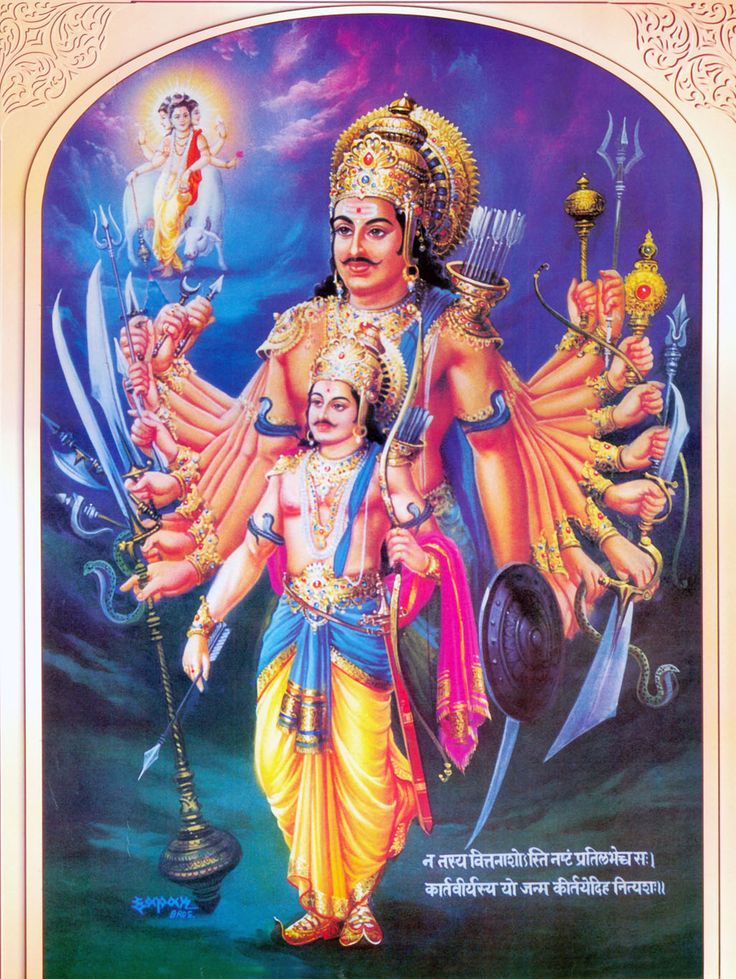
Unbeknownst to most Bhaaratheeyas, and contrary to his common image, Karthaveerya Arjuna was a dharmic king. He was so meticulous in the performance of dharma that it was said he would appear before a subject in order to prevent the latter from committing any sin.
Dripping with caste supremacism, Golkonda vyaapari revisionists attempted to cast mighty Karthaveerya Arjuna as a “demon” king all while recasting Raavana as some sort of misunderstood braahmana-rishi worthy of worship. In reality, it is Raavana who is the demon and Karthaveerya who himself is more of a true Avatar than Parashurama himself. Here is the distinction:
“According to Garga Samhita, Lord Maha Vishnu descends in six kinds of forms:
(i) Amsamsa Avatara (a part of a part): The amsamsa incarnations begin with Marici, The amsamsa incarnations are understood to perform the work of executing missions.
(ii) Amsa Avatara (a part or portion): The amsa incarnations begin with Brahma. The amsa incarnations are said to oversee the execution of the Lord’s mission (in the world).
(iii) Avesha Avatara (entrance into a jiva):The avesha incarnations begin with Parashurama. The various avesha incarnations Lord Vishnu enters (a jiva), executes His mission, and then departs.
(iv) Kala (era or period): The kala incarnations begin with Kapila and Kurma. Millennium after millennium Lord Hari’s kala incarnations teach and establish the principles of religion, and then disappear.
(v) Purna Avatara ( full): The purna incarnations are 1. Narasimha, 2. Rama, 3. Lord Hari, the ruler of Shvetadvépa, 4. Vaikuntha, 5. Yajna, and 6. Nara-Näräyana.
The purna incarnations are said to include the catur-vyuha incarnations. They are said to be the places where heroic powers and the nine rasas are seen.
(vi) Paripurnatama Avatara (perfect or quite full or most full): The paripurnatama form of the Lord is Sri Krishna, who is the original Supreme Personality of Godhead Himself. He is the master of countless universes. He is splendidly manifest in the realm of Goloka.”
Thus, Karthaveerya was an amsa avathaara of Vishnu in Sudarshana Chakra form, and would later take rebirth as Dasarathi Bharatha, of Ayodhya fame. Meanwhile Parashuraama is a mere shakthyavesha avathaara, albeit temporarily imbued with 7/8ths of Mahavishnu’s power. The actual demon was the demon-king raakshasa Raavana. Casteists should note that this is not about caste, as due to material power there is no shortage of demons taking birth among Kshathriyas (Duryodhana, Jarasandha, Sishupaala, Danthavakra, etc), but this is merely about Dharma and Adharma.
Due to a minuscule portion of Ahamkaara, and the subtleties of Achinthya-bheda-bheda, the great Sudarshana Chakra took birth as Karthaveerya Arjuna so that the power of the Poorna (Mahavishnu) would be proven to the Amsa (Sudarshana). Poetically, it is the poornavathaara of Maryaadha Purushotthama, a.k.a Dasarathi Raama who punished the Shakthyavesha-avathaara of Bhaaragava Raama. Raama of the Bow then took back Vishnu’s shakthi-aveshya from Raama of the Axe.
Bereft of the power of Mahavishnu, this also explains why later in the Dvaapara Yuga, Parashuraama is defeated by Bheeshma (unlike Karthaveerya, Devavratha was only just an incarnation of a Vasu, rather than powerful Vishnu-amsa). In all fairness however, it must be said that Jamadagnya, though mere jeevaathma, is himself slated to be a Saptharishi in a future Manvanthara. However, a narrative rebalancing is required to understand the full consequence of these avathaaras, and the leela of Paramaathma. It is only “Pagan-polytheist” casteists who bray in protest. But why babble on when Itihaasa itself clarifies:
Kartaveerya Arjuna Story in Mahabharata
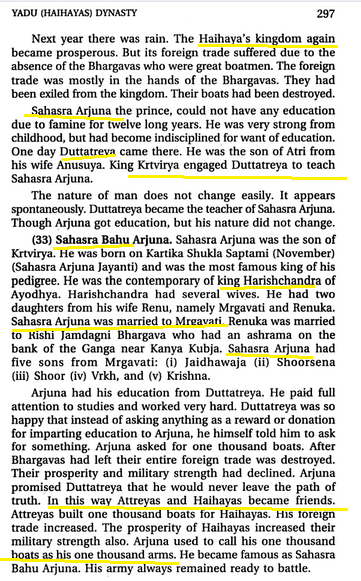
“Meanwhile the mighty son of Kritavirya, viz., Arjuna of the Kshatriya order and ruler of the Haihayas, endued with great energy, highly virtuous in behaviour, and possessed of a thousand arms through the grace of (the great Rishi) Dattatreya, having subjugated in battle, by the might of his own arms, the whole earth with her mountains and seven islands, became a very powerful emperor and (at last) [5, 102] gave away the earth unto the Brahmanas in a horse-sacrifice.“
“Assisted by the king of the Haihayas, the god of fire, caused by the wind to blaze forth with energy consumed the uninhabited but delightful retreat of the high-souled Apava. Possessed of great energy, Apava, O mighty-armed king, seeing his retreat consumed by the powerful Kshatriya, cursed that monarch in wrath, saying, ‘Since, O Arjuna, without excepting these my specious woods, thou hast burnt them, therefore, Rama (of Bhrigu’s race) will lop off thy (thousand) arm. The mighty Arjuna, however, of great prowess, always devoted to peace, ever regardful of Brahmanas and disposed to grant protection (unto all class), and charitable and brave, O Bharata, did not think of that curse denounced on him by that high-souled Rishis. His powerful sons, always haughty and cruel, in consequence of that course, became the indirect cause of his death. The princes, O bull of Bharata’s race, seize and brought away the calf of Jamadagni’s homa cow, without the knowledge of Kritavirya, the ruler of the Haihayas. For this reason a dispute took place between the high-souled Jamadagni (and the Haihayas).”
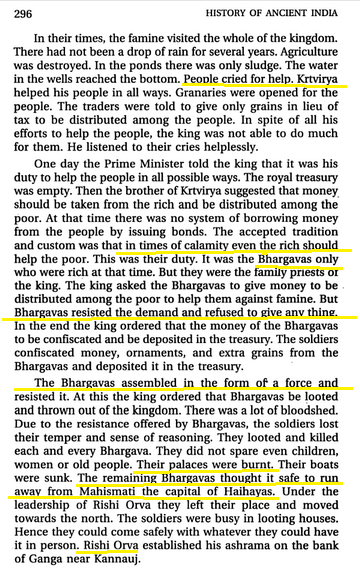
Parashurama’s sin
“The grandson of Viswamitra and son of Raivya, possessed of great ascetic merit, named Paravasu, O monarch, began to cast imputations on Rama in public, saying, ‘O Rama, were not those righteous men, viz., Pratardana and others, who were assembled at a sacrifice at the time of Yayati’s fall, Kshatriyas by birth? Thou art not of true vows, O Rama! Thine is an empty boast among people. Through fear of Kshatriya heroes thou hast betaken thyself to the mountains. The descendant of Bhrigu, hearing these words of Paravasu, once more took up arms and once more strewed the earth with hundreds of Kshatriya bodies. Those Kshatriyas, however, O king, counting by hundreds, that were spared by Rama, multiplied (in time) and [5, 103]
became mighty monarchs on earth. Rama once more slaughtered them quickly, not sparing the very children, O king! Indeed, the earth became once more strewn with the bodies of Kshatriya children of premature birth. As soon as Kshatriya children were born, Rama slaughtered them.” [5, 103]
However, there is a reason why Karthaveerya Arjuna is in fact celebrated in the Ramayana.
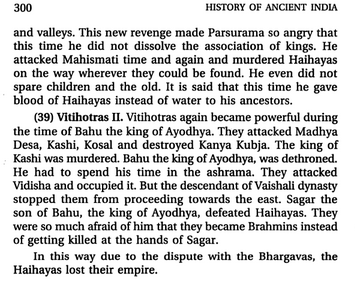
He is recalled with praise not only here but in the Mahabharata itself. He is mentioned to mock Raavanasura, whom he easily defeated. Raavana’s grandfather, Maharishi Pulastya had to humbly request the release of Raavana, who had been reduced from brahmaraakshasa to mere tied up plaything before the sons of Karthaveerya. Arjuna of the Haihayas happily and respectfully obliged the great Sage, and for his sake, emancipated the now-chastised tyrant of Lanka.
Indeed, Raavana would not soon forget his humiliation and chastisement at the hands of the Kshathriya Karthaveerya, nor would the Haihayas not fail to bounce-back from the later veergathi of Arjuna of the Vitihotras at the hands of Raama of the Bhargavas.
Mahishmati Odyssey from Madhya Pradesh to Andhra
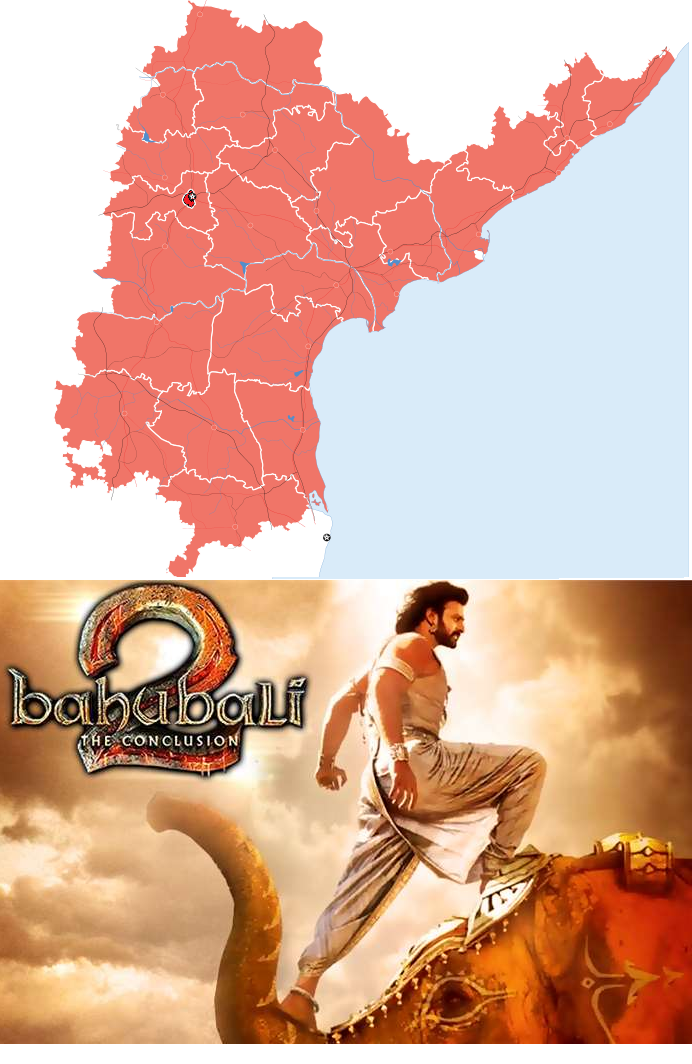
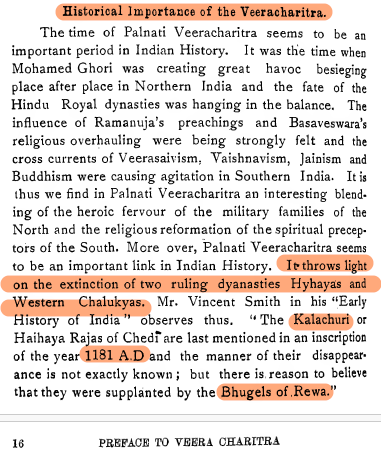
Why was a story about Mahishmati Samrajyam (in modern Madhya Pradesh) and Kunthala raajyam (in Karnataka), a Telugu story at all? Well, one need only start with the Palnati Veera Charitra. That epic by Kavi Sarvabhauma Srinatha has not for nothing, been dubbed the Aandhra Kurukshetra. The Kalachuris were an intrinsic part of this epic, and through them, the Mahishmati/Haihaya connection to Andhra even more obvious.
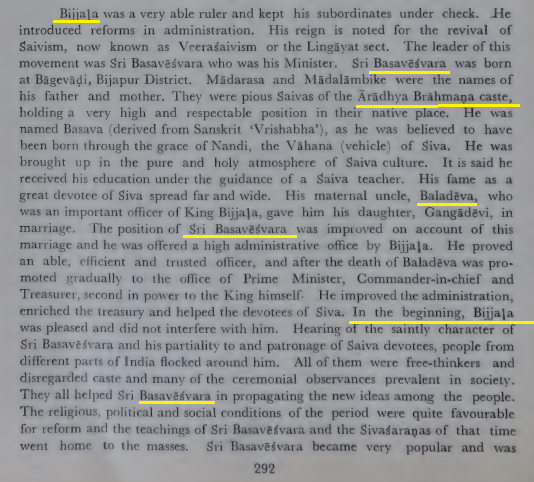
And for the self-proclaimed history savants, there was even a Bijjala deva ruler among the Kalyani Kalachuris, and Kalachuri Gangeyadeva was one of the commanders in the expeditions of Indic kings against the Ghaznavids.
Thus from Karnataka to the Kandahar, the name Kalachuri Haihaya is etched in history of the Indian Subcontinent. In any event, Mahishmathi through the PVC has a natural place in the Aandhra psyche for our own reason.
History
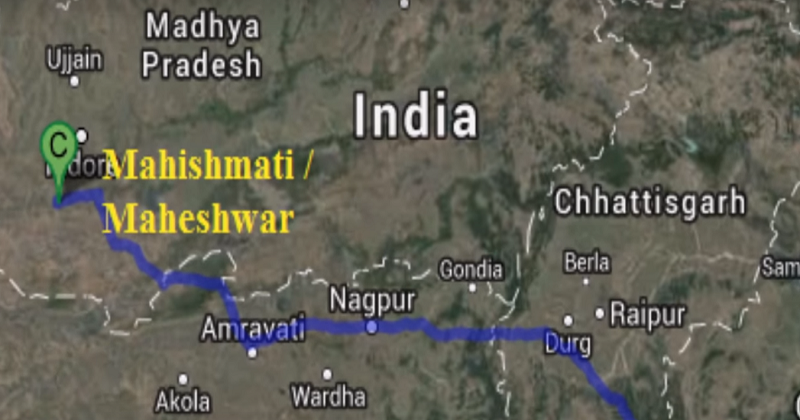
Historical illiterates that they are, vakrabuddhi vyaapaaris foolishly write that the Haihaya clan was destroyed by Parashurama. Even a passing knowledge of history would have acquainted them with the fact that Haihayas were alive even after Parashurama’s war, and famously drove the Ikshvakus from Ayodhya. Much later, Haihaya Kalachuri Gangayadeva was a famous king of the medieval period and Haihaya kings persisted well after him. Our story begins with the Kings of Ayodhya, especially Mandhata.
“The latter was a famous king, a Samraj (emperor) and extended his sway very widely. He overran the Paurava and Kanyakubja kingdoms, and defeated the Druhyu king Gandhara retired to the north-west, and gave his name to the Gandhara country. It is also probably that Mandhata or his sons carried their arms south to the river Narmada. The Supremacy of Ayodhya soon waned, and the Haihayas became the dominant power. One of their kings traversed the prostrate Paurava kingdom, and conquered Kasi. The most famous king of this dynasty was Arjuna, the son of Kritavirya. He extended his conquests from the mout[h] of the Narmada as far as the Himalayas, and raised the Haihaya power to pre-eminence during his long reign. The principal Brahmanas, who dwelt in the lower region of the Narmada, were the Bhargavas. They were ill-treated by the Haihaya kings, and fled into Madhyadesa.”
Demonstrating that Devaadhideva has a sense of humour, legendary kshathriya and braahmana antagonists Sahasrabahu Arjuna and Parashu Raama were actually related:
“The famous Rishi Richika Aurva, who was chief among them, married a daughter of Gadhi, king of Kanyakubja. The issue of the marriage was Jamadangi, who married a princess of Ayodhya [Renuka]. Gadhi’s son Visvaratha became the Brahamana Visvamitra. At the end of his long reign Arjuna came into collision with Jamadagni, and killed him. The latter’s son Rama took up the fight, and was supported by the princes of Ayodhya and Kanyakubja, who were allied to him by marriage, and who would naturally have opposed the dangerous raids of the Haihayas. With their help Rama kill Arjuna, and punished the Haihayas.
But although the Haihayas received a set-back, they grew in power, and their dominions stretched from the gulf of Cambay to Ganga-Yamuna Doab, and thence to Banaras. They overthrew the kingdoms of Ayodhya and Kanyakubja, and many other kingdoms in the north-west, with the co-operation of various foreign tribes. The king of Ayodhya driven from his throne, took refuge in the forest, and died there, leaving a child Sagara. Sagara, on reaching manhood, defeated the Haihayas, and regained Ayodhya. He extended his campaign, crushed the Haihayas in their own territories, and subdued all the other enemies in North India. India was thus saved from age-long struggles and depredations, bringing ruin and carnage in their train.” [5, 69]
This in turn spurred an exodus to the South of the Vindhyas.
“When Sagara established his empire over Northern India, the only noticeable kingdoms that survived were the Videha, Vaisali and Anava (descendants of Anu) kingdoms in the east, Kasi in Madhyadesa, and the Yadava kingdoms in Vidarbha, and on the Chambal. After the death of Sagara, the overthrown dynasties seem to have extended their authority northward over the Haihaya territory. Vidarbha, after whom the province was named, had a grandson, Chedi, who founded the dynasty of Chaidya kings in Chedi, the country along the south bank of the Yamuna. The Anava kingdom in the east, the nucleus of which was Anga, became divided up into five kingdoms, said to have been named after king Bali’s sons, Anga, Vanga, Kalinga, Sunhma, and Pundra. The capital of Anga was Malini, and its name was changed afterwards to Champa or Champavati (Bhagalpur) after king Champa.
The Paurava realm had been overthrown in Mandhata’s time, but, after Sagara’s death, it was re-established by Dushyanta. Dushyanta’s son by Sakuntala was the famous and pious Bharata. Their territory, however, appears to have been shifted to the northern portion of the Ganga-Yamuna Doab, for Pratishtahana is no longer mentioned, and the district was included in the vatsa realm. Bharata was a great monarch with a wide sway, and his successors, were the famous Bharatas. Bharata’s fifth successor Hastin made Hastinapura his capital. Under Hastin and his successors the Purava dynasty extended its sway over Panchala and other neighbouring realms.” [8, 70]
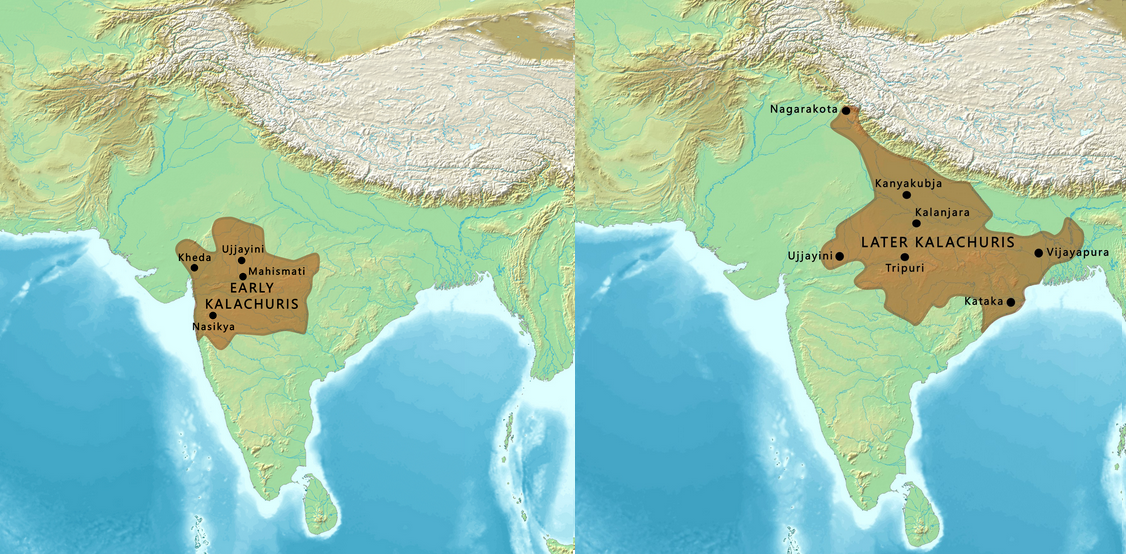
Progenitors to the Pandavas and Vrshnis aside, the name Kalachuri is intricately connected with the ancient Kingdom of Chedi (of Sisupaala fame). However, these were not ineffectual like this particular forebear. They would feature in the cataclysm with invading Thurushkas and win key victories against them.
“The Kalachuris, also been known as the Haihayas, were an ancient people…The Kalachuris of Chedi, also known as kings of Dahala, had their capital at Tripuri, represented by the modern village of Tewar, six miles to the west of Jubbulpore. The royal dynasty was founded about 845 A.D. by Kokalla who was one of the greatest military leaders of the age….he defeated the Turushkas, who were undoubtedly some Turkish forces of the ruler of Sindh.”[8, 292]
There were many accounts of their later exploits:
“Rulers like Karna and Bhoja no doubt defeated the Muslims; it has even been suggested, perhaps quite correctly, that they effectively prevented the Muslim aggression which was resumed after their death. But it is a fact that they also carried their victorious arms far and wide against other Indian rulers. One might as well ask why these rulers did not concentrate their energy and resources to extinguish finally the great national enemy.” [8, 314]
‘Nevertheless, it becomes painfully evident that the people lacked a true conception of Indian or Hindu nationality, as we understand the term; that the policy of Indian rulers was not guided by the common concern of India as a whole, nor even by the enlightened self-interest and true statesmanship which would correctly visualize the remote, as opposed to the immediate, gain or loss.” [8, 314]
“The Kalachuris of Dahala rose to be the greatest political power in India in the 11th century A.D.” [8, 322]
“But Gangeyadeva’s boast that he carried his arms to the Kira country (Kangra Valley), which was part of the Ghaznavid province of the Panjab, may refer to a sort of retaliatory expedition against the Muslim power. In any case, it proves the ability and willingness of Gangeyadeva to fight the Muslims in their dominions. It also shows that for this purpose he could count on something like a few passage through the territories of other independent rulers. Gangeyadeva assumed the title Vikramaditya” [8, 323]
“Gangeyadeva was succeded by his son Lakshmi-karna, better known simply as Karna. He was also a veteran general like his father, and a hero of hundred fights.” [8, 323]
“Karna next carried his victorious arms along the eastern coast as far as the country round Kanchi, which was then ruled by the Cholas.” [8, 324]
“After the usual struggle fo succession Maudud, son of Mas’ud, made himself master of both Ghazni and the Panjab. But the Saljuq attacks continued and, taking advantage of this, the Indian rulers seem to have made a combined effort under the leadership of the Tomara king of Delhi to wrest the Panjab from him. The confederacy of Indian rulers, probably comprising, among others, the Paramara king Bhoja, the Kalachuri Karna, and the Chahamana Anahilla (of Naddula) conquered Hansi, Thaneswar, Nagarkot, and other places, and at last besieged Lahore itself, in 1043 A.D. The garrison in Lahore were reduced to great straits, and being in utter despair made a sally. The Indian army, taken unawares, took to flight.” [8, 344] “In light of later events, this failure, entirely due to lack of generalship, may be said to have paved the way for the final conquest of India by the Muslims.” [8, 345]
However, it is in Aandhra that Kalachuri Haihayas would achieve their most poetic fame.
The Southern Haihaya Kalachuri Clan
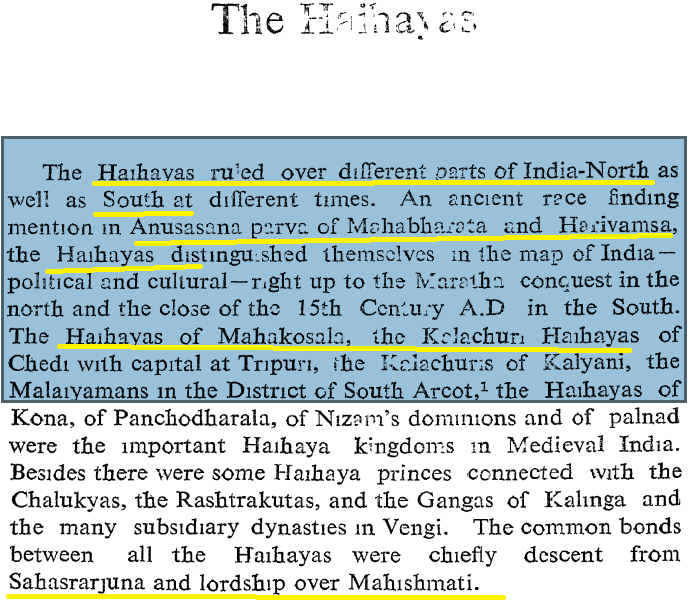
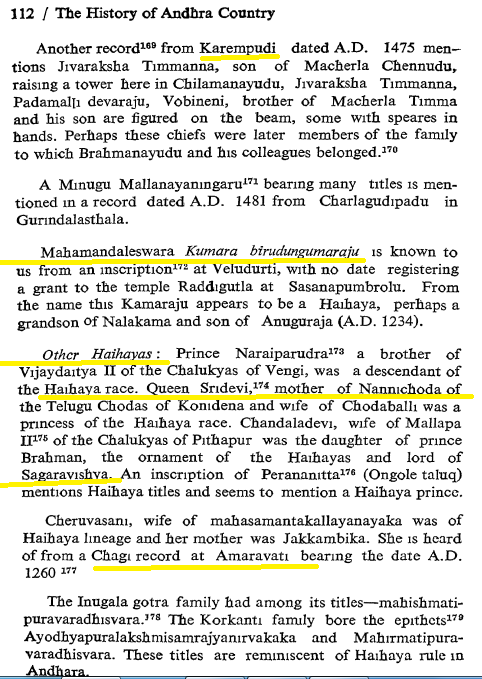
Haihayas of Mahishmathi are said to have made their way to Aandhra via Mahakoshala. From there, a cadet branch moved south and became feudatories of the Cholas and later Chaalukyas respectively. There were notably the Macherla Haihayas who featured in the Palnati Yuddham, a.k.a., Aandhra Kurukshetram. The main branches, however, were Konamandala, Panchadharala, Vardhamanapura Gona, and the famed Palnadu Haihayas of Gurajala.
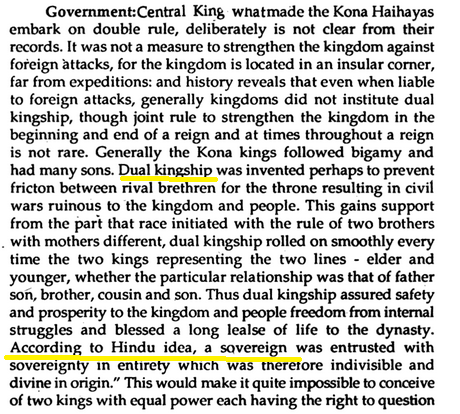
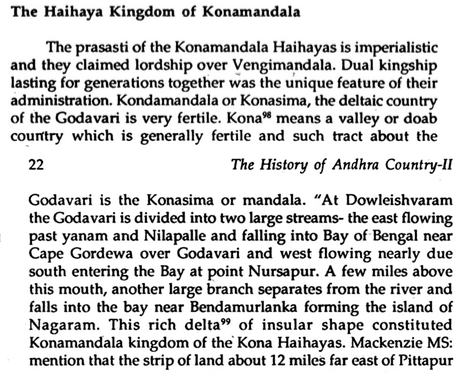 An interesting feature of the Konamandala Haihayas was the presence of the Dvairaajya, i.e. Dual Kingship.
 They mostly owed allegiance to the paramount power of the South, the Chola Emperors. The Konamandala lineage began with Haihaya Keerthiraaja and Mummadi Bhima I and ended with Bheemavallabha, around 1369 CE. It was effectively incorporated into the Reddi kingdom. They would ally with Annadeva Chola and intermarry with the Reddi kings. [7, 91]
Another lineage was the Gona Kingdom of Vardhamanapura. They were feudatories of the Kakatiyas. They were erroneously classified as Reddis in some revisionist scholarship.
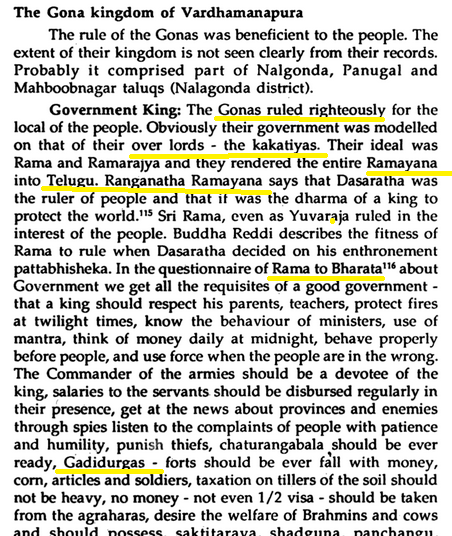
In actuality, they were Kshathriya Kalachuri Haihayas of the Gona lineage——hence Raaja Gona Buddha, author of the Ranganatha Ramayana. Democratic-republic is one thing, social engineering is another. This episode shows the danger of social engineering—truth is occluded in the quest for fame and politico-religious prestige.
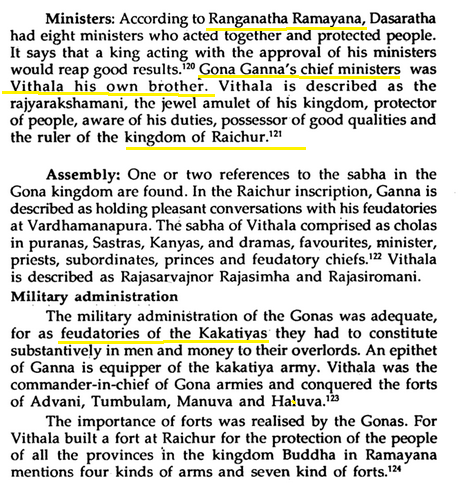
All of this is clearly established here in the Raichur inscription.
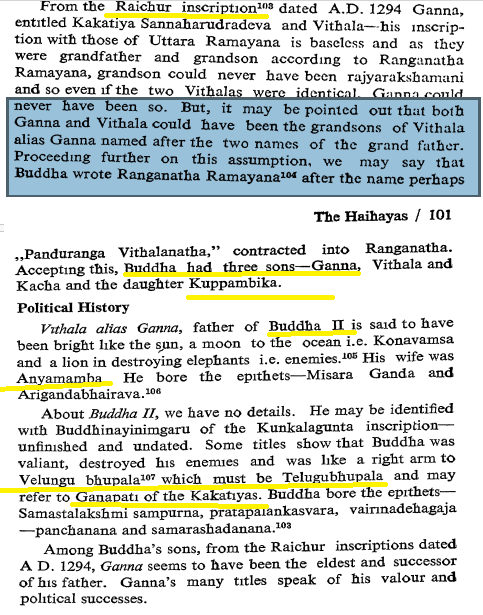
Panchadharala aavali was the next notable lineage of Haihayas.
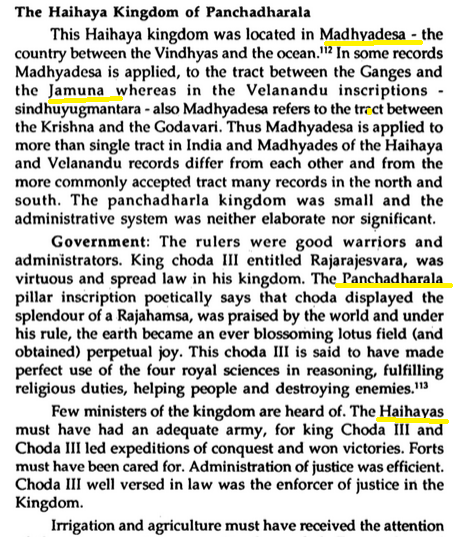
The Panchadharala lineage that stands out, especially for its clarity on lineage and Genealogy.
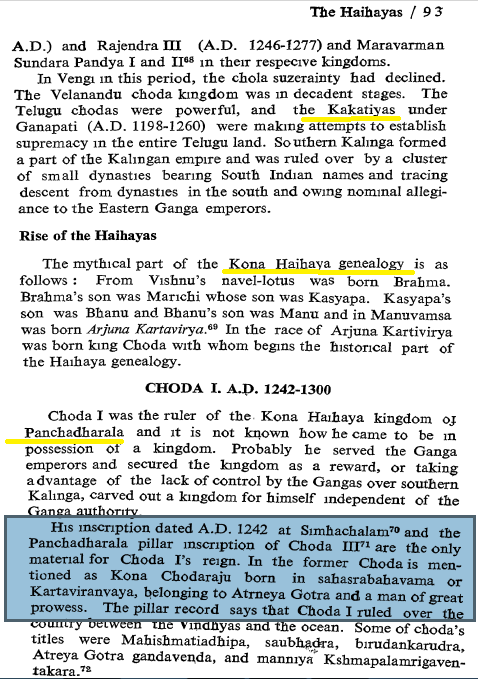
Choda I was followed by Upendra. He ruled with the benefit of a peaceful reign. He was succeeded by Choda II. The exploits of Choda II, likely a feudatory of the Eastern Ganga emperor, stand out here.
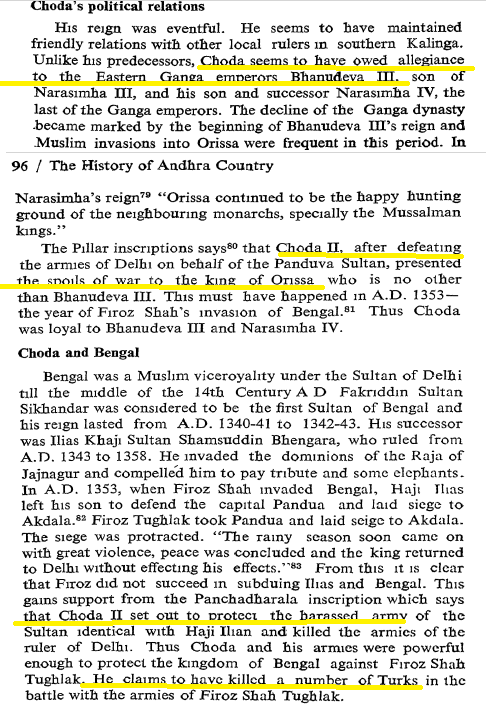
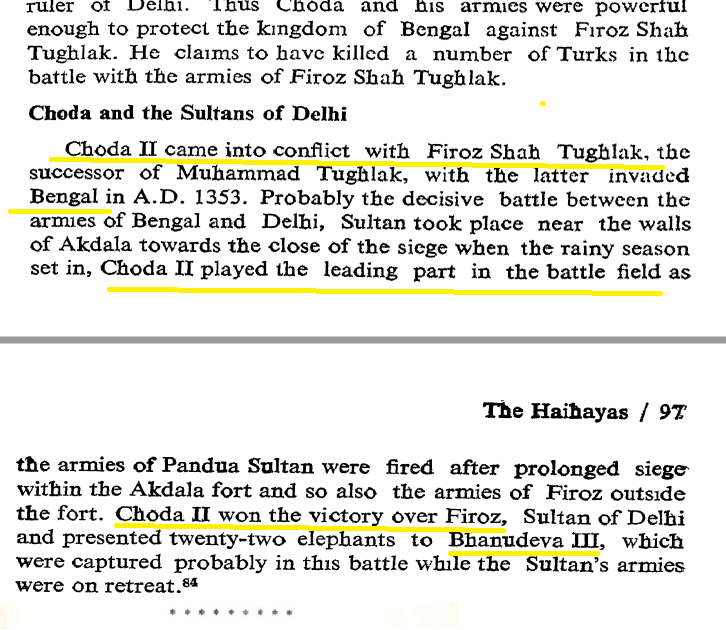
Regardless, Choda II would be thought of as the greatest of the Panchadharala Haihayas, and is credited with a victory over Firuz Shah Tughluq himself.
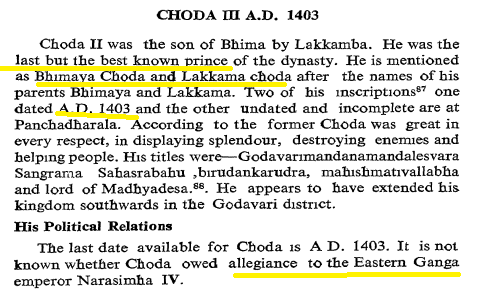
Choda II would be succeeded by Haihaya Bheema and Choda III, considered the best known and most successful. It it is unclear but believed that he owed allegiance to the Eastern Gangas. The name Choda can often be confusing as the Telugu Cholas, Eastern Gangas, and Kona Haihayas all had kings who bore that name—though the origin is obviously in reference to the mighty Chola dynasty. The Kona Haihayas of the Panchadharala would be conquered by Vema and Veerabhadra Reddi of the Rajamahendri Rajyam.
Indeed, due to the marital and familial relations between the Cholas, the Gangas (i.e. Chodaganga), and the Chalukyas, the Velanatis would feature in the Eastern Ganga’s prolific wars against the Delhi Turks. Eastern Ganga emperors of Odisha would have the distinction of the only major Indic dynasty not to fall to the Tughluqs, and would stand proud until a palace-temple conspiracy saw them replaced by the Gajapati usurpers. These pretenders to the throne would install themselves only to ally with the Bahmanis against Vijayanagara, putting the latter on the backfoot for mere temporary coastal expansion upto Kanchi itself.
Though they would later be punished and cut to size by Krishna Deva Raya, the damage that they wrought on fellow Indic dynasties would be in stark contrast to the cooperation and alliance between the Eastern Gangas and the Kakatiyas. This Krishna niti of allied resistance to foreign powers would be in stark contrast to the later short-sighted kautilya niti of alliance with foreign power for temporary gains against home team rivals.
Finally, we have the illustrious Palnati Haihayas who featured in the eponymous Yuddham.
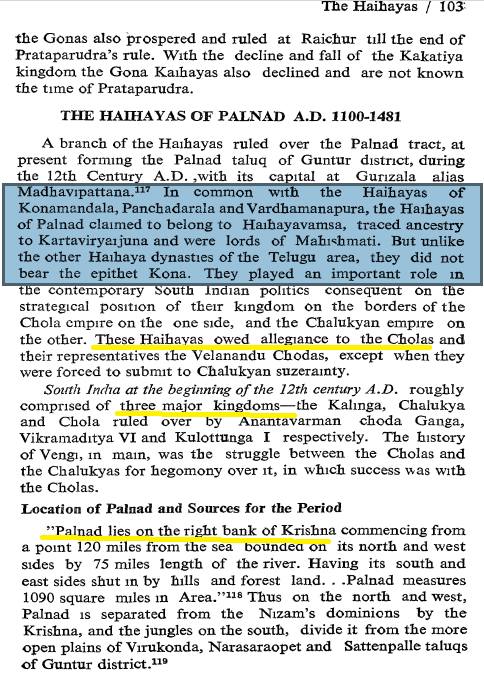
They too are known for the somewhat idosyncratic Dvairaajya setup as with the Konamandala Kalachuri-Haihayas.
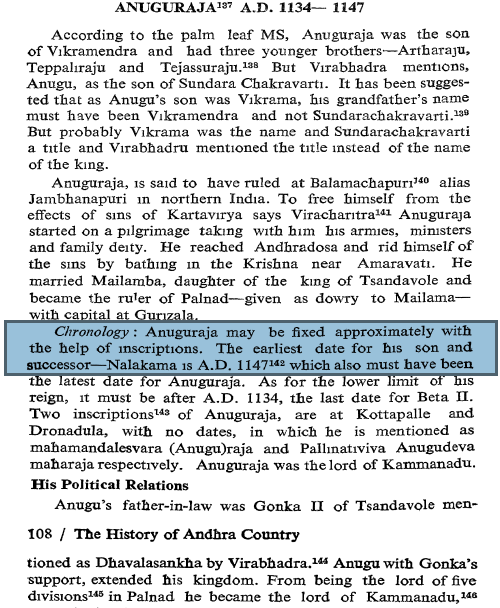
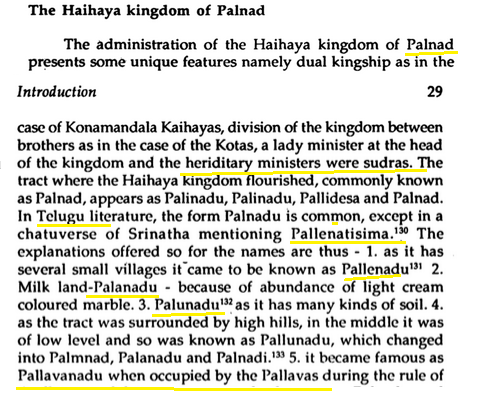 The lineage runs as follows: Beta I, Vikrama I, Rajaraja I, Beta II, and the famed Anuguraja.
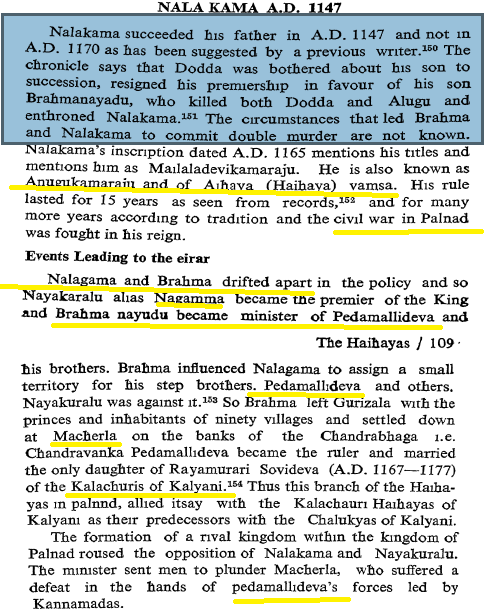
Due to politics between the duelling ministers Brahma Naidu (of the Padmanayaka section) and Nayakuralu (Nagamma), a separate kingdom was facilitated by the former within the Palnadu Haihaya realm at Macherla, under Mallideva. His step-brother and reigning overlord Nalagama deva found this unacceptable, paving the way to civil war on the vaunted fields of the Aandhra Kuruskshetra..
The duelling Palnadu kingdoms of Gurajala and Macherla met in full force to settle the civil war, at Karempudi. The order of Battle would see the flower of Aandhra Chivalry slain, and the effective end of the Palnadu kingdom as factor in Aandhra politics.
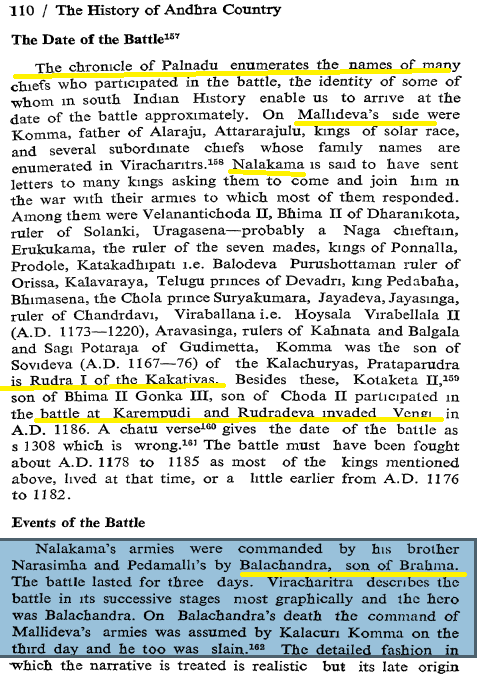 Although they perhaps would have been better spent in service of Northern Defence against the Turkic invasions, this episode did leave a consolidated Kakatiya kingdom as net gainer, after 3 days of battle. This would serve Aandhra by not only providing a solid desa level defensive kingdom to field against Delhi Turks, but also lay the foundation for the implementation of the vaunted Nayankara system, which would lead to the Andhra Liberation Confederacy and the later Vijayanagara Empire.
The final Haihayas appear to have declined from Maharaaja to lesser status as Mahamandeshvara. Nevertheless, they produced a number of notable figures, and many Princesses who featured as beloved ornaments adorning the families into which they were married. And so passed the mighty Haihayas from story and song…
Vamsa Vrksha (Genealogy)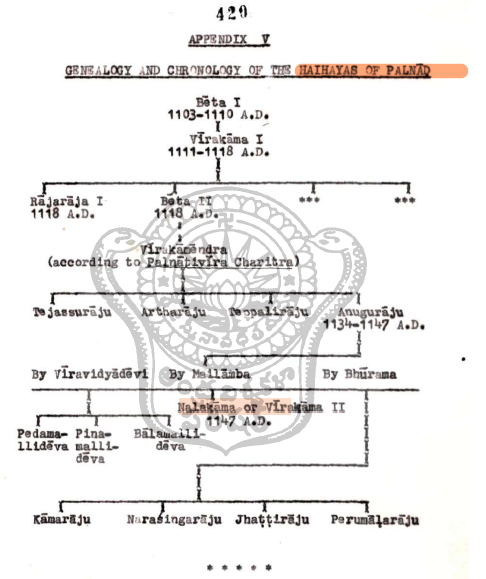
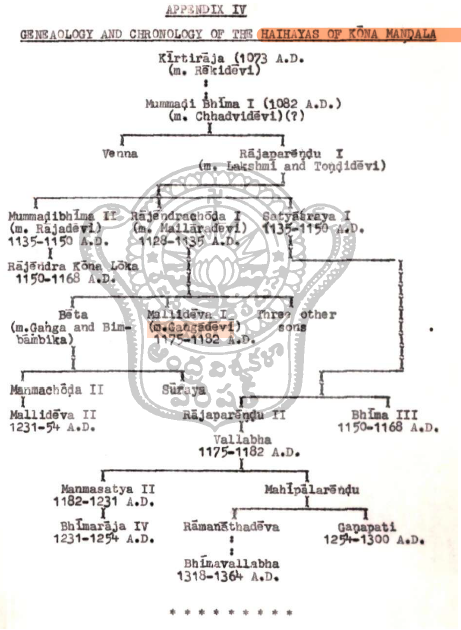
As mentioned previously, the Kalachuri-Haihayas would be eminent not only in Aandhra desa, but in neighboring Kunthala/Karu Desa (a.k.a. Karnataka).
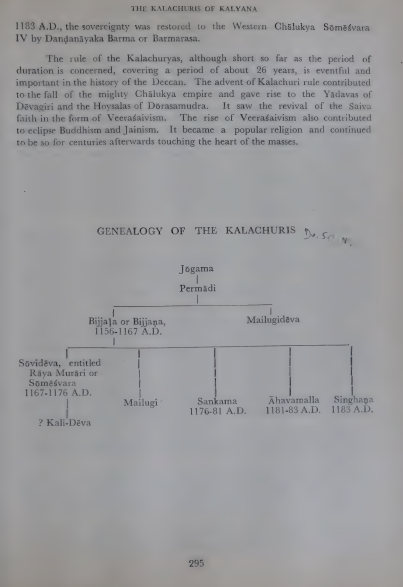
However, this reality was not limited merely to the Karnataka Kalachuris. It would continue with the Karnakata Samrajya itself. The name Tuluva did not refer to the Tulu region as both the Tuluvas and Araveedus were earlier recognised as Aandhra Kshathriyas, ’til boorish bores at BORI no doubt got their grubby hands on hindu historiography.
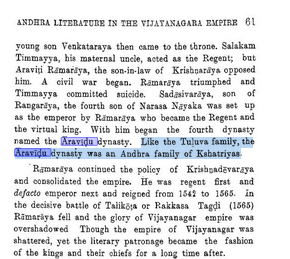
Krishna Deva Raya’s ritual-kshathriya status is seen not only in his patrilineal descent (the Tuluvas descending from the Turvasu Chandravanshi dynasty), but also in the inter-marriage with the previous dynasty of Saluva Narasimha. The Saluvas were themselves Haihaya Chandravanshis of Aathreya gothra. KDR married the daughter of Saluva Narasimha. Details about KDR’s mother are limited—with many outright slandering her in order to slander him. While the popular consensus today appears to be that she was a Balija Naidu aristocrat from Aandhra (hence KDR’s promotion of Telugu Nayaks to the Madurai kingdom), there remains a scholarly view that she was from a Veeropadeya aristocratic family of Ummattur. What’s more the Veeropadeyas are themselves thought to be the forerunners of the Wodeyars of Mysore. The rebellious Ummattur vassal-king Gangasimha was deprived of his kingdom by KDR. However, due to inter-marriage this family was restored to its vassal-throne by Emperor Achyutha Raya. Hence, the Wodeyars should actually trace their descent not to Gujarat, but to the Saluva Haihaya Chandravanshi Dynasty. Veeropadeya →Wodeyar.
“In the 16th century A.D the Aravidu dynasty, the feudatories of the kings of Vijayanagar claimed chalukya descent. These rulers were of Atreya gotra and traced their ancestry to Rajrajanarendra of the Eastern chalukyas of Vengi”
“At the same time, Somadeva, who claimed descent from the ancient line of the Chaalukyas and became the progenitor of the later Araveedu kings of Vijayanagar, led the Hindus of the western Telugu country in revolt against their…governor of Kampili. With the centre of his power in the neighbourhood of Kurnool, he seized the forts of Anegondi, Raichur and Mudgal.” [11, 215]
Conclusion
The history of the Kalachuris is rooted in controversy worthy of their Haihaya ancestors. From the fields of the Palnadu to the illustrious capital of Mahishmati, this dynasty and its root branch was the source of many an important historical episode in Aandhra and in Madhya Pradesh—none more so than the all-important clash between the Haihayas and Bhargavas.
Per the Puraanas, it was the behaviour of the Bhargavas themselves that brought about this calamity. Yes, the Kshatriyas shattered the limits of justice through their later behaviour and committed unjustifiable atrocities, but then why hide the full story unless you have an agenda?
Brahmanas have no right to wealth and lavish living, yet the Bhargavas amassed it due to the generosity of the Haihaya kings (who were allied with the Atreya Brahmanas). These descendants of Bhrgu refused to return the grants for the common need of a society undergoing a devastating famine. When Brahmanas fail to think of the rest of society and allow non-Brahmins to starve to death, this is Adharma. And such individuals will be punished. Common brahmins are not Maharishis and are punishable even by Smrthi. Brahmins are not above Dharma.
Dharma does not exist to serve Brahmins. Brahmanas exist to serve Dharma.
But then like the entire clan of Raavana, this lot of vyaapaaris itch for their own destruction. Ironically, Karthaveerya himself had defeated the haughty Raavana who overestimated his power, and was imprisoned and tied up. Karthaveerya’s infant son even played with him like a toy. It was only out of respect for Maharishi Pulasthya (one of the Saptharishis of a different manvanthara) who pleaded on Raavana’s behalf that this rishiputra was released.
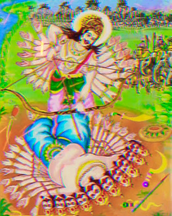
So much for alleged “Dada Raavan”…
Irrespective, the point is that when Brahmanas misbehaved, Kshatriyas were permitted to punish them. But when Kshatriyas misbehaved and exceeded their limits, a Parashuraama was born as a Braahmana to punish Kshathriyas and restore the balance. And when the Jeevatman Parashuraama became blinded by pride in his religious merit, Paramatman Sri Rama, the Poorna avathaara (the epitome of the full soul of Vishnu, along with his brothers) took back the shakthyavesha and punished Parashuraama for ahankar and sanguinary behaviour.
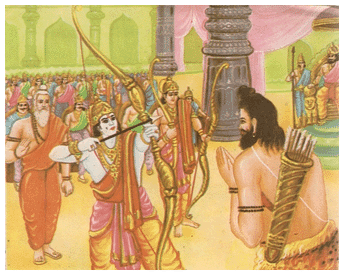
Separation of atman from sathya only goes to show the extent of their mental midgetry. Like infants playing with diamonds as though they were baubles, these brahmic babies pursue navel-gazing whilst corrupting the tradition. Despite repeated warnings on this misbehaviour and continued corruption of our tradition, they nevertheless continue to produce such puerile pablum on the authority of…not an acharya…not a qualified vedic teacher…but a journalist-philosopher. It’s clear for all their claims of orthodoxy, its only use for them is to confirm rights by birth they would be denied on account of their characterlessness.
But errant children can only be tolerated for so long before they get soundly thrashed.
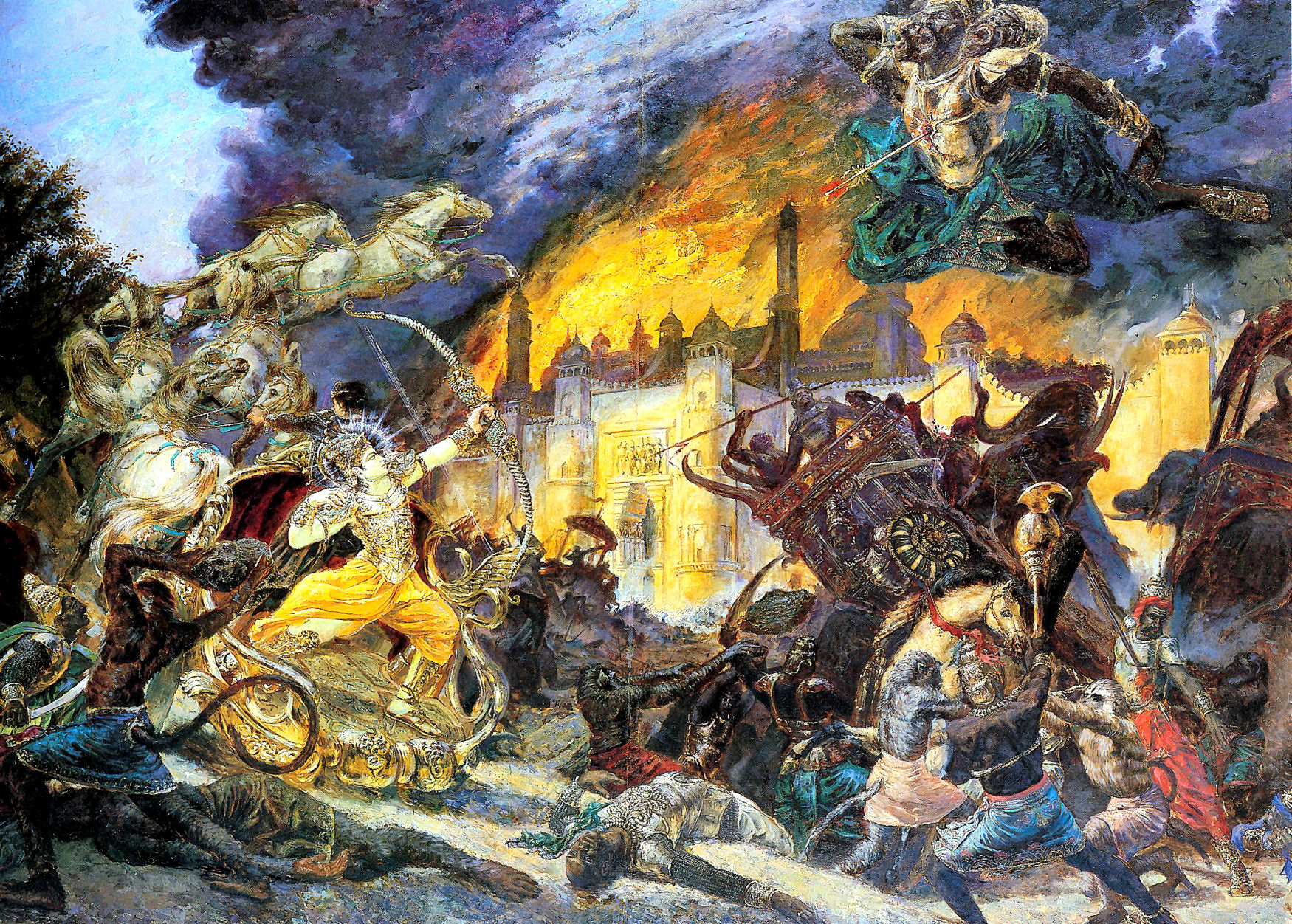
Kshathriya Rama ultimately eliminated the Braahmana Ravana for his tyranny, also due to the latter’s pride in learning and merit, which was the origin of this.
And finally in the late Dvapara, Kshathriya Krishna was born to punish the Kamsas, Jarasandhas, and Duryodhanas who came to characterise the majority of Kshathriyas in the end of that era. He did this by having them punish themselves in the Kurukshetra War as the cost of oppressing Braahmanas, Women, and other vulnerable sections of society.
So none of this is a matter of covering up to further discrete caste agendas, but discussion of everything to understand real Dharma. That is true Discretion.
The moral of the story is: Adharma breeds greater Adharma and no one, no matter what their caste, is above Dharma. The interesting thing is that in both the Durvasa and Bhargava episodes, Maharishi Vasishta was on the side of Ambareesha and the Aathreyas were allies of the Haihayas. And when Parashurama crossed his limits, Maharishi Vishvamitra was on the side of Rama.
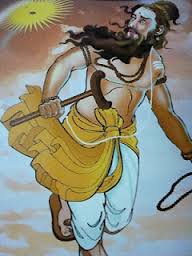
It is Ego that is the enemy of all, that undid Karthaveerya, that punished Parashurama, and that humbled Durvasa, and that destroyed the Kauravas. Thus, it is not caste vs caste, but Dharma vs Adharma. Until Dharmic Brahmanas begin challenging and defeating Adharmic Brahmanas, until Dharmic Kshatriyas begin challenging and defeating Adharmic Kshatriyas (and so on), expect more of the same. Oh, and if you just sit on the sidelines waiting and watching to side with the winner…you have no right to expect anything at all.
In the end, Puraana explains better what mere mortal men aspire to aspirate:
Why Kshatriyas Exist
“When anarchy sets in on earth, the weak are oppressed by the strong, and no man is master of his own property. Unprotected duly by Kshatriyas observant of virtue, and oppressed by the wicked in consequence of that disorder, the earth quickly sank to the lowest depths. Beholding the earth sinking from fear, the high-souled Kasyapa held her on his lap; and since the great Rishi held her on his lap (uru) therefore is the earth known by the name of Urvi. The goddess earth, for protection’s sake, gratified Kasyapa and begged of him a king.
“The Earth said, ‘There are, O, regenerate one, some foremost of Kshatriyas concealed by me among women. They were born in the race of Haihayas. Let them, O sage, protect me. There is another person of Puru’s race, viz., Viduratha’s son, O puissant one, who has been brought up among bears in the Rikshavat mountains. Another, viz., the son of Saudasa, has been protected, through compassion, by Parasara of immeasurable energy and ever engaged in sacrifices. Though born in one of the regenerate orders, yet like a Sudra he does everything for that Rishi and has, therefore, been named Sarvakarman (servant of all work). Sivi‘s son of great energy, viz., Gopati by name, has been brought up in the forest among kine. Let him, O sage, protect me. Pratardana’s son, named Vatsa of great might, has been brought up among calves in a cowpen. Let that one of the royal order protect me. Dadhivahana‘s grandson and Diviratha’s son was concealed and protected on the banks of Ganga by the sage Gautama. His name is Vrihadratha. Possessed of great energy and adorned with numerous blessed qualities, that blessed prince has been protected by wolves and the mountains of Gridhrakuta. Many Kshatriyas belonging to the race of Maratta have been protected. Equal unto the lord of Maruts in energy, they have been brought up by Ocean. These children of the Kshatriya order have been heard of as existing in different places. They are living among artisans and goldsmiths. “
Why Bheeshma was chosen by Sri Krishna to give upadesh on Rajadharma
“”Vasudeva said, ‘Since, O bull among men, thy devotion to me is very great, for this, O prince, I have displayed my celestial form to thee. I do not, O foremost of kings, display myself unto one that is not devoted to me, or unto a devotee that is not sincere, or unto one, O Bharata, that is not of restrained soul. Thou art devoted to me and art always observant of righteousness. Of a pure heart, thou art always self-restrained and ever observant of penances and gifts. Through thy own penances, O Bhishma, thou art competent to behold me” [5, 107]
References:
- Kota, Venkatachalam Paakayaji (Pandith). The Age of Buddha, Milinda, and Amtiyoko. Guntur: Sri Ajanta Printers.1956
- Mittal, J.P. History Of Ancient India (a New Version) : From 7300 Bb To 4250 Bc. Atlantic.
- Malampalli, Somasekhara Sarma. History of the Reddi Kingdoms.Delhi:Facsimile Publ. 2015
- South-Indian inscriptions (texts) : Telugu inscriptions from the Madras presidency
- Ganguli, K.M. The Mahabharata
- Myneni, Krishna Kumari. The Rule of the Chalukya-Cholas.
- B. Yashoda. The History Of Andhra Country 1000 A D 1500 A D., 2990100067231. 1933
- Majumdar, R.C.Ancient India. MLBD: Dehli.2003
- Akkiraju, D. Ramapathi Raju. Palnati Veeracharitra. Hyderabad: Potti Sriramulu University.1997
- Babu, Ranjan P. Palanati Vira Charitra. Nagarjuna Nagar: Nagarjuna University. 2000
- Sastri, K.A.Nilakantha. A History of South India. New Delhi: Oxford. 2015



Really informative piece. If I am not mistaken, in the North, among the Rajput community, the same Kalachuri Haihayas are referred to as ‘Hayobanshi/Hayovanshi”.
It is said that they played a role in uniting in not just with Bappa Rawal, but also his grandson Rawal Khuman II in defeating Arab invasions along with other Rajas.
It is time for Bharatheeyas to get inspired by the Pan-India nature of the Haihayas and unite again as one country and protect our nation and sanskriti.
Thank You!