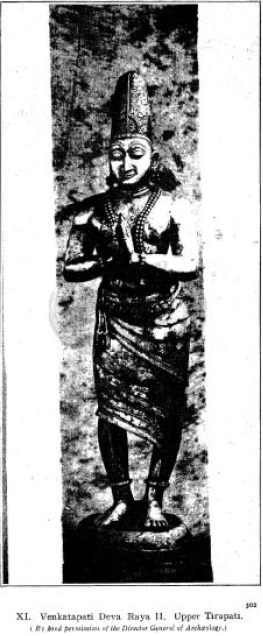
Returning to one of our favourite topics, Vijayanagara, we turn to one of its greatest and, chronologically speaking, its penultimate Emperor at Penukonda: Venkatapati Deva Raya.
Introduction
Often times, a solitary battle can become the defining feature of a polity, especially kingdom. The ultimate kingdom is invariably an empire, and the Vijayanagara Empire’s ultimate battle considered to be Rakkhasi-Tangadi, better known as Talikota. But contrary to koopastha-manduka kautilyas, who think warfare need only be taught ought of a book (that too only 1 book…), it has historically been attrition that has taken the true toll on armies, via the ebb-and-flow of soldiery, logistics, and finance. It is for this reason that the Marathi Bhonsles are praised over the Peshwai, Rajputs, and even the Sikhs. The ability of the 96K Maratha community to maintain cohesion, all whilst coordinating across the far flung geography of the Subcontinent, to wear down the wicked mughal empire, is what inspired even the Vietnamese, who were doing the same, to fight on.
The Fall of Vijayanagara was no different. Like Panipat III, Talikota was merely a setback. It took multiple battles, often reconquests, betrayals, and in the end, simultaneous rebellions, to end the last Empire of Old India. In fact, the Empire would see its revival under its least famous of the great Rayas, Venkatapati–the only true gem of the Araveedu Dynasty.
Background
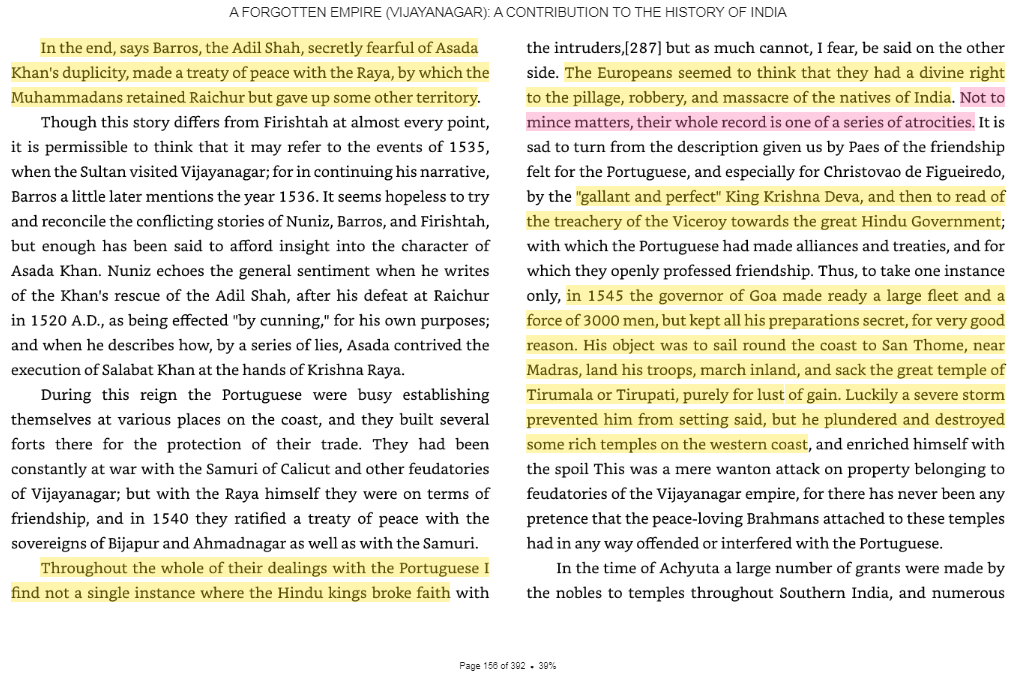
Before beginning with the background of this Royal Raaju of Aandhra Kshathriya provenance, one must first lay out the background of his rise. The devastation of the Imperial City following Talikota was a veritable crime against humanity, but not total. Typical of Thurushkas, many of its hapless denizens were enslaved (chattel slavery is inhumane, adharma according to Veda), and the urbanity, heavily de-populated. However, just as the Marathas were soon back in de facto ownership of Delhi, the Vijayanagara Empire soon retook and re-settled its namesake city. Nevertheless, this 2nd of 5 capitals (Anegondi, eponymous, Penukonda, Chandragiri, & Jinji) never recovered its former grandeur. With the administration relocated to the favoured “House Arrest” fort of Penukonda, the environs of Aanegondi were eventually taken up by, what some say today, is a ‘pretender’ line.
Regardless of apologia today—and the craven behaviour of the Salakam (Thirumala) brothers—there is no doubt that Araveedu Rama (never truly a Maharaaya), de-stabilised the Empire with his intrigue, plotting, and later over-confidence and ill-advised pride in the wake of squabbling enemies who were, yes, nevertheless united by ethnicity (turkic) and religion. However, credit must be given where due.
The Portuguese
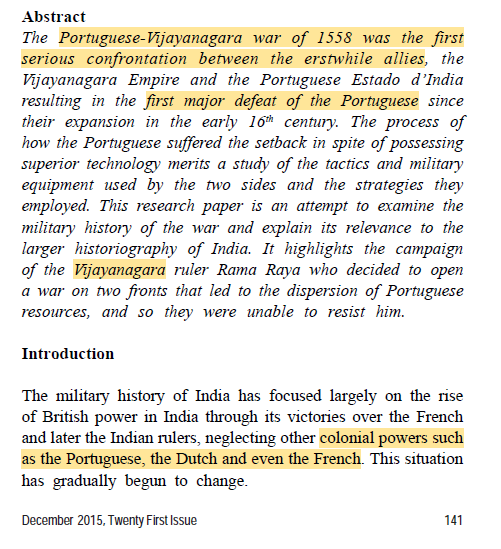
It has been made to seem—most of all by the Europeans themselves—that the piratical portuguese were somehow everywhere, all at once, all-victorious, and all-pervading. Nothing could be further from the truth. In fact, the European pirate-colonisers (be they royal like the portuguese, or corporate like the Dutch, French, and English East India Companies) were routinely and often comprehensively defeated.
After the Nair King of Travancore so thoroughly defeated the VOC (Dutch) at the Battle of Colachel, and the mughals the English in Child’s War (1680 CE), failure forced a veritable corporate merger of VOC & EEIC. This resultedin the significantly more successful British East India Company—not unlike that other Anglo-Dutch conglomerate the USA or for that matter Unilever (owner of, wait for it, Hindustan Lever, and namesake of Telugu Jannaih, aka Johny Lever). As such, one need not take the portuguese’s own account for themselves or the goings-on of the Subcontinent as the “tHe yOOnEEk isCientiFic eehIstoriC trOOtH“. Indeed, they like the even more piratical british, routinely cast aspersions on the character of opponent kings, and even their mothers (something which pakistani khanzadas happily deploy in their propaganda against the Marathas today). But a characterless people with notoriously even more characterless women should not talk. Our own accounts are suffice to secure the chastity of the leading ladies of our people, royal or otherwise, confirmed or otherwise.This self-same tactic was in fact deployed by that one-eyed wretch rushdie recently against the royal lead character of his recent book, a disguised screed against “Victory City”, no doubt at the insistence of these same masters. It is time digital “dharmrakshak” dopes stop being duped and stop prioritising drama over actual dharma (which necessitates alliance unity against invaders).
As a result, the portuguese, who arrived in Kerala in 1498 CE, and were ensconced in Calicut by 1505, were ejected by 1509. However, having set themselves up at Goa by 1510, via the benign neglect of Vijayanagara (some imply connivance via the royal privateer Timoja/Thimmayya), the loss at Kerala was more than made up for. [3, 147] Quilon was anyways an Imperial Tributary of Vidyanagari. Suffice to say, it was not just Goa, but prior to or soon after, also Cannanore, Cochin, Ceylon, Socotra (Yemen), Malacca, Zanzibar, and the currently relevant Hormuz that the thalassocratic portuguese managed to take and fortify.
However, as is the wont of pirates, their greed soon gets the better of them. Vijayanagara was not a centralised empire, as a result, this far-flung polity often had vassals, feudatories, and tributaries who were refractory or remiss in tribute. Such occasions always presented opportunity to the piratical portuguese, and they began taking advantage as they did to attack and raid key port cities. One such city was Mangalore. 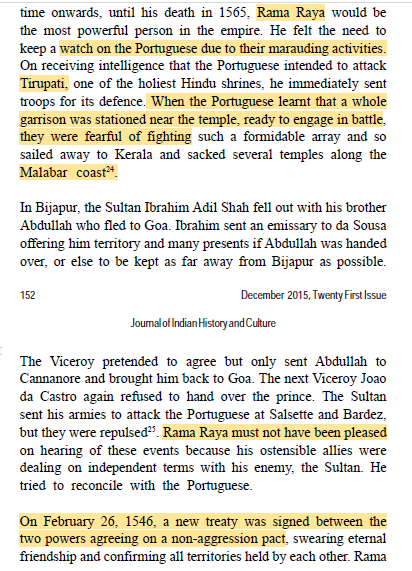
However, the transgression of the piratical portuguese continued. Their sacking of Mangalore and taking of chattel slaves (oops, we mean “spreading of civilization” and crusader values) proved to be a grave provocation to Aliya Rama Raya–regent of Imperial Vijayanagara.
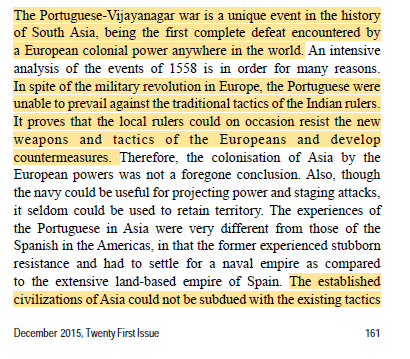
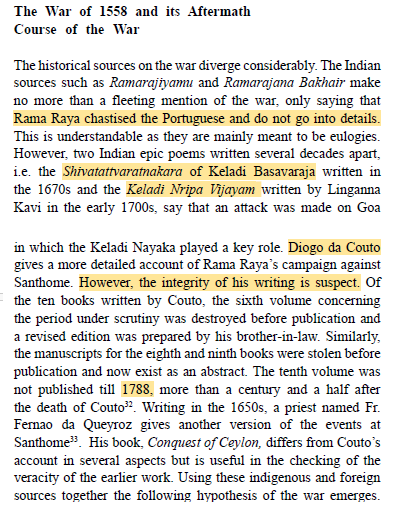 Demonstrating what happens when you have those with actual military records prosecuting war AND strategy, Rama Raya developed a 2 pronged strategy. He sent Thirumala Naayaka to besiege Goa, while he himself took and estimated 500,000 troops to take San Thome, in Mylapore.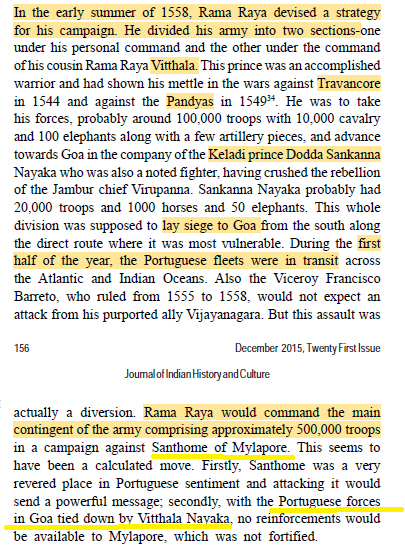
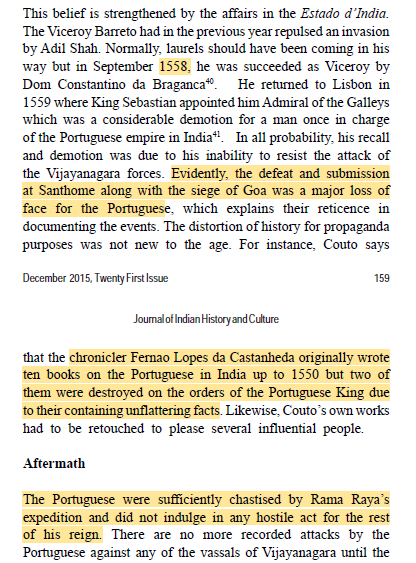 The defeat and submission of the portuguese was so complete, their own king demanded the destruction of their “sacred” histories—so much for rational-empiricism. “Truth and fair play, dear boy”. This penchant for the portuguese (and really phirangis and other foreigners) to prevaricate, is a reality that our pedantic sepoys pretending to be pandits suspiciously downplay. Their own sources, whether Father Heras or Robert Sewell would remark of the same. Defeats were almost always catalogued via omission or allusion.
Regardless, the subsequent demotion of the Viceroy Baseto, of Portugal’s “Estado da India” colony proved all there was to the episode. Some might again ask why Vijayanagara did not simply finish off the portuguese—who time and again would find their “Estado da India” close to erasure (the last time by the Marathas). The answer in the case of the Araveedus (as with the Thuluvas) was that the portuguese were treaty-bound to ensure the critical horse supply to the parched plains of Southern India. This is what ultimately tipped the balance from defensive war under the Saluvas to serial offensives under the Thuluvas and even the Araveedus.
The Araveedus had to navigate in this environment, and facing the existential threat that was the Deccan Sultanates (egged on by the mughal empire for…yes jnu sepoys… religious reasons), it soldiered on under its Soldier-Emperor.
Vamsa Vrksha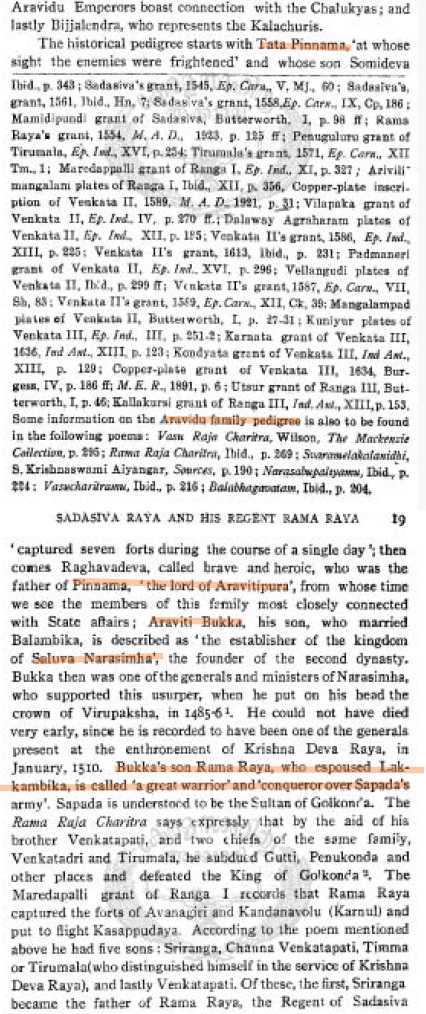 The provenance of the Araveedu dynasty has been heretofore discussed at length. Nevertheless, the reader may be in need of a refresher for the Vamsa Vrksha. While there remains much controversy as to whether the Vijayanagara Empire, that is the Karnataka Saamraajya was Kannada or Telugu, the origins of the Fourth and Final Dynasty are clearly from Aandhra.
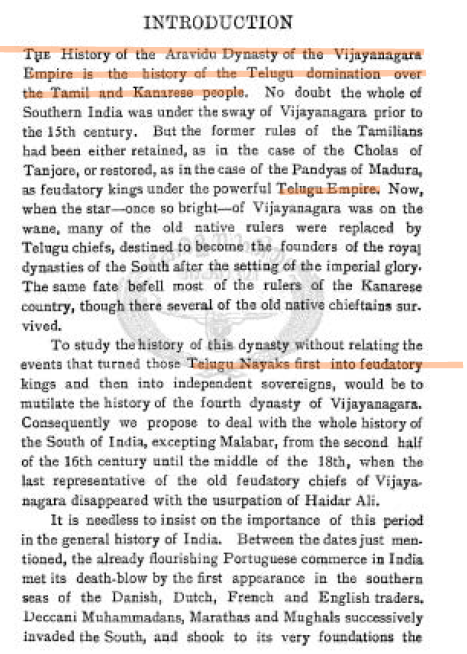
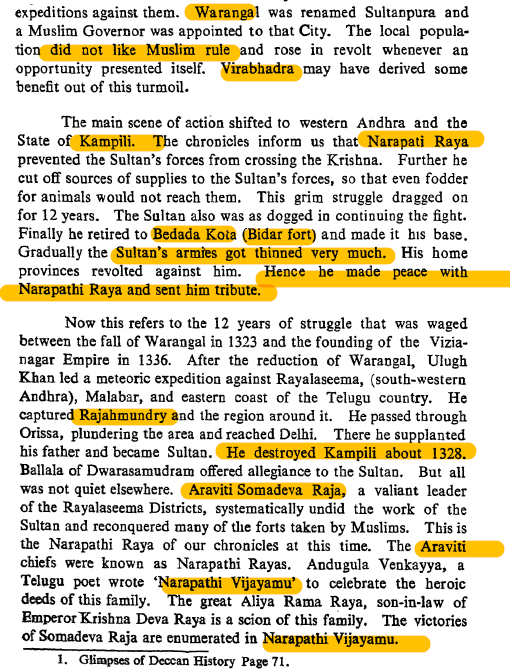
Being descendants of the Eastern Chalukyas via Araveedu Somadeva, Sriranga I and his line are often seen as Narapathis, and are even thought to be mentioned in the Kakatiya Charithra as such (though others postulate it was the Sangamas themselves).
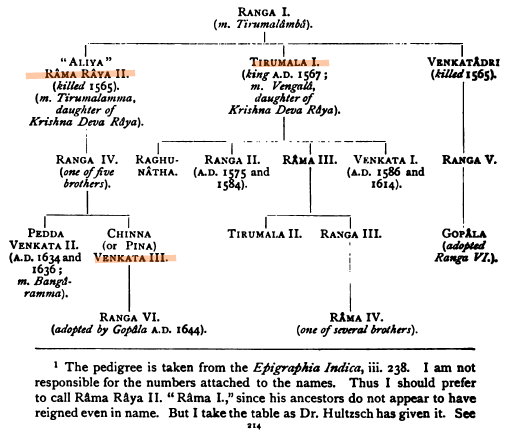
Araveedu Venkata I, that is Venkatapathi Deva Raaya, was the son of Tirumala I and brother of Sri Ranga II. His grandfather was Ranga I, and his uncle was the infamous Aliya Raama Raaya.
Claim to the throne is typically contentious; however, the dire straits of the Empire demanded a redoubtable ruler for the occasion. Enter Venkatapathi Deva Raaya.
Venkatapati Deva Raya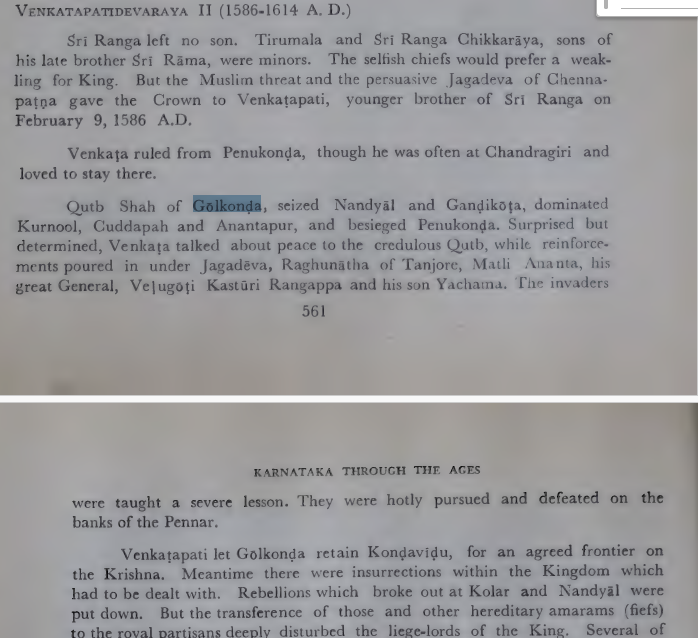
Emperor Sri Ranga I would be succeeded by Venkatapathi Deva Raaya. Aliya Raama Raaya’s sons were both minors, and the danger the Empire faced necessitated a strong ruler. Venkata I proved more than a match.
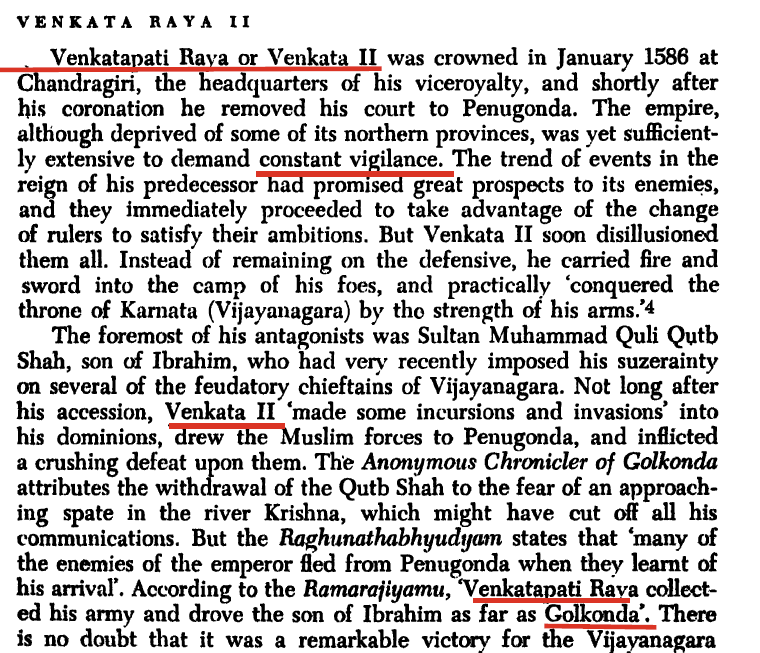
Having previously been Viceroy of Chandragiri—to which he would later relocate the capital—Venkata I was more than equipped with the treacherous politics of tributaries and rebellious vassals.
Rebellions Crushed
The first order of business for the new Emperor was to crush his refractory vassals. He swiftly took care of Vellore, Jinji, and Madurai. The battle of Vallamprakara would prove pivotal.
However, he soon had to face the qutb shah of Golkonda. He was taken almost by unawares and was besieged by Mohd. Quli Qutb Shah. However, the signal victory he would win here at Penukonda was a matter of taking a page out of the enemy’s playbook, played so many times at Madurai and Khanua. Hoisted by their own petard, the paarasika-thurushkas had to retreat to Pennar. Here another battle would be fought, and the enemy would be driven all the way back to Gollakonda itself.
Following this, Venkata I would round out his victory at Kasimkota and later Gandikota.
International Diplomacy
Another under-rated area of Vijayanagara in general and Venkatapathi in particular is international diplomacy. Though Thuluva Veera Narasimha is thought to be the first Vijayanagara ruler to treat with the portuguese, it is Krishna Deva Raya who is considered to be the real diplomat and geo-strategist. When faced simultaneously with foreign invaders in the North, and new ones arriving on one’s shores in the South, understanding how to play them off is no mere child’s play of A vs B, as today’s chaanakya’s teach. For boastful white supremacists, it would be the equivalent of Chola Imperial vessels showing up on the shores of Spain, in the middle of the Reconquista—with markedly better artillery. As such, rather than reduce everything to manliness or intellect or such pithy nostrums as “it is all in the jeenz”, serious observers of history must comprehend the concept of differential of power.
KDR was careful upon their approach, gathered as much intelligence on them as possible (particularly of their depredations in Kerala) and only treated with them after clash became inevitable. The value of this alliance was seen not only at Raichur with their arquebusiers, but also via their securing of Arabian horses via sea-trade. It was no different with Venkatapathi, who having inherited the peace of Aliya Raama Raaya, sought to maintain good relations with these Doms who dominated the seas.
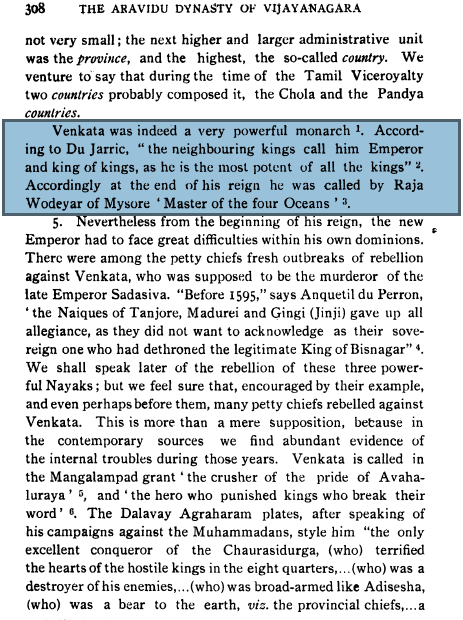
Nevertheless, this did not stop the Wodeyar King from referring to his liege-lord as ‘Master of Four Oceans’. The introduction of the Dutch and the English to the Indian Ocean, made this boast at least somewhat credible, on account of the interplay between all these commercial and imperial powers.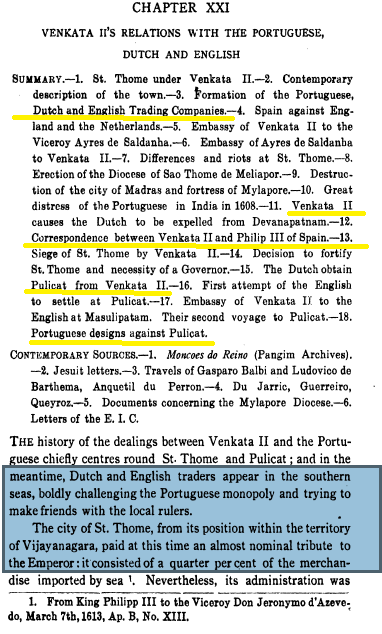 What is notable is that amidst these commercial rivarlies, even the heretofore royal portuguese formed their own trading company.
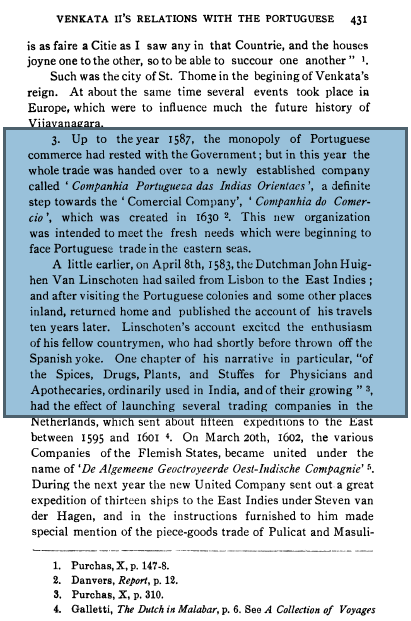
The English East India Company was itself formed around 1600-1, and had several failed expeditions before finally reaching Surat in 1604.
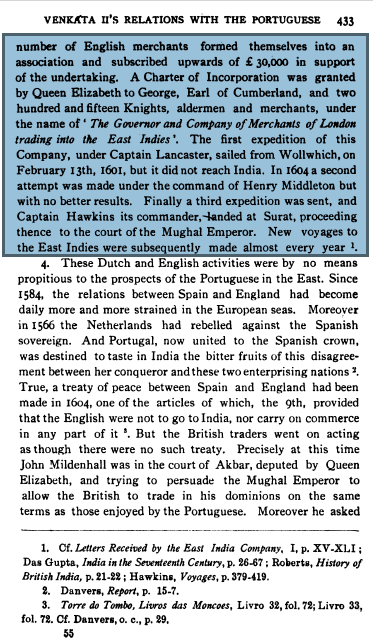
However, it was the contention between the portuguese and the dutch that would prove to be the most defining of Venkatapathi’s reign. The bone at stake was Pulicat Lake. The Dutch had been requesting a factory (not all possession were auto-colonies, despite modern pretence), on condition that they would not interfere with any seaborne traffic, etc. This was granted by the local commander, Krishnappa Naayaka, at Devanapatnam.
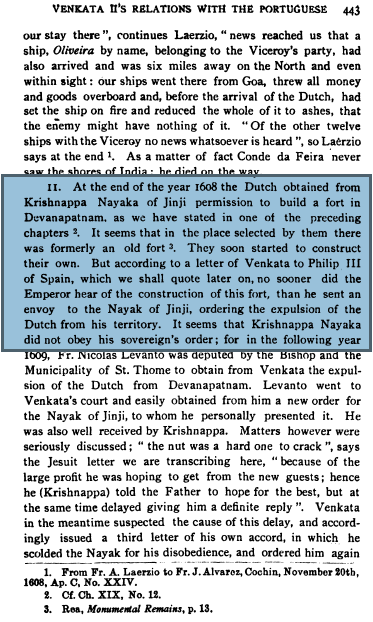
The portuguese would protest and eventually capture this factory. Distraught, the Dutch doubled their efforts and took back their factory at Devapatnam. They now had a pretext to request fortification of this factory. As with the Danish at Tranquebar, these “fortresses” were often just small forts, with a jetty for docking ships. Fort Geldria was no different, and factory fortification was now permitted on account of the conflict among Europeans themselves.
Succession Crisis
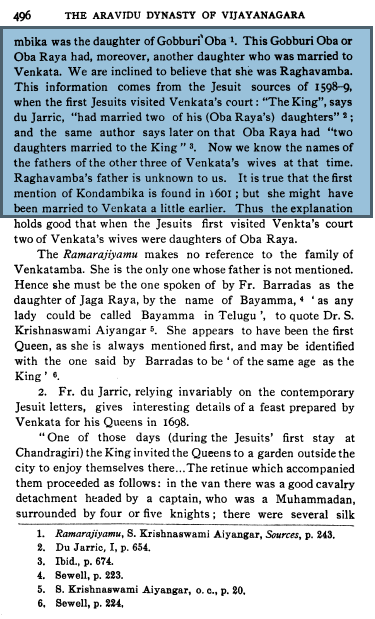
Venkatapathi Deva Raaya’s family life was described as not quite happy. He is said to have married four wives, his favourite (Raghavamba) from the Gobburi family, later passed away. Gobburi Obularaaya was his father-in-law,and as a result of this favouritism, wielded capital sway over the capital and administration in general. However, this changed with the passing of Raghavamba, and have implications following Venkata’s reign. As a result, the eldest queen Venkatamba began asserting her claim not only to the administration but the succession itself. Unfortunately, none of his wives produced a natural-born heir. As a result, the eldest queen pretended to bear a child, who was immediately dubbed “Chikka Raaya”, indicated succession. Despite this pretence, Venkata I behaved contrary-wise
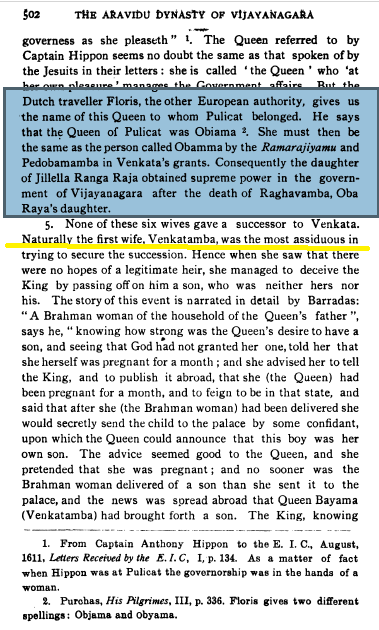 This resulted in questions as to whom his successor would actually be. In the contest between two of his nephews, Thirumala and Sriranga II, it is the latter who was chosen. As he was the younger (with a lesser claim), this action was deemed as opening the door to this alleged son of Venkata I. In actuality, this paved the way to one of the most devastating succession wars that Vijayanagara would face, and has been interpreted to be the true cause for the weakening and downfall of the empire.
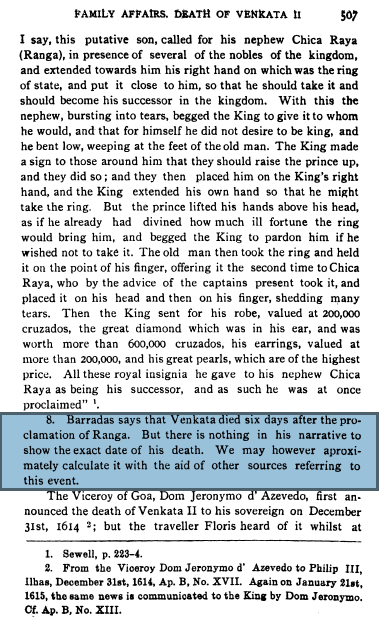 Venkatapati Deva Raaya would pass away not long after, in 1614, with 3 of his Queens joining him on the funeral pyre. So passed the last of the great Raayas.
Achievements
- Revival of the Vijayanagara Empire
- Excellent Generalship as Soldier-King
- Well-managed International Diplomacy
- Battle of Penukonda
- Battle of Pennar
- Battle of Valamprakara
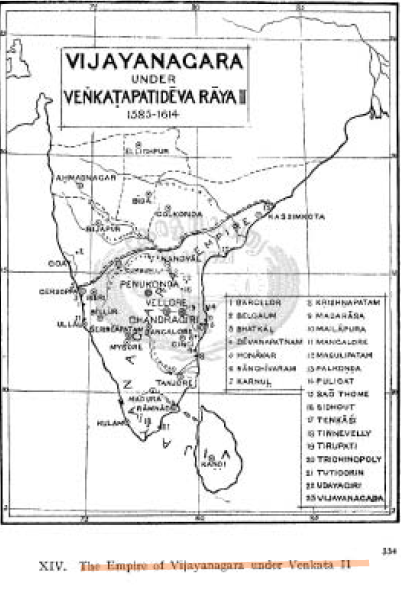
The revival of Vijayanagara’s fortunes can be in no small measure attributed to Araviti Venkatapathi Deva Raaya. His Imperial reign would oversee the regaining of most of the Telugu country–so much so, that for a time, he was seen as the legitimate lord of the Telugus.
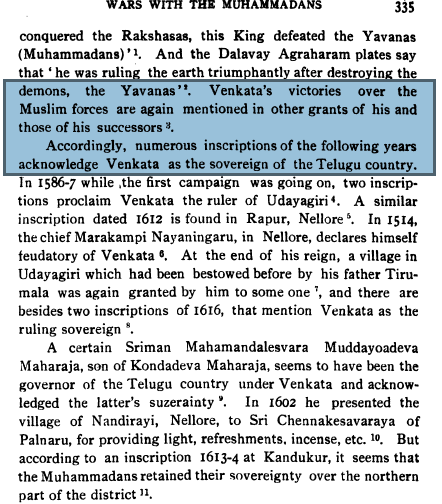
He is seen as an effective overseer of administration, frequently in the hands of his in-laws. He was also a great patron of the arts, notably painting, but also literature. Above all, he was a military leader, as political leaders general ought to be. There were a number of great battles during his reign: Vallamprakara, Penukonda, Pennar, Kasimkota, and Gandikota. For brevity’s sake we will cover the first 3:
Battle of Vallamprakara
No King can long ignore challenges to his reign, so what of rebellions? The Nayaks of Madurai, Jinji, and Vellore had to be brought to heel. In this matter, the loyal Nayak of Tanjore would prove pivotal.
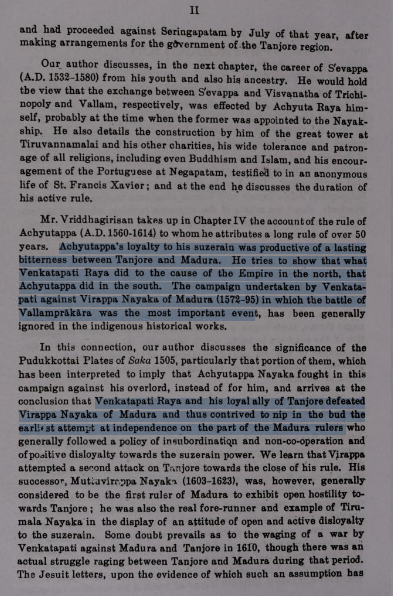
This loyalty of Thanjavur to its suzerain would again be seen at the even more pivotal battle of Penukonda.
Battle of Penukonda
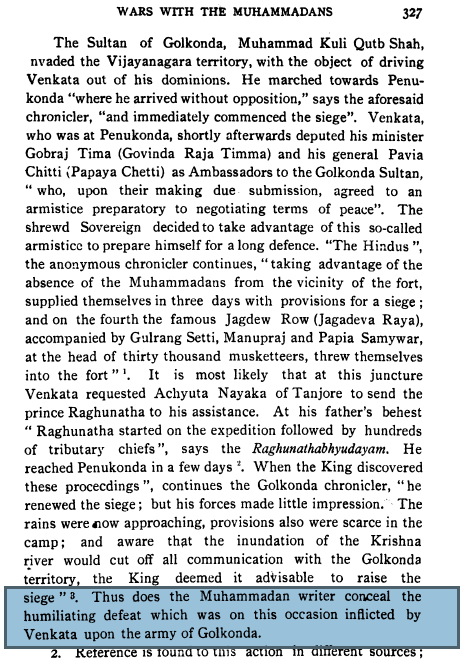 The investment of Penukonda by the MQQS of Golkonda put Venkata I in a pickle. However, he was quick to pull a trick from the paaraseeka playbook and hoist them by their own petard. He relied on his envoys to engage in dilatory tactics, whilst he called for reinforcements and prepared for a long siege. Then, at the appointed time, he and his strengthened forces crowded into the fortress-city. Raghunatha Nayak, from loyal Tanjore then arrived on the scene with reinforcements, forcing the Golkonda sultan to retreat.
However, this retreat would eventually turn into a rout. The next battle of the Northern Campaign by Venkata, would take him to Penneru, better known as the Pennar River.
Battle of Pennar
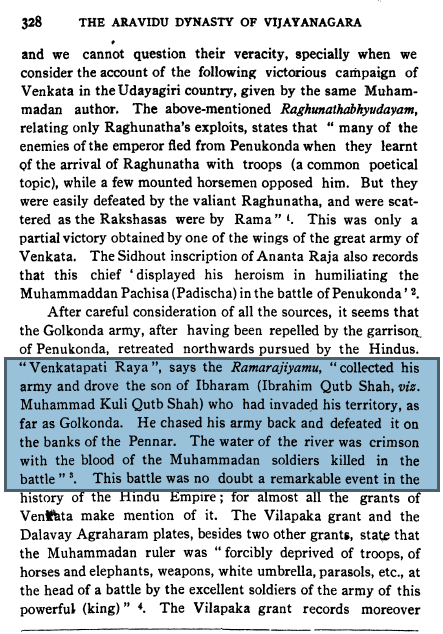 All sources virtually countenance these claims, including the usual sultanic silence. The battle of Pennar crushed Golkonda forces here so badly, that Venkata’s armies would advance to Kasimkota in the North and Gandikota in the west.
What is notable here is that Venkata did not merely rest on his laurels in languor at Penukonda, but sought to follow it up by defeating his retreating enemy, in detail and veritably chasing him back to the enemy capital itself.
Legacy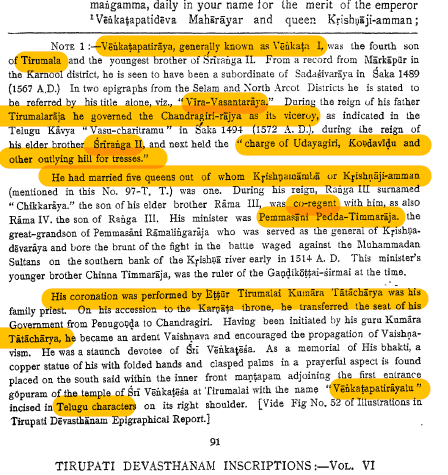
Contrary to modern revisionists, the Vijayanagara Empire did not end with Talikota. Indeed, under Venkatapathi, it would revive to almost 85% percent of its peak territory. That is the legacy of the last of the Great Emperors of Vijayanagara. His squabbling successors would not rise again to the summit of the dynasty.
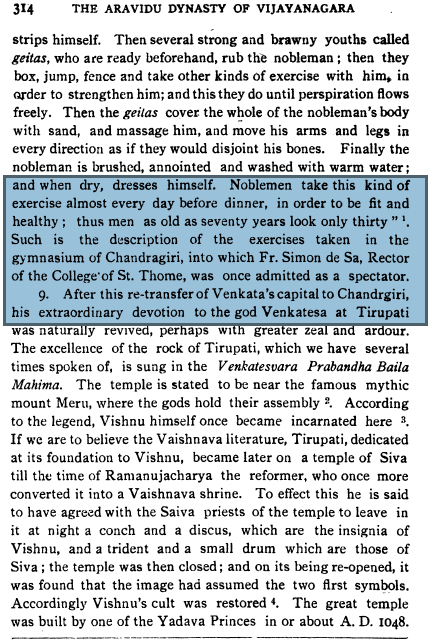
Much of this could be credited to the culture of fitness among the aristocracy, that is the real ruling class and nobility known as Kshathriyas. Unlike today’s pedantic, pot-bellied pretenders to bureaucratic tyranny, these soldier-generals practiced what they preached, and were truly fit for war and leading men on the field.
 It is only appropriate that his greatest General Mantla, was not only fit for war, but a poet-laureate himself.
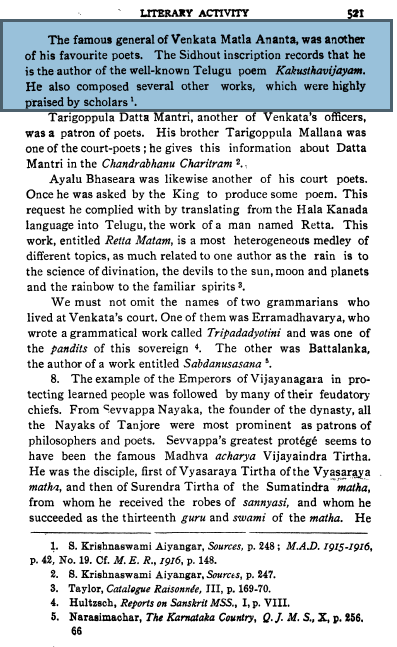 Indeed, as a patron of literature, there were many luminaries at his court, including the celebrated Tenali Ramakrishna.
Perhaps the only true failure of Venkatapati is actually what should have been the most important triumph–succession. Besotted by his beloved wife, he did not outright reject her quite obviously adopted son (from a brahmini matron-in-waiting) as his ‘natural born’. This type of typically Telugu indulgence of short-sighted self-sabotaging behaviour by relatives, is what laid the path for the true downfall of Vijayanagara.
Conclusion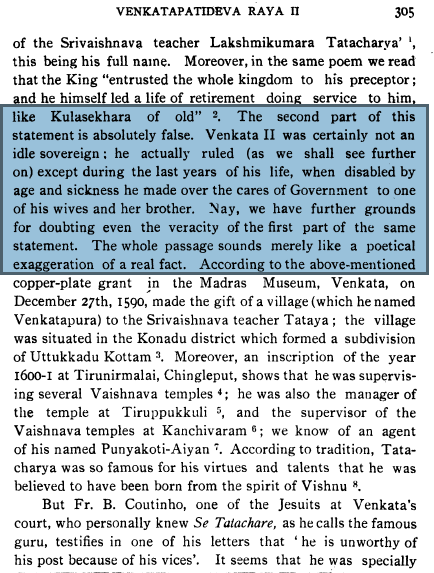
Like Sewell, Heras himself brings into question many of the claims of so-called traditional historians among Hindus. One often finds “rajgurus” making routine claims to controlling the royal administration for the sake of “rajdharma”—how selfless. However, the actual story on the ground was a bit more complicated. Venkatapathi himself was no idle ruler. Indeed, if anyone could claim controlling the administration, it was the queen. The key lieutenants and courtiers during his reign were Matla Anantha as his best general and Thimmayya Manthri as his Prime Minister.
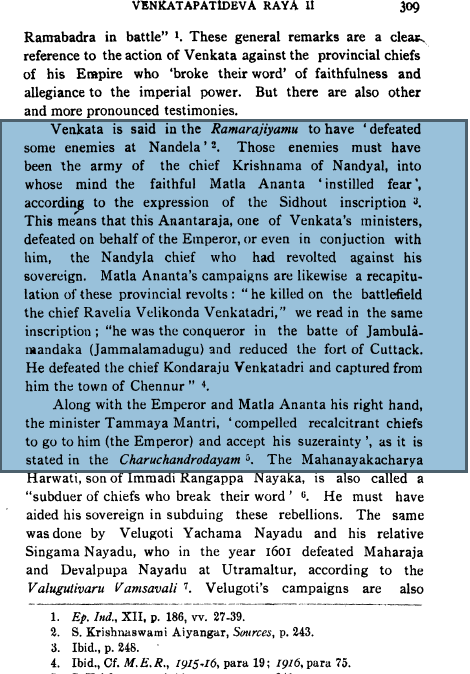
Unlike today’s toadies of Tatacharya (already spinning yarns of how Venkata was “guided by” him on when to breathe and when to move his right foot, then left foot), it was actually Matla Anantha whose generalship made possible Venkata’s reign. From crushing the refractory Ravella’s of Vellikonda to leading armies up to Cuttack to win a decisive victory at Jambula-mandaka, it was Anantha’s loyal command that proved endlessly crucial at pacifying subordinates by the sword.
As such, Tatacharya who was the rajguru of Venkatapathi Deva Raaya finds himself on the receiving end of not so charitable accounts of his influence. It is perhaps for this reason that the title should not be rajguru, but Kulaguru or Kulacharya, with the title-holder more ascetically ensconced in a proper aashrama–rather than claiming to control the administration by proxy, at court.
But the catholics at the court were no saints themselves. Portuguese priests as well as members of the Society of Jesus (later ejected on requested by King Phillip) would be busily intriguing at Venkatapathi’s court, trying to convert him with little success. They would nevertheless build a college here during that period, and would apparently managed 3000 converts at various coastal settlements during this time, the most notable of which was around San Thome.
Either way, San Thome is of particular note not just to Aliya Raama Raaya’s rule, but to that of Venkata I. This portuguese possession was permitted to exist on payment of tribute to the Tanjore Nayak. However, mischief amid such polities results in conflict, and on one occasion Venkatapathi himself had to get involved.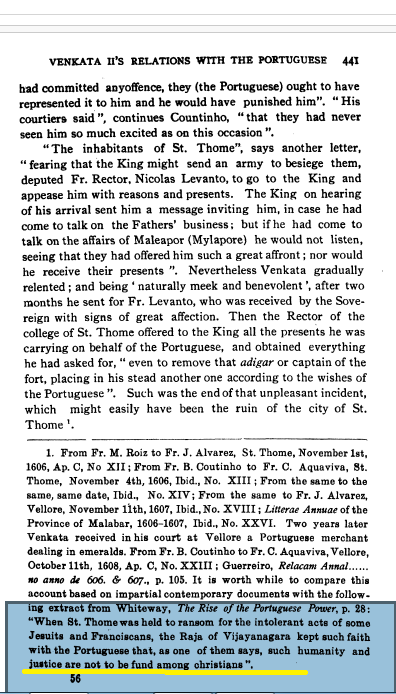 In conclusion, the piratical portuguese, the devious dutch, and the ever-entrapping english would spread their tentacles during this most eventful of reigns. Nevertheless, it should be noted that Indian rulers were not so utterly helpless as portrayed. Whatever their record at sea (nullified by recent innovations in artillery metallurgy), native rulers remained preponderantly dominant on land...until 1737.
Whatever the record of the Araveedus, they can be credited with routinely restraining and even chastising errant and arrant European enterprises and mercenaries, as the situation demanded. It was only the advance and pressure of the timurids that made total war at sea ultimately untenable.
Venkatapathi and his dynasty can be credited with doing the best they could, with what they had.
References:
- Rao, Venkata Gutty (Prof.). “Vijayanagara Empire”. CH.16 of Vol. 5 of ‘ A Comprehensive History of India’. New Delhi: People’s Publ. House. 1970
- Sharma, R.S. History of Vijayanagara
- Panjaje, Krishna Kumar. “The Portuguese-Vijayanagar War of 1558: A Study in Military History”. Journal of Indian History & Culture: Delhi. 2015
- Heras, Rev. Henry. The Aravidu Dynasty of Vijayanagara. B.G.Paul & Co: Madras. 1927
- Vijayaraghavacharya, Pt. V. “Inscriptions of Venkatapati’s Time: From 1530 A.D. to 1542”. Tirumala Tirupati Devasthanams Inscriptions: Vol. IV. 1998
- Sewell, Robert. A Forgotten Empire: Vijayanagara
- Vriddhagirisan, V. Nayaks of Tanjore. New Delhi: Asian Educational Services. 1995




I am fascinated by your content. My ancestors are Rajus of Andhra Pradesh.