Continuing our theme on Vijayanagara, long-time readers would have seen the work of many a Telugu poet. However, the poetesses of India in general and Aandhra in particular have received less limelight. This article is an attempt at rectifying that.
Our Post today is on the talented Princess of Vijayaganagara named Ganga Devi, and her poem on her mighty husband Kampana and his Madura Vijayam.
Introduction
History is part objective fact and part poetic re-telling. It is not the rote recitation of dates and personalities that stirs the hearts of a populace or that inspires the mind of children, but the brandishing of the bon mot to the benefit of the people. Although this has most often been the ken of men, there have been many a poetess in sanskrit literature as well.
“Among the authors of the hymns of the Rg Veda, We have some women. The Aatreya house produced the poetesses, Visvavaaraa (V.28) and Aapalaa (VIII.91). In the Kaksivat house, there was a line of poetesses and of these Ghosaa was the greatest. She was the daughter of Kakseevan. She called herself a princess and probably her father was a ruler. She remained unmarried to a late age, when she was favoured with a husband by the grace of the Asvins. She wrote in Jatee metre and her verses are easy and well balanced.” [2, 391]
It should be noted that “Juhuu (X.109), Sasvatee (VIII. 1), Maandhaatree (X. 134), Maadhavee (I.91), Saasiprabhaa (IV.4), Anulakshmi (II.78, III., 28, 63, 74, and 76)m Revaa *I.87), Pahaayee (I. 83), and Rohaa (II. 63) are also poetic seers of the hymns”. [2, 391]
“Vijjaa was Sarasvatee incarnate except that she was dark in com-plexion. VIjjakaa has been identified with the queen of Candraaditya son of Pulakeshin II, from the Nerur and Kochre grants dated 659 A.D.
Raajasejharacarita mentions poetesses, Kaamaleelaa, Sunandaa, Kanakavallee, Madhuraangee, Lalitaangee, and Vimalaangee (of Malava). Ballaala’s Bhojacarita mentions some poetesses too…The anthologies also quote verses of Jaghanacapalaa (Padyav), Avilambitasarasvatee (Padyav, Indulekhaa (Subh), Kuntidevi (Subh), Candaalavidyaa (Skm), Nagamaa (Sp.), Padmaavatee (Pmt), Madaalasaa (Sp), Rajakasarasvatee (Skm), Lakshmee (Sp), Veerasarasvatee (Padyav), Sarasvatee (Skm), and Seeta (Bhojaprabhandha). ” [2, 392]
There are of course many, many more, such as Priyamvada, Vaijayanti, Jayanti, Uppaya, Kahina, Triveni, Lakshmi Raajnee, Sundaravalli, Jnanasundari, Kamakshi as well as the famed Mohanaangi (better known as Thirumalamba, daughter of Emperor Krishna Deva Raya). [2, 396]
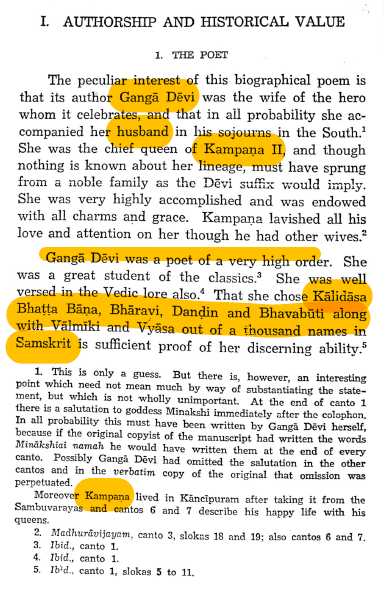
This litany of poetesses aside, there is one who stands tall in the history of Aandhra and Bhaarathavarsha in general, and that is Princess Ganga Devi. Traced to the Royal Line of the Warangal Kakatiyas, this talented literateuse was proudly married to Prince Kampana of the Sangama Dynasty. She wrote of his magnificent exploits in the Southern Campaign catalogued in the Madura Vijayam.
History
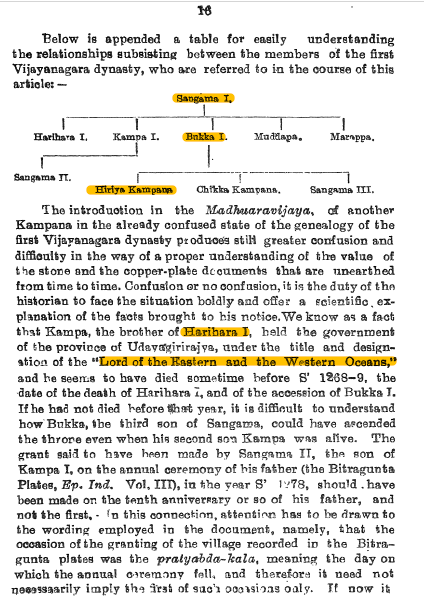
The history of Princess Gangadevi begins with the rise of the Vijayanagara Empire. She is prolific in the details about her husband, Prince Kampana the Elder (son of Bukka I). The Sangama dynasty remains a contested claim. Nevertheless, it’s rise to Imperial stature is incontestable. In this it was aided by a number of loyal lieutenants who would critically feature in later periods. One such was Saluva Manga.
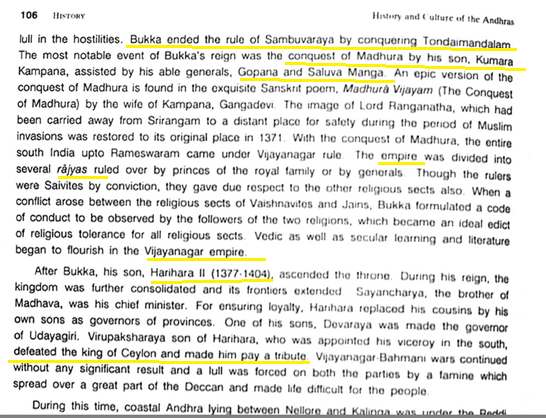
Saluva Manga, of course, would be the ancestor of the famous Saluva Narasimha, Emperor of the Second Dynasty of the Vijayanagara.
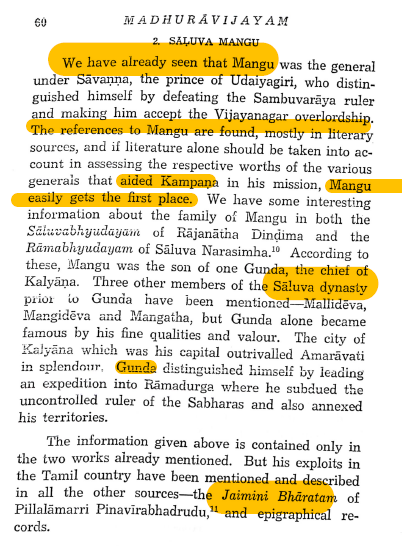
“Saluva Narasimha was a king of VIjianagar of the second dynasty who ruled in 1456-1486 A.D. His father was Gunda, grand-father Gauta (Gautamara) and great-grandfather Saaluva Mangi. His mother was Mallaambikaa. He married Sreerangaambaa. He died in 1493 A.D. Gauta was the chief of Kalyaana and his decent has been traced to the Moon. Mangi was a friend of prince Kampana, son of Emperor Bukka, and accompanied him in his expeditions to the south. He made extensive gifts to the shrine of Sreerangam. He was for a long time commander of the forces under king Mallikaarjuna and his successors of the first (Sangama) dynasty and appears to have proclaimed himself king late in his life. His mother Mallaambikaa had no issue for a long time. Gunda and Mallaambika retired to Ahobilam for perfoming penance near God Narasimha of that place. ‘Please with their devotion the God appeared before the king in a dream, and expressing his satisfaction at their devotion, promised them a son possessed of all virtues and ordained to rule the whole world. The king awoke from his dream and communicated it to his wife. After a short time a son was born to them whom they called Narasimha after the God. The military genius and excellent qualities of Narasimha are then described at length. He is said to have ruled over the territory comprising the Kalyana, Kanchi, Katak, Kuntala, Chola and Pandraka.” [2, 218]
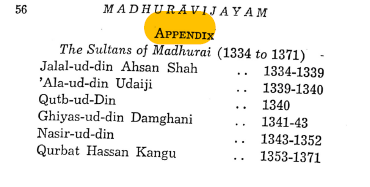
Nevertheless, the outset to all of this remains the fall of the Pandya Dynasty and the rise of the despicable polity of Ma’abar. More colloquially known as the Madurai Sultanate, it was the southernmost vestige of Malik Kafur’s campaign.
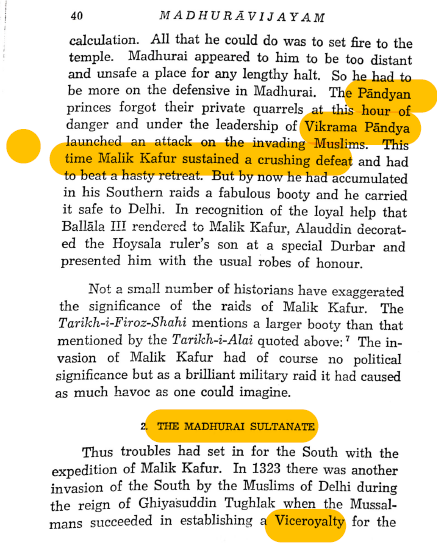
it attained infamy for its bigotry, rapine, and debauchery in its brief period. It had routed the brave Hoysala King Veera Ballala III by treachery. Having initially been defeated in the field and surrounded by his mighty force of an estimated 100,000, it feigned surrender. Then within the declared 2 week armistice it launched a surprise attack on the unwitting Hoysala, and brutally flayed and stuffed his corpse. It was by breaking the laws of (chivalrous) war that the defending army of 6,000 could sally forth 2 victory. Rather than cry betrayal—it is time defenders of Dharma understand the nature of their foe and adjust accordingly as per Sri Krishna.
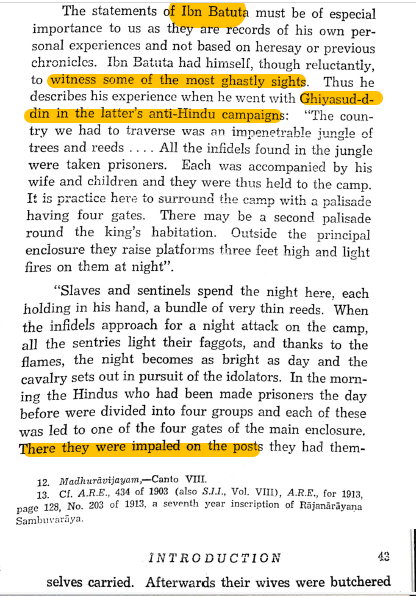
So villainous and despicable was this brief, 48 year tyranny, that even famed Moroccan traveller Ibn Battuta was disgusted at its cruelties. He condemned this sultanate, despite his being a moslem jurist by profession. Indeed, more than virtue, it was an ephemeral victory for unrestrained vice.
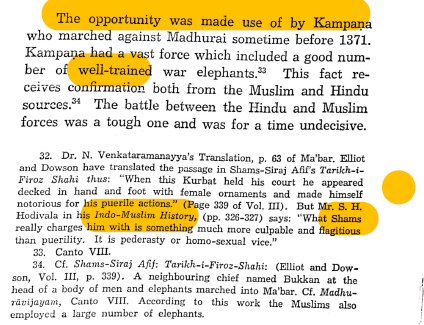 Though these disgusting names aught not be uttered out loud, they have nevertheless been recounted here:
 When faced with such flagrant inhumanity that an own-side account could not disguise its opprobrium for the figure, then providence could not help but raise a hero for the age. And that hero was Kumaara Kampana.
Author
Though Ganga Devi herself is thought to be of the Royal House of Kaakatheeya, not much is in fact known about her. She was the Chief Consort of Kumaara Kampana, who was otherwise much married. She is reported to have accompanied him on his Southern Campaign, making possible her closely delineated details of this prowess.
Composition
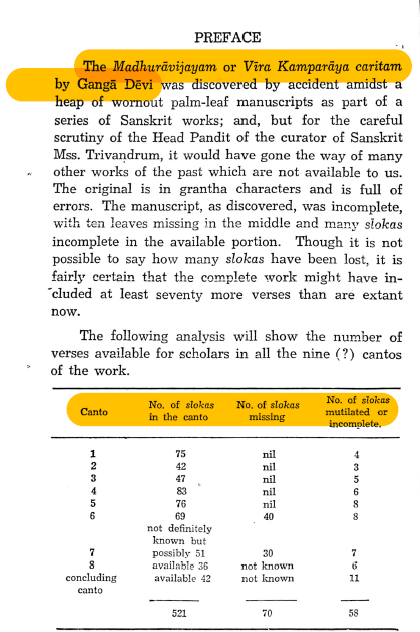
The Composition is actually known as the Kamparaaya-charita, as per the colophon. Nevertheless, the poem is coequal to the city of Madhura/Madurai itself.
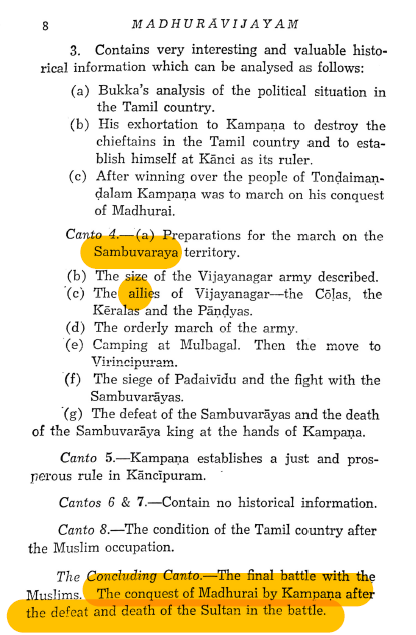
It is a Sanskrit Mahakavya, and was composed in 8 cantos. It is replete with biographical information and accurate retelling of events. This makes it of significant historical value.
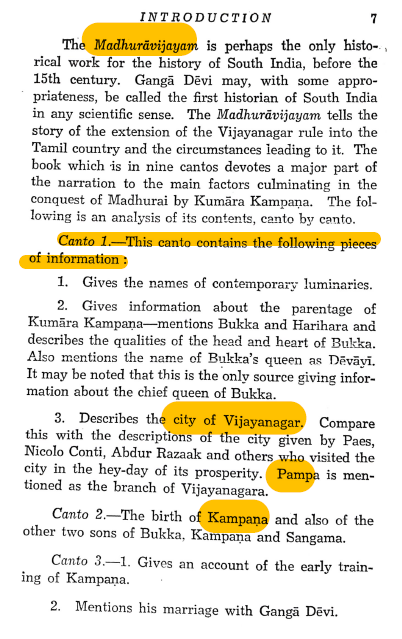 From the refractory feudatory Sambhuvaraya to the heinous and hideous anti-Hindu bigots that ruled Madurai, this poem is a veritable chronicle of the period.
Selections
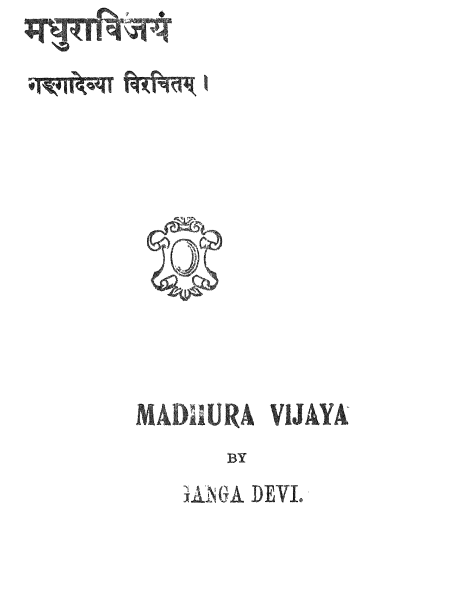
§
The poesy of Princess Gangadevi is at once uplifting and educative. She commences with the obligatory Benediction of all proper Kaavyas.
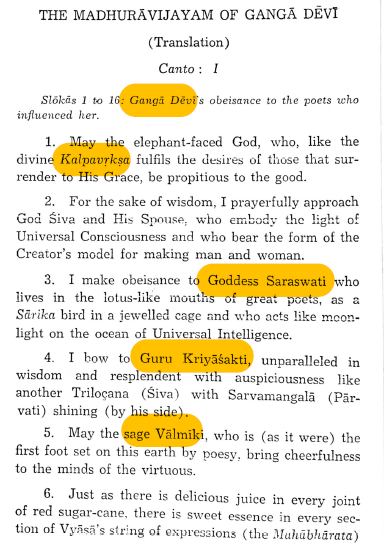 §
§
Contrary to modern Indologists, there is an obvious literary spectrum that runs from North through South that embraces the tradition of Purvacharyas. The poetess lavishes generous encomium upon her antecedents.
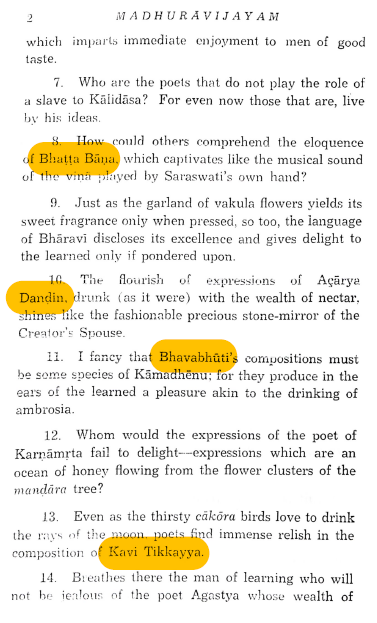
§
Princess Gangadevi bemoans the withering of Dharma in the Kali Age. She recounts the reign of her father-in-law, Bukka I, and praises him to high heaven. The Imperial City of Vijayanagari is compared to the Amaravati of Indra himself.
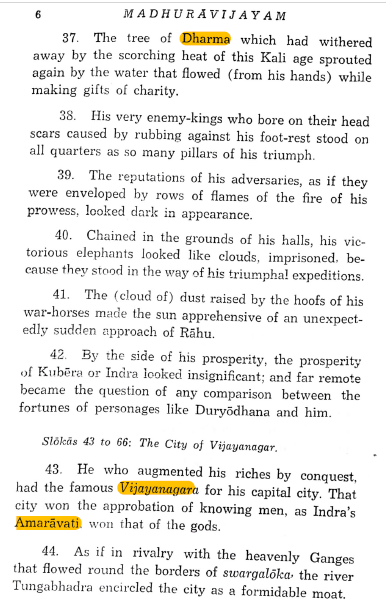
§
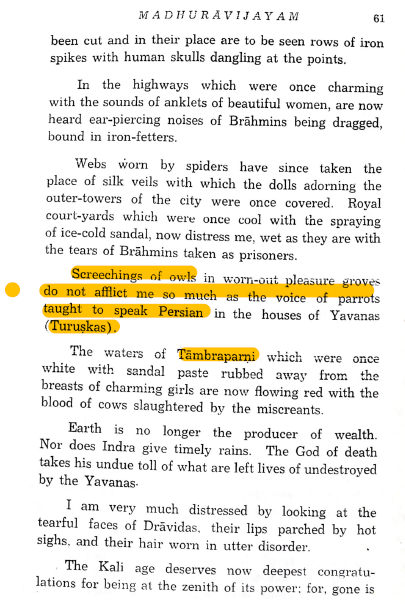
Contrary to the self-abasing persianisation that is replete in the rekhta-induced raktha of today’s alleged ganga-jamuni “sophisticate”, the high-born Indic royals and elites of yesteryear scorned Farsi and condemned it as inauspicious and guttural to the ear:
§
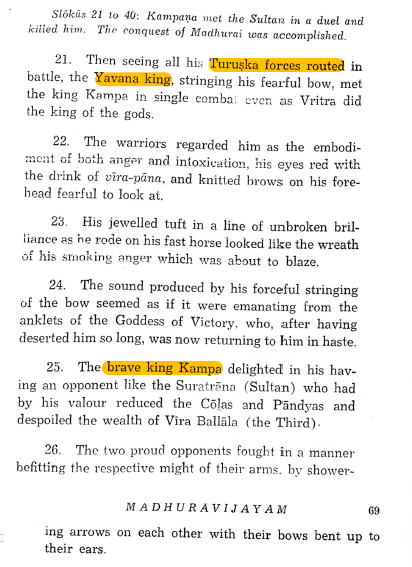
The concluding canto concludes with an exciting blow-by-blow recounting of the duel between Kumara Kampana and the Thurushka Madurai ruler.
References:
- Thiruvenkatachari, S. Madhuravijayam of Ganga Devi. Annamalai University. 1957
- Krishnamachariar, M. History of Classical Sanskrit Literature. Delhi: MLBD. 2016
- Sastri, G. Harihara. Madhura Vijaya or Virakamparaya Charita. Trivandrum. 1924
- Modali, Nagabhushana Sarma, Ed. Mudigonda Veerabhadra Sastry. History and Culture of the Andhras. Hyderabad: Telugu University. 1995



A fascinating article. My ancestors are Kshatriya [& Brahmin] from Andhra and I am very interested in any history of the people, and ancient ways.
Another Gem! What I love about Rani Ganga Devi ji (among many things) is that she wrote of military exploits in a time where perhaps the ruling classes of Bharat did not give much focus to recording their experiences for future generations.
Hopefully Rani Ganga Devi ji’s example will inspire the future ruling classes to do so. This reminds me of another article of yours (I am forgetting which one exactly) in which even foreign writers/historians accepted that military and political history was best recorded by those who practiced it.
Not that we need foreign sources for our teaching, Dharm itself acknowledges that the best teachers, for any dharm, especially rulers, is best taught from those who have had to apply it.
This is why even though the great Rishi Vashitha Ji taught Shri Ram Raja-Dharma and Dhanurveda, he said in Ramayana, that your parents will always be your first and most important teachers (shows the greatness and humility of Rishi Vashitha ji)
Not only because naturally the bonds between parent-child will always be the strongest, and its that love and trust between them that will allow a child to trust a Guru (as their parents themselves trust the Guru), but also because :
Theory is very important for abstract knowledge (which provides a crucial and necessary base), but being able to actually use that knowledge and be useful is best learned from those who have had to practice its applicability.
This is why even though we should not make Uday Bhan Rathore a hero (and I can understand movie makers creating a “black and white” image to help better inspire future generations), I appreciate Maratha histories commissioned under Chhatrapati Rajaram ji- still referring to him with respect and acknowledging that he was a noble man, despite the fact that he fought vs the great Dharmarakshak Tanaji Malusare ji.
This is because the Bhonsles understood that many Rajputs who “were on wrong side” (some blacksheeps are always there in every community) (who even tried to help. Ch Shivaji as best as they can), had their heart in the right place, but due to the ritualistic thinking (which Shri Krishna warned us about) that had penetrated the minds of even the bravest dharmik warriors due to people like Chanakya, found themselves fighting against people they severely respected. Heartbreaking…. (This was not just case with Rajputs, I am a self-respecting Rajput myself who has great admiration for Rajput history)
But the good news is that articles like this that show the brilliance of Rani Ganga Devi ji will inspire Rajputs, Marathas and other ruling communities to look back into their history themselves, and use their discretion to see who their actual friends are, and who is playing who against whom. Only then will Dharma prevail, will all Dharmiks be safe, and will our land be filled with great dharmik saints like Ramana Maharishi ji and Mirabai ji.
Thank you Rani Ganga Devi ji for kindling the spark, no surprises there as… Women Are the Foundation of Culture… Jai Naari Shakti!