Continuing from our Ancient Desa Series over at Indic Civilizational Portal is the natural next step in clearing up the propaganda around Telangana state. The people of Telangana have earned their new state and have their own cultural distinctiveness; however, this cannot be used as pretext for changing ancient history in order to advance new claims or even nizami razakar separatism. Indeed, there are reasons to believe that this is the purpose behind the bifurcation of old Andhra Pradesh state which honoured the old Andhra desa, dating back to Kakatiyas & Satavahanas.
It is possible to respect a new state, and its cultural festivals, while rejecting it’s shameless praise for turkic invaders like the bahmanis and asaf jahs. History should be studied objectively. But in an environment of colonial slavery, one must pushback against actual propaganda. One such baseless compliment lavished upon these medieval colonisers is the one around Golkonda Fort, and the creation of Hyderabad/Bhagnagar.
History
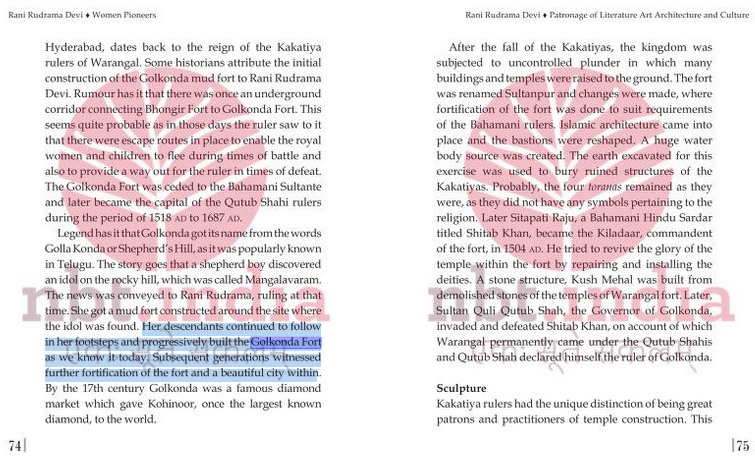
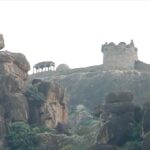
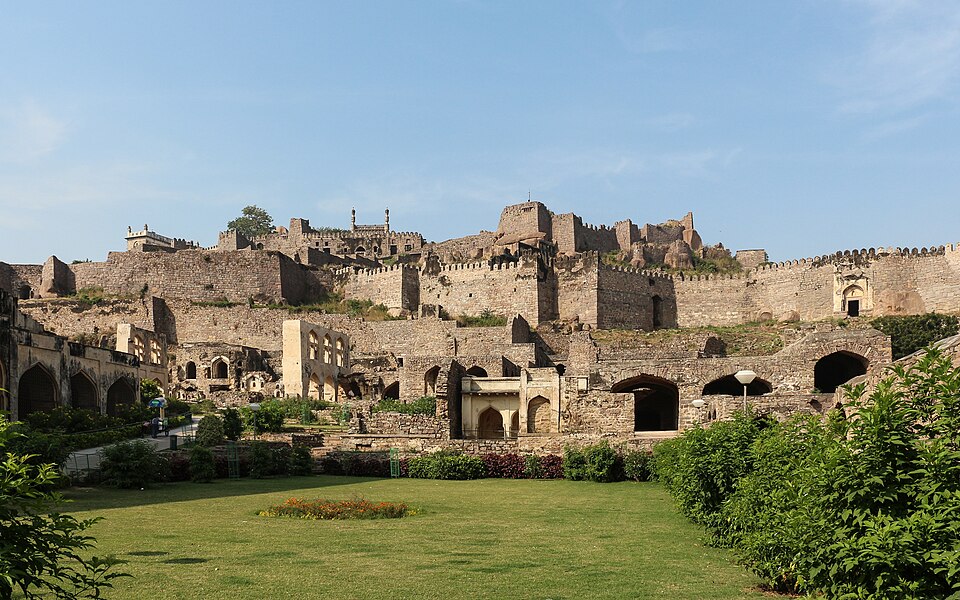
“Golconda: Described as the king among the hill forts of Andhra Pradesh, it stands about 5 miles west of Hyderabad. The beginnings of the fort go back to 14th C. i.e. The Kaakateeyas of Warangal and known locally as “Golla konda”. It stood as the border of the Kaakateeyas on the west…The fort of Golconda stands on a rocky granitic hill and surrounded by a strongly built crenellated wall of stone curtain, with little over 3 miles in circumference, having high bastions 87 in number. ‘The bastions, semi-circular in shape, are built of solid blocks of gran[ite], firmly cemented together and sometimes with iron clamps”. Originally it had 8 gates, but only 4 in use now.‘” [8, 129-130]
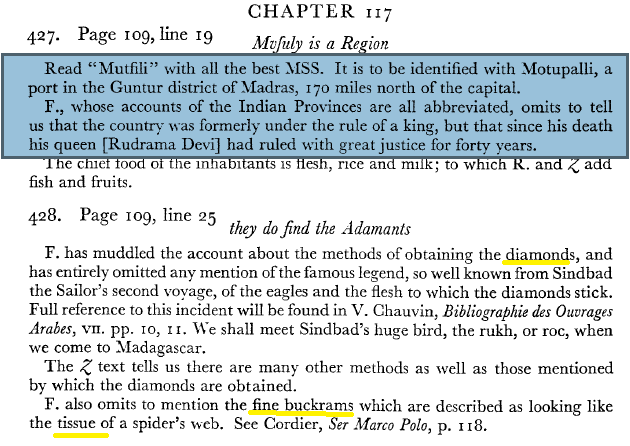
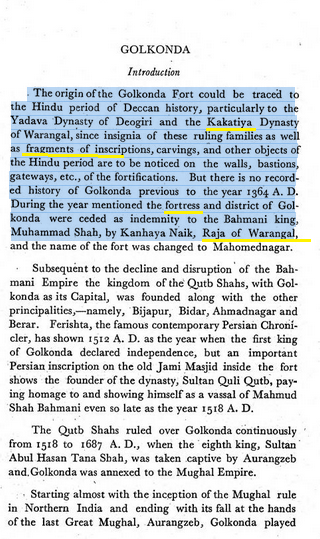
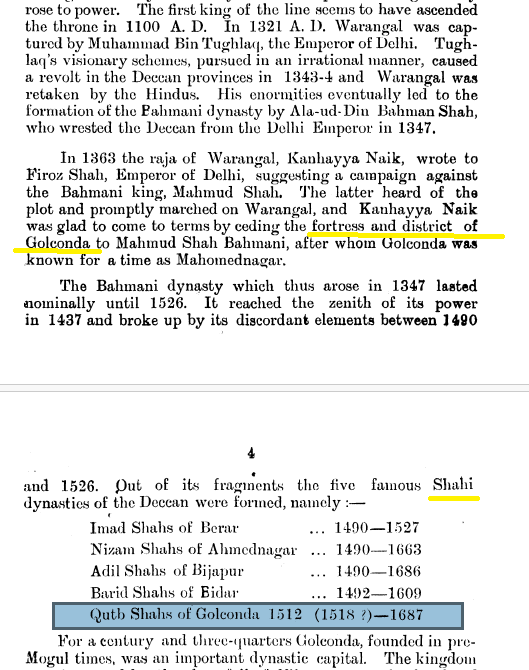
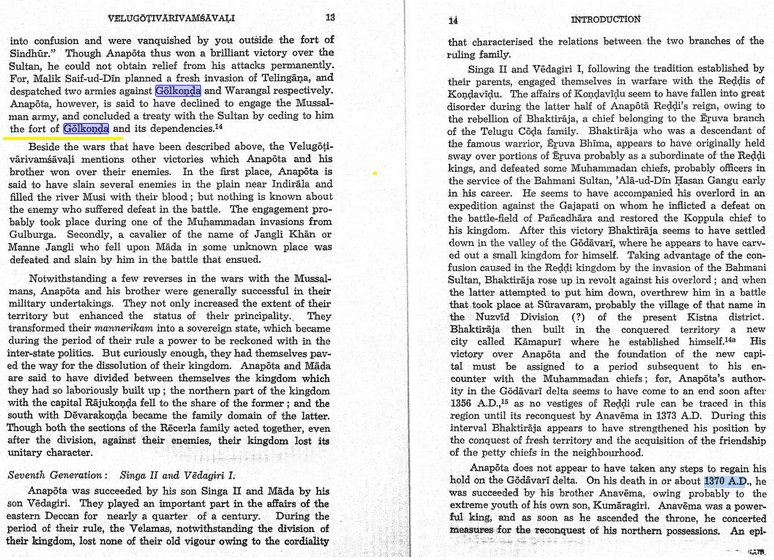
“Kaapaaya Naayaka had to flee to the jungles and was only able to purchase peace by…the cession of the town of Golconda, much gold and many elephants. He also yielded a throne studded in turquoises”. [1, 221]
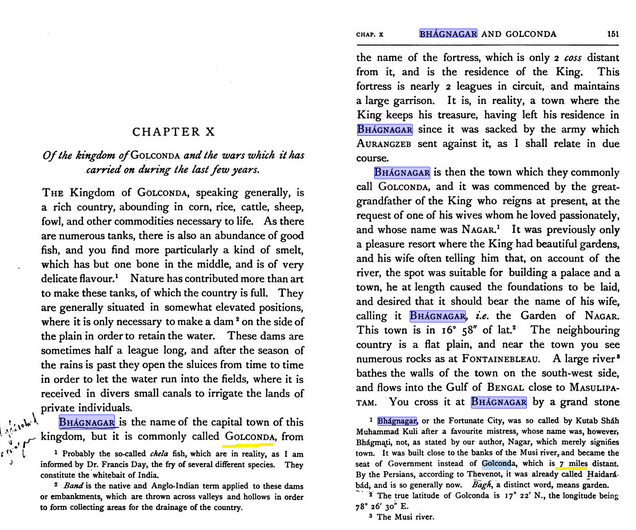
When the diameter of ancient Pataliputra (Patna) was itself 9 miles long, the satellite-town of Hyderabad/Bhagnagar being 5-7 miles from Golkonda town does not make it a new city—but in effect, a suburb. No doubt Bhagyanagar was founded by Mohd. Qutb Shah and a number of years later renamed to Hyderabad, followed by the construction of Charminar. But like Shahjahanabad, it is merely an extension of a pre-existing fort/city/town. Diminishing Gollakonda to a mere “mud fort” when there is clear evidence to the contrary is emblematic of an effort to minimise the contributions and claims of the Telugu natives of the land. Those with allegiance to pakistan and turkistan are welcome to return there. Telangana state belongs to Telugus and tribal Gonds, and as one can now see, so does the ought-to-be restored fort-city of Golkonda.
 [6]
[6]
From Kaapaaya/Krishna Nayak, the city would be ruled by the bahmanis and their Qutb Shah subordinates. It is important for dharmics to study the history of other peoples, though independent of our own legitimate rulers. The history of a land’s colonisers can often be edifying for political events, not recorded in our own.
Qutb Shah Dynasty
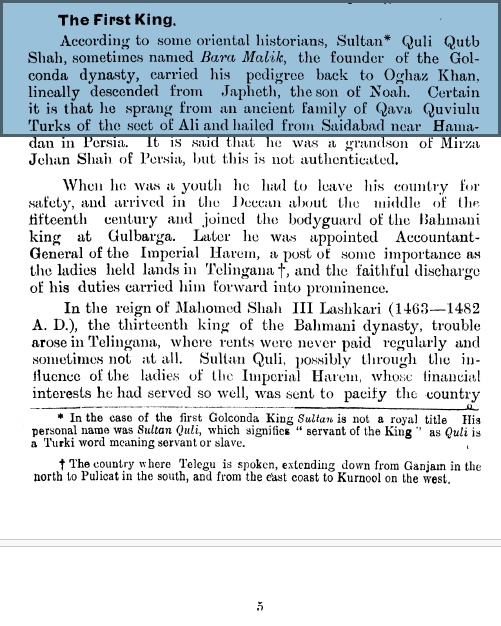 Quli Qutb Shah was the first of this dynasty. Qara Qoyunlu Azeri Turkmen 1374 Bairam khwaja, then qara mohd. Qutb shah was latter’s cousin.
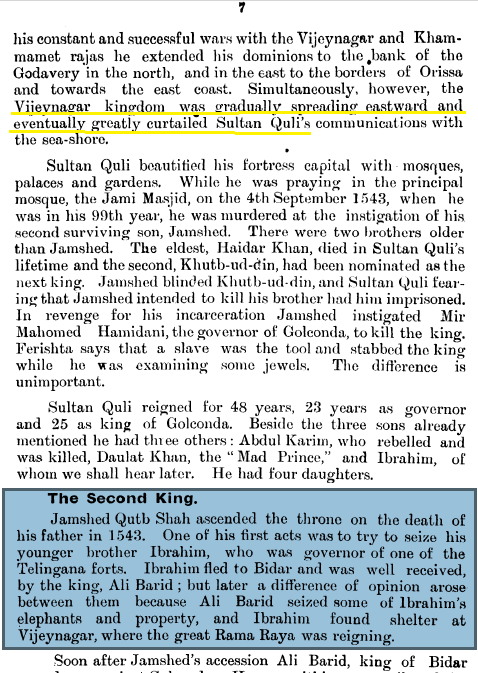
Third & Fourth Qutb Shah
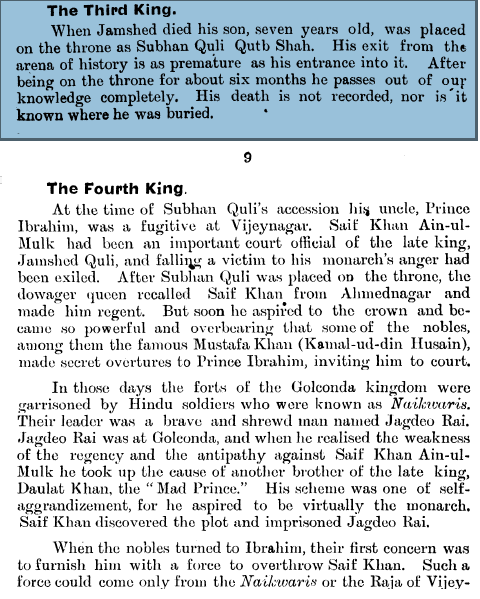 The third Qutb Shah was forgettable.
The fourth was the infamous Ibrahim Quli Qutb Shah, who first sought refuge in the Imperial Court of Vijayanagara. Araveeti Rama Raya controlled the reins of power and ruled as Emperor-in-all-but-name. His munificent generosity to the ingrate Ibrahim would be betrayed at Talikota (Rakkhasi-Tangadi), where the latter fought on the opposing side.
IQS would go on to displace his nephew at Golkonda. Ibrahimpatnam tank is credited to him, as is the popularisation of Classical Indic Music at his court, which he learned during his time at Vijayanagara.
His reign was nevertheless politicking and typical for turkic invaders, who slew family members with little compunction. This set the stage for the rise of one his middle sons.
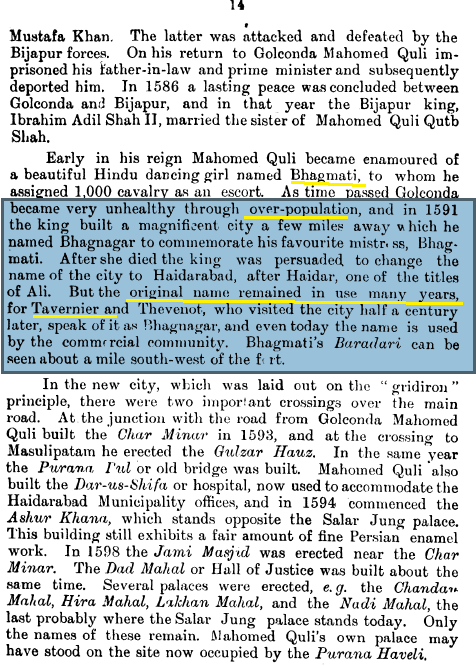
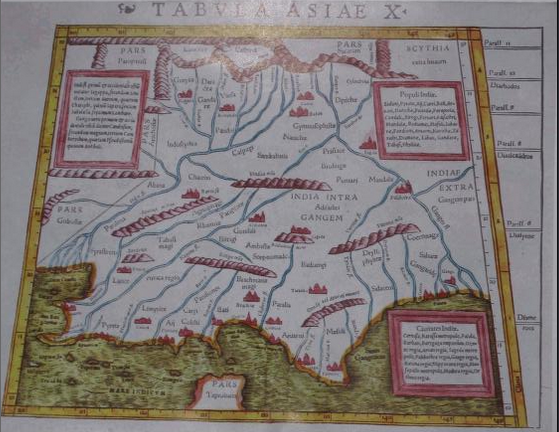
Fifth Qutb Shah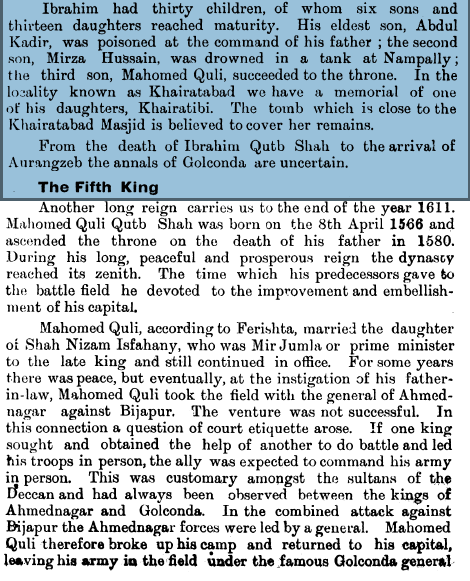 He is credited for marrying the hindu dancing girl Bhagmathi. The suburb of the capital of Golkonda, Bhagnagar, would be built in her honour. Later, under the pressure of religious bigots, Ibrahim would officially renamed it as Hyderabad. Nevertheless, it continued to be popularly—and often officially—referred to as Bhagnagar and Golkonda. There are numerous European maps evidencing this. The reason for the newly designated “Hyderabad” was due to over-population in the fort-town of Golkonda.
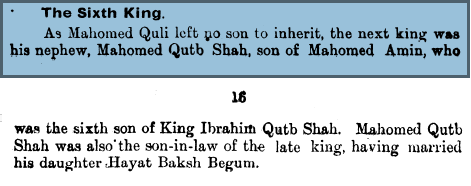
Sixth Qutb Shah
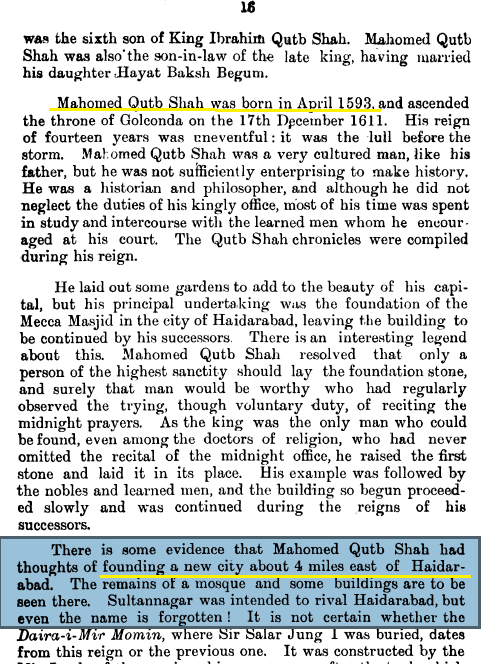
The Sixth QS’s reign is primarily notable for his putative desire to construct a new capital to rival Hyderabad—a mere 4 miles east of it. This again underscores how whether it is Hyderabad or this aborted Sultannagar, a mere 4-5 miles from the original city does not a new city make.
Seventh Qutb Shah
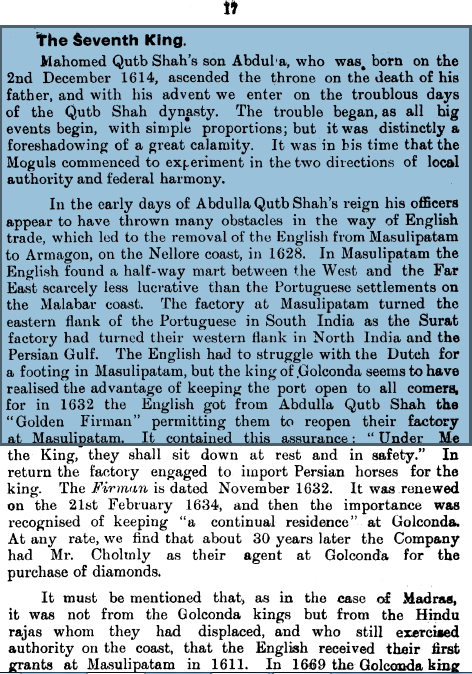
The Seventh Qutb Shah had an eventful reign. The famed French traveller Tavernier frequented the kingdom during this period. The politicking Mir Jumla expanded his power as minister until he finally alienated the king. He fled Golkonda seeking aid from the mughals, who promptly sent an army to besiege Golkonda. The king was saved only by giving a daughter to aurangzeb’s son, whom he promised to make heir.
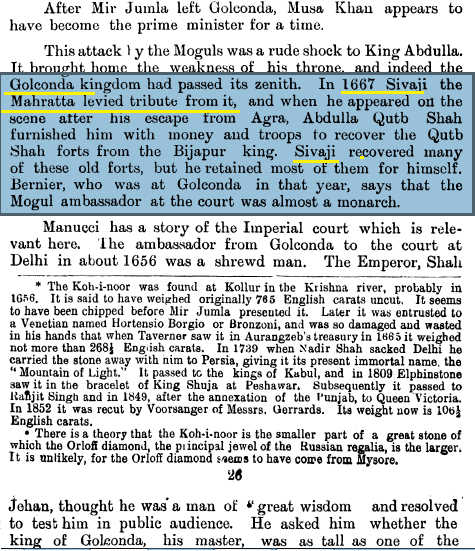
In the mean time, it should be noted that the even moslem chroniclers record that Chhathrapathi Shivaji collected tribute from Golkonda during this time.
Tanashah
The 8th and last of the Qutb Shahs was Abul Hasan ‘Tanashah’. He is considered the most tolerant of the QS sultans, mostly on account of his hedonistic ways, considered refined (hence his epithet). Kuchipudi (which originates in Chindhu Yakshagana) is often erroneously credited to him—though he did give it patronage. His reign is notable for his ministers Madanna & Akkana, who aligned him with Shivaji Raje, for the War against aurangzeb, the fanatic. It should be noted that he would be the second Qutb Shah to pay tribute to the Marathas (this time to Sambhaji). Sambhaji would greatly assist Golkonda in fighting the final mughal siege in 1687. [4, 38] Tanashah would resist the mughals for months, but would eventually be captured and imprisoned by the mughals.
Epilogue
After the Qutb Shahs, Golkonda was taken by the mughals in the time of Tanashah. It would later by assigned by the mughals to the turkic asaf jahs to govern as viceroys, rather than sovereign kings. The asaf jahs would then be defeated by the Marathas and Hyderabad state would pay tax and become subordinate to them. Then finally the nizam signed the Treaty of Subsidiary Alliance becoming british imperial subordinates. Even if one takes into account their disobedience to Delhi, nizami Hyderabad would have been fully autonomous for barely a decade or two given its fealty to the Maraatthas and later vassalisation by the East India Company. A barely autonomous vice-regalty does not an independent sovereignty make. Whether old Andhra Pradesh state or new Telangana state, Hyderabad-Golkonda belongs to the native Telugus by right of historical origin and modern Liberation by India in 1948.
Architecture
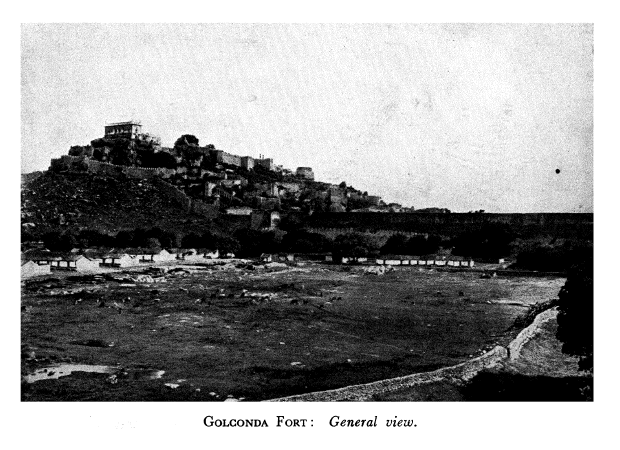
The description of the architecture of this fort will be general. Like many medieval sites, Golkonda is a product of many layers. However, the danger of Indology is the constant effort at erasure of the ancient. The qutb minar complex in Mehrauli is on such example, where 27 Jain temples once existed near Delhi, but were destroyed for the maseed. The old fort, Puraana Qila, is dated at least as far back as Anangpal Tomar, if not to Indraprastha itself. This does not change the reality that Lal Qila (Red Fort) dates to Shahjahanabad.
Similarly, there is no doubt that the Golkonda maseed and various other additions can be credited to the four centuries of (oft-interrupted) administration by the qutb shahs and asaf jahs. This is all discussed in great detail by various academic works. As a result, the focus of this article will be primarily on the native Telugu-Kakatiya contribution.
Construction
“As regards the plan or shape of a fort, Kautilya prescribes, either circular (vritta), rectangular (deergha chaturasra) or square (Chaturasra). While choosing the site of a fort, he warns that care should be taken to see that it is not exposed to external dangers. Hence, he says that the capital city shall be in the centre of the kingdom, preferably on the bank of the confluence of rivers or a deep pool of perennial waters.” [8, 63]
Indeed, even the irregularity of a rhombus (a kind of trapezoid) is not unknown:
“This place is identical with modern Naagaarjunakonda in the Krishna valley of Guntur district. Archaeological excavations conducted here between 1955-60 revealed numerous structures of early historic period. ‘Of them, the citadel with its grand fortification wall, ditch, gates, and barracks is indeed very important. The citadel wall which encloses a trapezoidal area of 3000′ x 2000’, ran along the right bank of river Krishna in the west” [8, 88]
One might go back even further to account for this: “The Vishnu Dharmottara mentions three shapes (viz.) aayata (oblong [rectangular/trapezoidal) chaturasra (square) and vritta (circular). [8, 103]
The assertion that the prior construction could only be a “mud fort”, a.k.a. mud-brick, is also false. “During this period developed a new masonry technique called cyclopean, in which, large blocks of stones were piled up one above the other and tightly fitted into each, without the use of any joining or binding material as chunam or mortar. Writing about Forts in medieval Deccan, Yazdani observers “By the advance of knowledge, masonry seems to have been introduced in building defence works, first in crude forms, but later quite regular, although the size of the stones, as in cyclopean walls, remained a significant feature of military architecture of the Deccan, until the advent of the Moslems“. [8, 104]
In fact, many other Telugu forts including and ante-dating Golkonda were also made of stone, and in particular, granite:
“The second criterion that governs the construction of a fort is the availability of strong building materials, locally or in close proximity. This is amply proved by the fact several hill forts are built on high rocks, where granite or black granite (basalt) which is locally available, in the hills of Hanumakonda which lies nearby, within a distance of 3 miles, while the huge mud rampart was built of the dug out earth and mud from the deep moat. Similarly other hill forts like Gutti, Gandikota, Golconda, Kondaveedu, Kondapalli and Udayagiri were built of red granite that is locally available where as Penugonda, Charagiri and Aadoni were built of white granite available in the local hills.” [8, 106]
A survey was taken of all the forts of United Andhra Pradesh state as follows:
“I. Sthala durgas
Coastal Andhra 66 Rayalaseema 42 Telingana 21
II. Jala durgas
Coastal Andhra 3 Rayalaseema 1 Telingana ___
III. Giridurgas
Coastal Andhra 6 Rayalaseema 8 Telingana 16
IV. Vanadurgas
Coastal Andhra __ Rayalaseema 2 Telingana___ ” [8, 126]

Even Europeans mapped modern Hyderabad as “Golconda”, noting “as far as Santhome on the east coast and in land as far as Penukonda, Kurnool, and Indoor, while its north-eastern border touched modern Orissa. The whole of this area, in fact, corresponded to modern Andhra Pradesh, and named as Tilang by the Indo-Persian Chronicles, for, to a large extent, the population of this region spoke Telugu as their mother-tongue.” [8, 166]
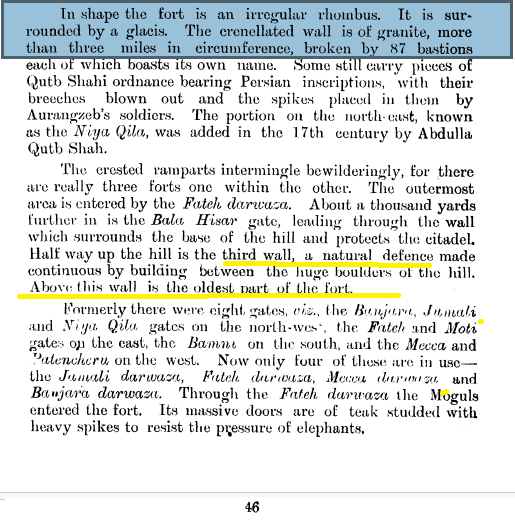
The modern fort of Golkonda is 3 miles in circumference. The fortifications maintain two walls called Puttakota and Khilla, although 3rd also exists. As stated previously, there are 87 bastions. Similar layouts can also be seen elsewhere.
“Kondapalli is stated to have been built at the behest Komaragiri, by one Dinakarareddi in the year Bhaava, corresponding to A.D. 1394. There were in all 84 forts termed as tthaanas. It also mentions that a certain Donti Allaada Reddi was the Durgaadhyaksha of Dharanikota in A.D. 1225 There were also appointed several officers to defend different forts, who belonged mostly to the Velama and Balija communities. ” [8, 151]
Structures
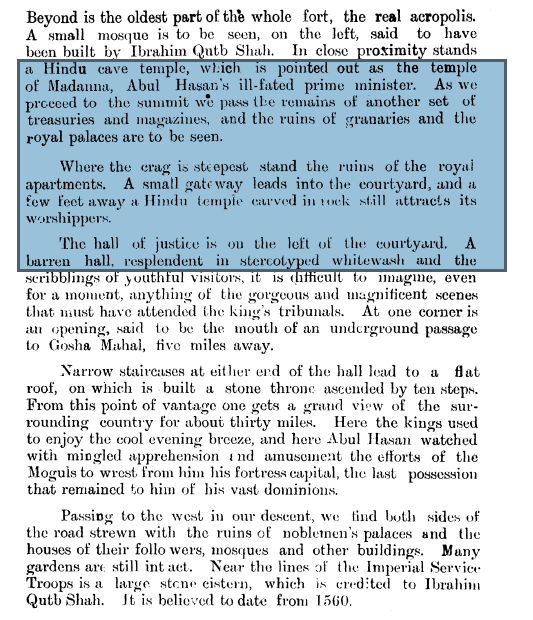
Even the most biased accounts from the nizami period of Golkonda attest to the preceding older structures. These include not only cave shrines but an actual Hindu temple and hall of justice. While one might be credited to Madanna, the Maraatthi brahmin (some assert Telugu Niyogi) minister of the Qutb Shahs, the cave shrine would clearly be older.
Conclusion
No AP-ite cares if Telangana people want to create a new identity around their tribal influences. But Telangana itself is a neologism from foreign turkic hordes who enslaved and oppressed the locals.
The true heroes of Telangana are those who fought the Sayudha Poratam, like Chakali Ailamma and the tribal hero Komaram Bheem.
Hyderabad was merely founded as a satellite city of the existing fortress-town of Gollakonda. Indeed, the agglomeration known Cyberabad/Hyderabad, if at all it should be renamed, it should be Golkonda since that was the original municipality. There are undoubtedly maps by Europeans showing the name Bhagnagar, indicating the renaming to Hyderabad is at a later date. It too is similar to the cultural colonialism seen in changing names from Manukota to Mahbubabad, Mahishapuram to Bhainsa, Edhulapura to Adilabad, Enugandhala to Karimnagar, and Indrapuri to Nizamabad.
Whether from Turkestan or Inglistan, an invader is an invader & is there to exploit. Every once in a while there might have been a less criminal ruler, but the real locals of the land, the true bhoomiputras are the Telugus of Telangana, Rayalaseema, & Coastal Andhra. Those who live alongside them, must learn that respect is a 2 way street. Those who embrace this one-sided love story are either shameless slaves or dora collaborators pushing for the same separatism that was crushed in 1948. The asaf jahs were cowards who were the first local rulers to slavishly sign the british East India Company’s treaty of subsidiary alliance. They were servants of the mughals, servants of the Marathas, and servants of the british. They are bereft of any dignity and worth, and have no claim to sovereignty based on a mere 200 years in the satellite-city of Hyderabad/Bhagnagar (only 7 miles from the original fort, with connected subterranean walkway). Most modern cities and even many ancient cities were several miles in diameter. Even in that time, Emperor Krishna Deva Raya captured Golkonda town—so much for exclusive possession. He also conquered Warangal in 1516 CE.
There were Hyderabadi Moslems like Shoaibullah Khan and Bilkis Latif who embraced their own identity while respecting the local culture and distinguished medieval history from modern politics. Accepting the democratic status quo and living together in harmony is one thing, re-fighting settled issues and inventing phony colonial identities is another. No number of new political parties or digital accounts or purchased professors/academics will change the reality that Asmaka desa was in Western/Central Maharashtra (Nashik) only, and that the vast majority of Telangana was in Andhra desa itself. Indeed, rather than Asmaka, if Telangana were to cede districts to any desa, it would be to some new Vidarbha state, which was the ancient desa on that border.
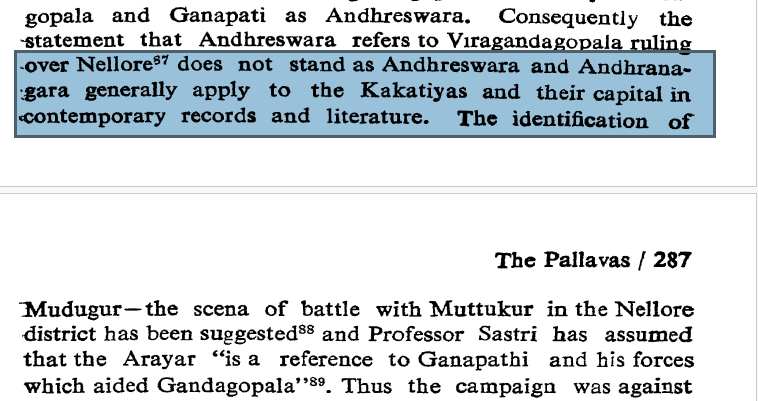
Seeking to extend Telangana’s archaeological sites towards Andhra’s coast only proves Puranic history itself. Andhra/Trilinga desa was marked by Kalesvaram, Bhimesvaram, & Srisailam—in Telangana, Coastal Andhra, and Rayalaseema respectively. It is also why the Telugu Association in Hyderabad Princely State was called “Nizam Andhra Mahasabha” and why even Warangal was called “Andhranagara”, and the Grand Kakatiyas were called”Andhreswara”.
Telanganites have every right to celebrate their new state, cultural festivals like Bonalu, and tribal heritage from the Gonds. But all of these must respect the true Puranic history of Trilinga/Andhra desa of which Telangana, Andhra Pradesh, and Rayalaseema were all a part. After all, historically Andhra itself meant Telugu, and it was settled not from the West (i.e. Asmaka), but from the east (Prachya/Trikalinga).
If one is really “shaastriya” and not a propagandist, undivided Andhra Pradesh would actually be the view of “dharma”. It is most hilarious that nizami-dora propagandists are now claiming to speak on behalf of “dharma” and “shastra” when here is an actual Vedic Brahmin Pandith (Kota Venkatachalam gaaru) on the topic of Andhra desa:
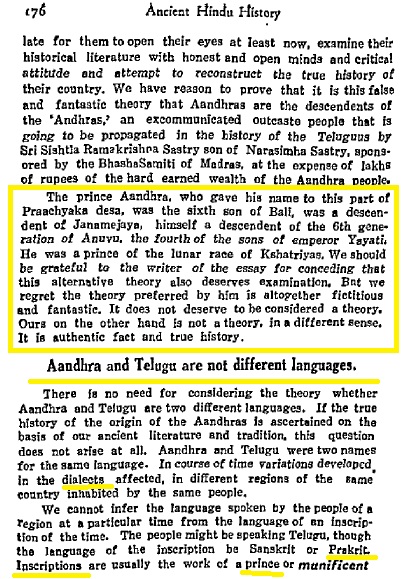 [2]
[2]
References:
- Sastri, K.A.Nilakantha. A History of South India. New Delhi: Oxford. 2015
- Kota, Venkatachalam Paakayaaji (Pandith). Chronology of Ancient Hindu History Part I. Vijayawada: AVG.
- Punjala, Alekhya. Rani Rudrama Devi. New Delhi: National Book Trust India. 2016
- Sreenivasachari, P. Golkonda. Dir of Archaeology: Govt. of Hyderabad. 1954
- Rocco, Sha. A Guide to Golconda Fort and Tombs. Government Central Press. Hyderabad
- Tavernier, Jean-Baptiste. Travels in India. Vol. I. London: Macmillan & Co. 1885
- Ramanayya, N. Venkata. Velugotivarivamsavali. University of Madras. 1939
- Murthy, Dr. N.S.Ramachandra. Forts of Andhra Pradesh (fron the earliest times upto 16th c.A.D.). Delhi: Bharatiya Kala Prakashan. 1995
- Frampton, John. The Travels of Marco Polo. London: Argonaut Press. 1929
- Gole, Susan. Early Maps of India. New York: Humanities Press. 1976