Subsequent to our article on the Tanjore Nayaks, it is only natural to round out this Series with the Southernmost outpost of Nayakdom. This polity would be located not in the geographical boundaries of the Indian Mainland, but on the island of Ceylon, better known today as Sri Lanka.
Today’s Post is on the Telugu Kingdom of the Kandy Nayaks.
Introduction
A little known but consequential polity in the subcontinental littoral was the Telugu Nayak Kingdom of Kandy. Unlike the delectable sweet with which it is homophonous, this story is not treacly saccharine. Contrary to popular opinion, conquest by colonial Europeans was not a cakewalk. With dedicated financing not only by their home nation corporations and kingdoms, but by the Church itself, these various East India Companies (from the Northern to the Southern ends of Western Europe) could concentrate forces and finances in a way subcontinental peers and near peers could not. Even if defeated, the invader home base was 6,000 miles away and defended by the most advanced naval power.
Indeed, Hindu cupidity and greedy stupidity being what it is, Surati bankers were in fact financing locally many of these same companies, who were expanding elsewhere (and later, closer to home). This is the policy of hoping the crocodile eats you last. True, there is the hope that he might have eaten his fill and become tired of a next gulp, but who wants to bet survival on space in another’s stomach.
The Madurai Nayaks have of late, come under much deserved condemnation for their selfish conduct and disloyalty to their Imperial overlord, the Emperor of Vijayanagara, but also the craven opportunism versus the Mysore Maharajas. While the Wodeyars can be castigated for declaring independence first (effectively sealing Sriranga III’s fate), they were still somewhat supportive of Vijayanagara’s struggle against Bijapur & Golkonda. No such luck with the Madurai, which had truck with the likes of the latter, and shamelessly invited and aided their campaigns against Mysore.
However, scions of Madurai Nayaks need not hang their hands in complete shame. There were a number of bright patches. First and foremost was the cultural significance of this dynasty, which was one of the exemplars of pure samskrthi in this age (rajadharma vis-à-vis Vijayanagara was another matter…). Second, was that Chokkhanatha, the last major ruler, himself had a change of heart and reversed Madurai Nayak policy versus Bijapur & Golkonda by opposing them. Madurai took up the native cause all too late, and was in fact, devoured last.
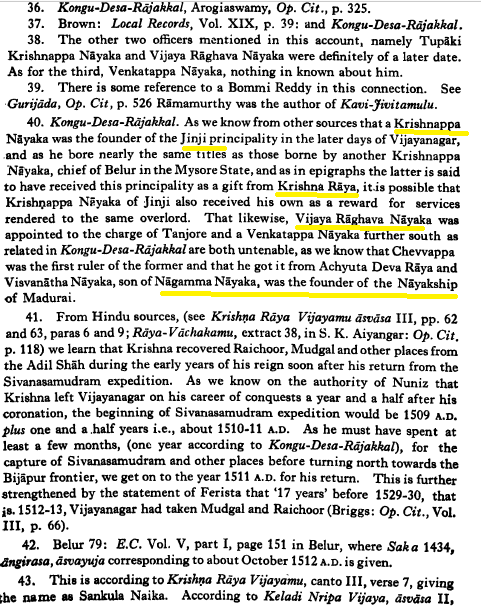
However, from this same family was spawned a Nayakdom that would prove a stubborn opponent to rising European colonialism—in Sri Lanka of all places. The provenance of this and other Nayakdoms can be traced as such.
[1]
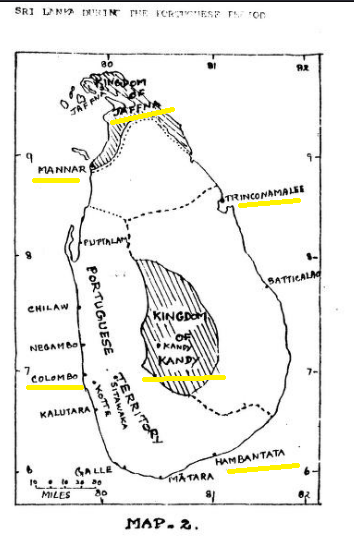
The Kandy Nayakdom was founded by a member of the Madurai Balija Nayakudu family. Contrary to modern politickers in dravidian circles, these Telugus were not related to the native Sinhalese populace, but ruled over the Bengali-Odia origin Sinhalas (as per their own traditional history). Sri Lanka at this time was divided into multiple petty polities. These proved to be easy pickings for the piratical portuguese, who could only be held back by the might of large kingdoms and empires, such as Vijayanagara & the Maraatthas. At a time when the piratical portuguese were gulping ports & petty kingdoms left and right, Kandy not only successfully resisted them & won multiple battles against them, but decisively defeated them with their Dutch alliance. Though Kandy would eventually be taken over by the british, this formidable foe of colonialism had its crescendo in the Telugu Nayak Kingdom of Madurai.
Background
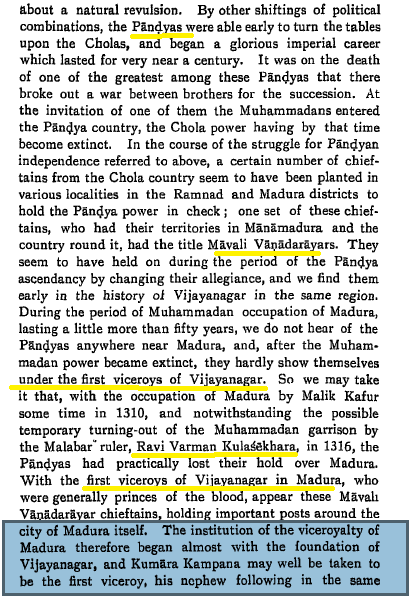
The Background of the Madurai and Kandy Nayakdoms must be understood in the background of the Viceregalty of Madurai. The Madurai Nayaks were not merely another Nayakdom but were treated by Vijayanagara as the Viceroy of the entire South. This is what gave them the authority to intervene in the affairs of other kingdoms (even Sri Lanka) and why they arrogantly demanded deference from Thanjavur—even in the matters pertaining to the Imperial Capital, such as Imperial Succession.
Here is the backstory of this erstwhile Pandya kingdom capital.
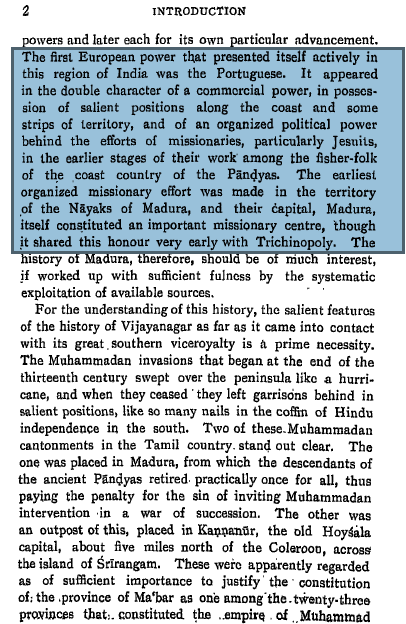
[2]
The Viceregalty of the South meant that the Madurai Nayak was the Overlord of all of Kerala, including Travancore (which famously defeated the Dutch at Colachel).
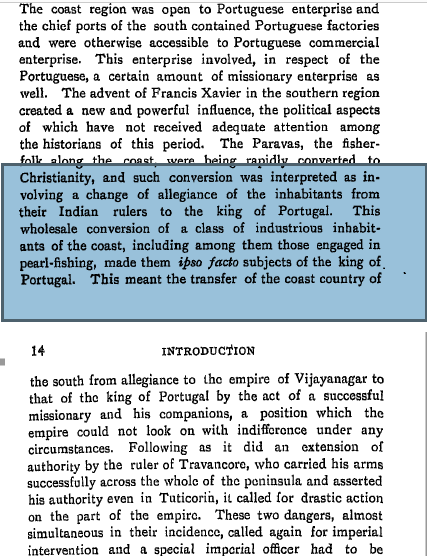
[2]
Mysore declared independence in 1646 & Madurai followed. The Empire effectively reigned from 1332-1646 CE.
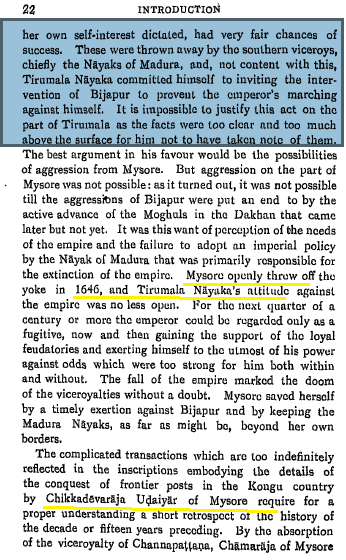
[2]
Shivaji Raje issued coinage on the model of Vijayanagara. Emperor Sriranga III d.1677. Imperial lists end 1710CE.
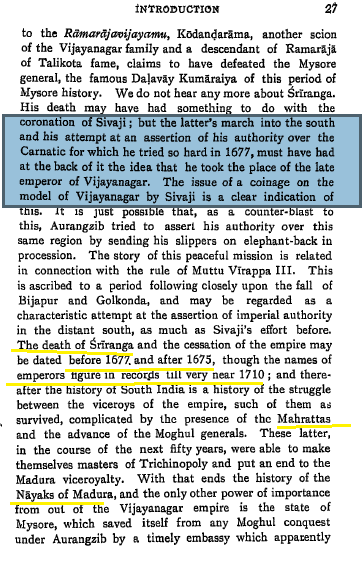
[2]
The outset of the Sri Lankan Conquest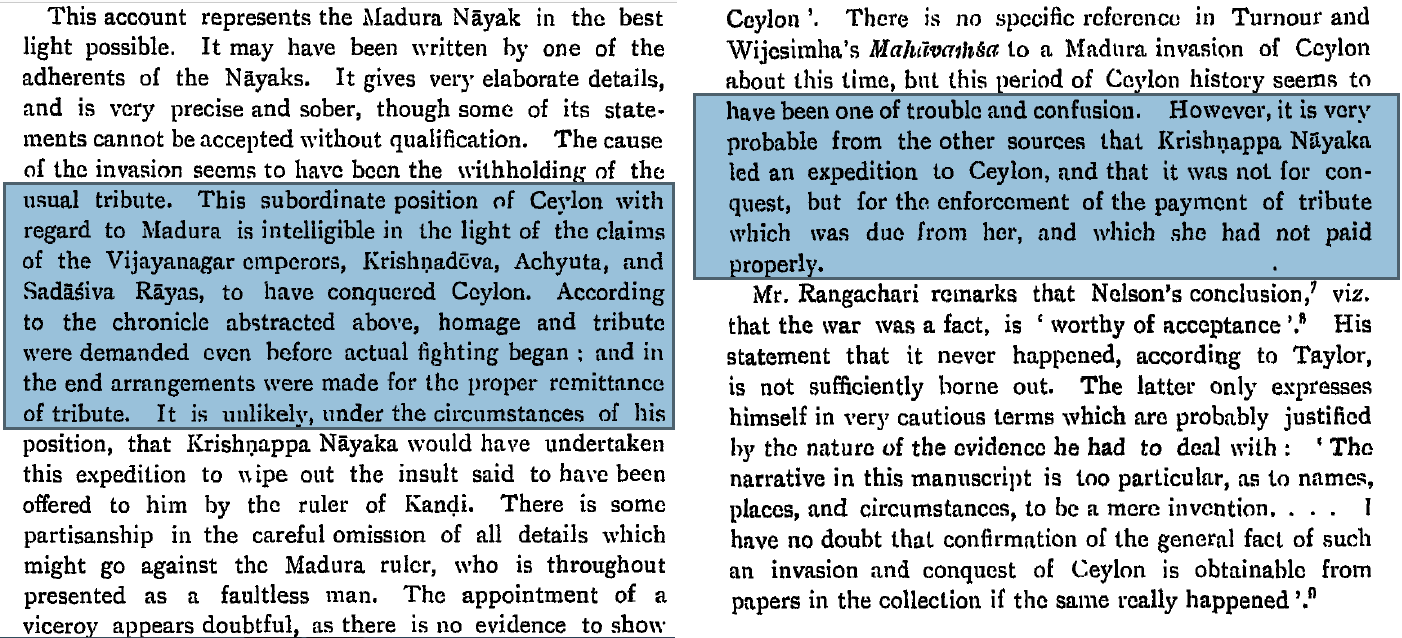 [2]
[2]
Though Sri Lanka was a Tributary of Vijayanagara and in its Sphere of Influence, due the prevailing winds of fortune, the piratical portuguese washed up on their shores and almost immediately began meddling, subverting, and pillaging the coast. The rulers at this time were the Tamil Jaffna kingdom of the North, the Sinhala Kandy kingdom of the centre, and the Kotte kingdom which was nominally the high king. All three were idiots.
The latter later sub-divided due to a succession crisis (the reigning king wanted his adopted son to succeed over his own descendants). These 3 sons then overthrew him and proved to be even more idiotic. In this climate, it was relatively facile for the portuguese to play protector to the less powerful claimant to the throne as pretext to control. When the new king proved hostile (as Mir Jafar later proved to the british after plassey) he was simply replaced. They also insisted on conversion to Catholicism, which a number of claimants did. 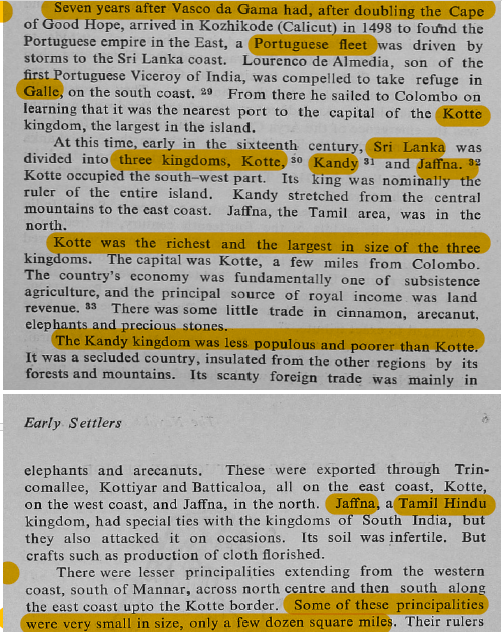 Despite desultory revolts, the short-sighted chaanakyan policy Bhuvanekabahu and his successors adopted resulted in the same pattern. They would seek the invader’s help against a local rival, then be despatched after so that an ever more slavish candidate could be set up. [3, 7] By 1538 CE, the portuguese began to dominate the island’s biggest kingdom and by 1597 CE had full control of it with a Catholic vassal-king: the ironically named Dharmapaala, who would be rechristened as, I kid you not, Don Juan.
The inland Kandy kingdom originally proved no different. It was defeated by another Sinhala kingdom (Sitawaka and its king Raajasinha) and its deposee Karaliadde Bandara fled and made abject samshraya to the portuguese. They promptly rechristened his children as Don Philip and Dona Catherina.
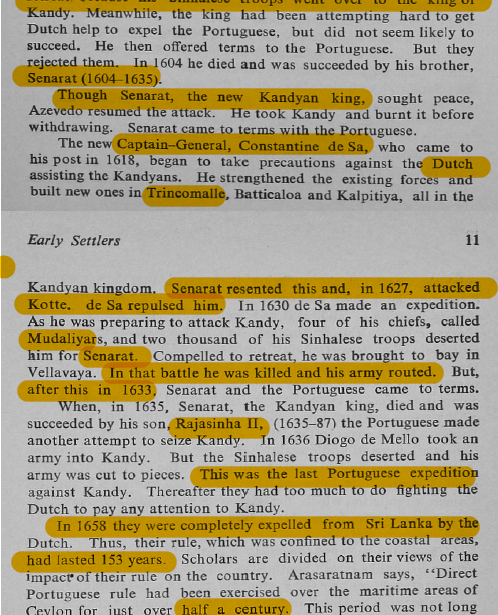
And like that, all 3 kingdoms fell like dominos. Jaffna had routine civil wars, with the portuguese finally pacifying them with a mix of carrot-and-stick in 1591. By 1620 the last regent of Jaffna (Sankili II) was deposed and Tamil Jaffna became a portuguese province. However, the portuguese overstepped when they attempted to insist that the Kandy Sinhalese Royal Lady marry a portuguese nobleman. This led to a popular revolt. The preceding Sinhalese convert king then reverted to Buddhism as Vimala Dharma Suriya and led a freedom struggle against the portuguese. This eventually succeeded. [3]
The struggled continued with Suriya’s successor. It was a mixed bag. Though the portuguese succeeded in burning Kandy, the polity remained independent and came to terms. But Goa remained adamant in its burning desire to control the Island and restarted the war. At least 2 phirangee armies were cut to pieces by the Sri Lankan natives. Through a mix of heroics, intrigue, and outside intervention, the portuguese were finally expelled after 153 years.
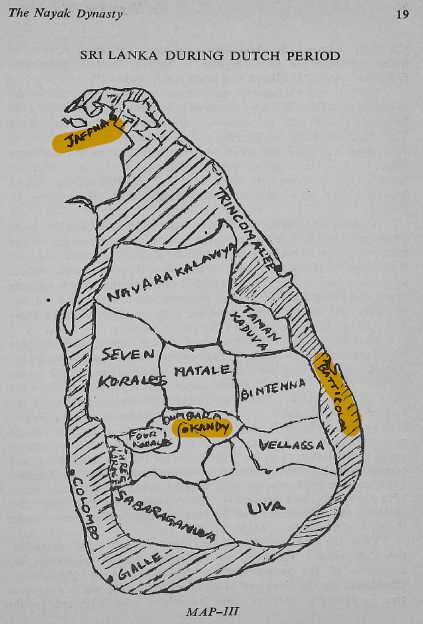
If the portuguese sought outright violent control of strategic chokepoints, the Dutch were more clever. Due to competition from the first-mover advantaged portuguese and later british, they focused less on chokepoints and more on indirect (followed by direct) control of the areas of production. [3, 20] It was a ingenious bit of strategic adaption that allowed them to lay a tight noose by which the fiercely independent Sinhala Kandy kingdom had its affairs muzzled.
The Dutch
 In contrast to the modern ambivalence that Sinhalas have to South Indians, there has long been a closeness between the royal families of Sri Lanka and Madurai going back to legendary sinhalese Prince Vijaya himself. After arriving from Bengal by way of Gujarat, he insisted on a consort of royal lineage. As a result he sought out the royal family of Madurai.
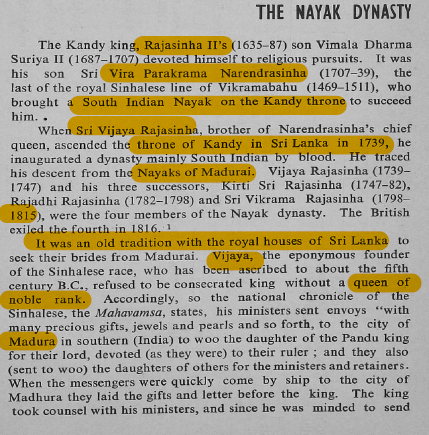
This tradition continued into the Kandy Sinhala kingdom. It is in this manner that the Telugu Nayaks of Madurai came into possession of the Kingdom of Kandy.
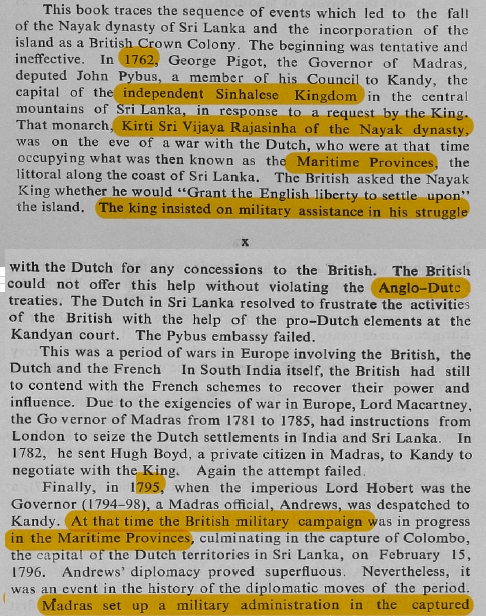
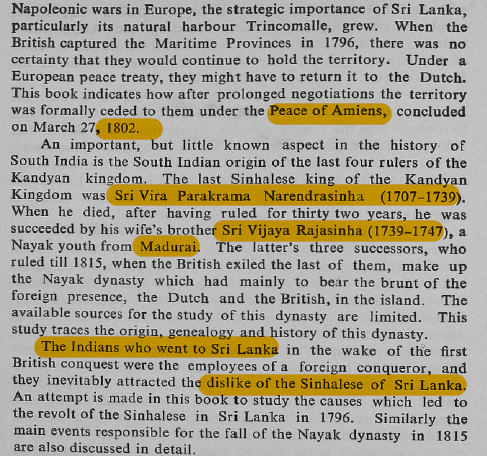
If the Sinhala Kandy Dynasty can be credited with evicting the portuguese on their own, with the Dutch then encroaching on the coasts, then the Kandy Telugu Nayak dynasty can be credited with evicting the Dutch and stoutly resisting the british.
Vamsa Vrksha (Genealogy)
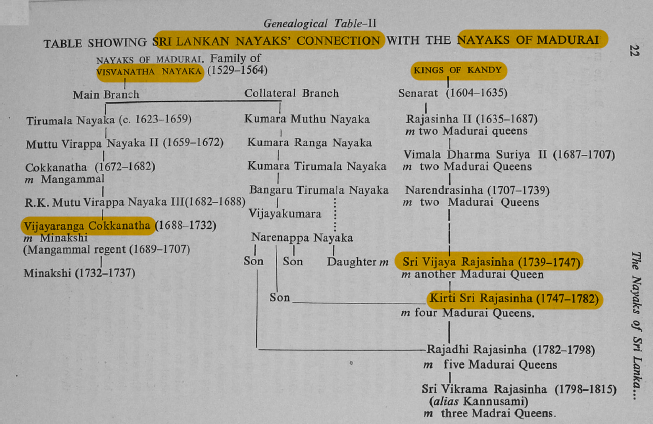
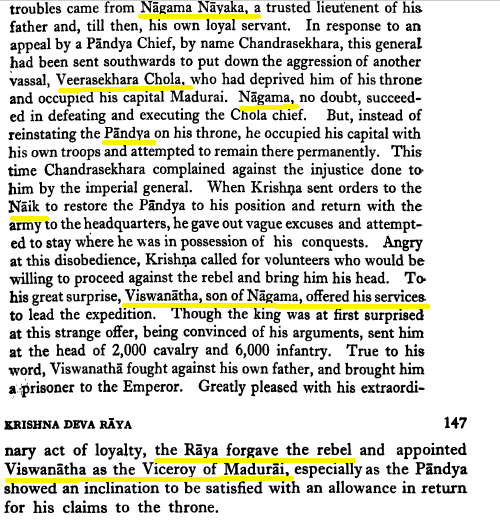
The origin of the Kandy lineage is rooted in the Madurai Nayak dynasty. This family traces its root to Naagama Naayaka of the Vijayanagara Empire. The curious case of Naagama and his son Vishwanatha is described thus:
 [1]
[1]
Sri Vijaya Rajasinha
The Sinhala Kandy Kings had a long history of intermarrying with Southern Royalty. Sometimes it was Madurai, sometimes it was Thanjavur. But as time wore on, and especially with the rise of the Nayakdoms, the Royalty became increasingly Indian rather than Sinhalese, and Telugu at that.
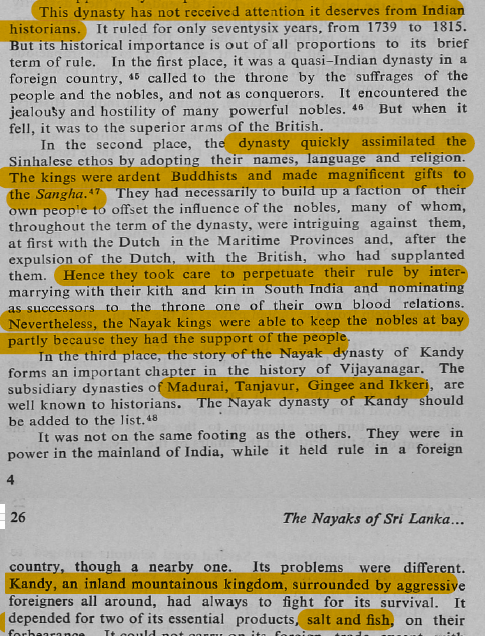
Officially the Telugu Nayak dynasty starts with Sri Vijaya Raajasinha in 1739. In the aftermath of the heroics against the portuguese, this dynasty would follow in its predecessor’s footsteps by becoming ardent Bauddhas. Ironically, many Buddhists retained their portuguese names to this day. Though Hindu in origin, the Telugu Nayaks gave patronage to the sangha and the buddhist clergy.
Narendrasinha was the last Sinhala dynast. Though there is an anecdote that the Madurai Nayak, a staunch Hindu, denied the request for marital alliance, this appears apocryphal. Narendrasinha was succeeded by his brother-in-law Vijaya Rajasinha, who married the daughter of Narenappa, a relative of Bangaru Thirumala Naayaka. [3, 23]
His reign was relatively uneventful. He was succeeded in 1747 CE by Keerthi Raajasinha.
Sri Kirthi Rajasinha
An intractable opponent of the Dutch, Sri Keerthi Raajasinha was a redoubtable king with dreams of full sovereignty. The Dutch had effectively tied a coastal noose around the Kandy kingdom. This was the price for their cooperation against the fanatical, piratical portuguese. It was out of the frying pan and in to the fire.
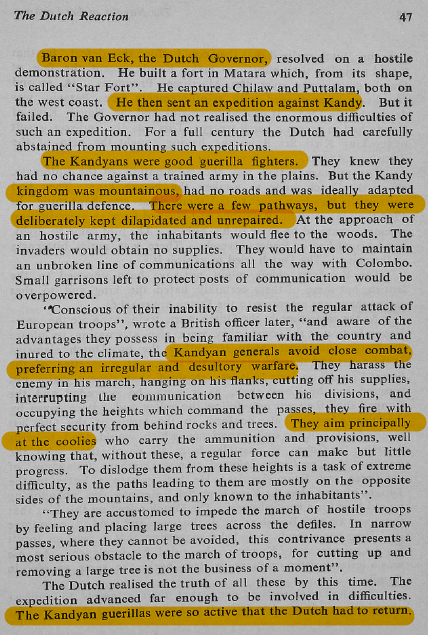 King Keerthi even reached out to the british in 1760. This however failed in 1762. The Dutch tried mollifying the king of Kandy, but war became inevitable. Keerthi succeeded in the first war, and utterly defeated the Dutch in the same year. Stung by the loss, they plotted revenge and struck again with a decisive defeat in 1765 CE followed by harsh terms.
For the next 20 years, it would be a defeated and subordinating peace. From mere caretakers of the maritimes, the Dutch had managed to legally established themselves as formal co-rulers of Lanka, rather than mere merchants-adventurer. Keerthi would stew in silence ’til his passing.
Rajadhi Rajasinha
When the previous king passed, he delayed the succession and appointed Raajadhi Raajasinha as regent. The Telugu Nayaks, to their credit, did everything needed to integrate into Sinhalese life. They learnt the language, became ardent Buddhists, and were even beloved by the masses.[3] The aristocracy, however, fumed at their foreign origin.
While it is true that Sinhala had become its own distinct nation since the days of Vijayabahu, since the days of Devanampiya Tissa, it had become staunchly buddhist and a part of Indic Civilization. As Europeans would show at the Battle of Vienna, even non-nationals of the same civilization can be favoured over complete outsiders to the subcontinent and its littoral. The Sinhalese aristocracy, time and again, did not seem to get that message. They remained as subordinate and subordinated adigars. The First Adigar in precedence was Pilima Talauma. Operating as veritable prime minister, his eye remained fixed on the throne even whilst serving as tutor to the minor-king Kannusami (later Vikrama Raajasinha), who would later have his tutor executed for treason.
For all the active intrigue and diplomacy, Sri Lanka remained in the eye of avaricious foreigners. This was primarily due to 2 reasons: cinnamon and the Bay of Trincomalee.
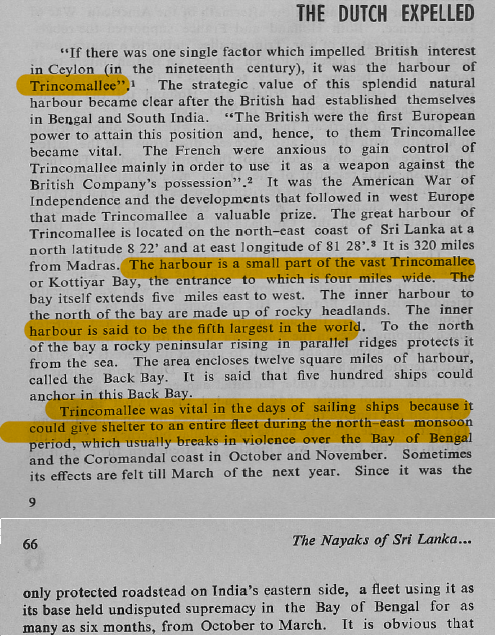 Eventually, Kannusami made it to the throne into majority and immediately prepared to despatch the Dutch. His predecessor suspected the latter plotting to assassinate him from the Maritime Provinces they controlled in Sri Lanka. This policy would continue with the successor.
Vikrama Rajasinha (aka Kannusami)
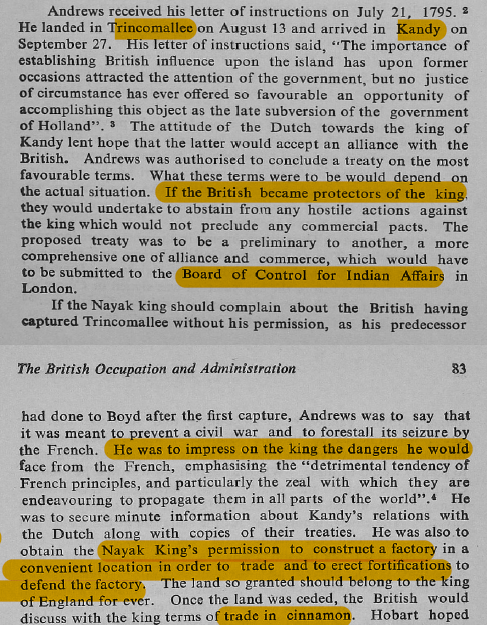 Vikrama Raajasinha, for all his glaring flaws, was a redoubtable king who stood out for his long resistance to both the dutch and the british. He engaged in hectic international diplomacy from the beginning, reaching out to not only european naval powers, but southern Indian powers such as Mysore (usurped by Haider Ali from the Wodeyars) and Tanjore (under new Maraattha management). None came to his aid, forcing him to seek out the French and finally the british.
Indeed, he won the first war against the british, relying on the time-tested guerrilla warfare of his people. He purposefully kept the roads in disrepair for logistic impediment. He lured them into the city, denied them supplies at every turn and then worsted them when they least suspected. He gave no quarter to the foreign invaders—a fact which ironically led to their somewhat lenient terms 10 years later.
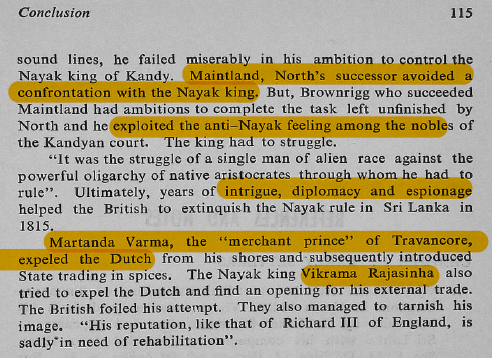
Though british conquest of the island was only a matter of time given their dominance of the Indian southern peninsula by this time, the treacherous sinhalese aristocrats would lead to his rapid downfall in the second war. Divide-et-impera is a time tested policy which occasionally worked even on the Nayak’s dynastic relatives, but the Sinhalese aristocracy proved uniquely inept (or adept at dividing and subdividing their already small island). The fact that they failed to modify policy even in the wake of wanton portuguese cruelty, but somehow had the stones to routinely revolt or betray entire columns of troops to the british only shows why Sinhala’s resistance was middling at best. After more than a decade of dogged resistance, the defeated Vikrama was sent to Vellore by the british.
Legacy
The Nayak kingdom can be credited with its formidable resistance to foreign invasion. They respected the local culture and indeed half-assimilated into it. However, they were everywhere surrounded by assassins (on 1 occasion, even the buddhist clergy was suspected).
The british were (and are) uniquely skilled at flattery to the face and subversion behind the back. They raised defamation, slander, and calumny to an artform and reserved it for their most inveterate foes. In the case of the Maraatthas, it was Tulaji Angre who was slandered by angrezi rumour-mongers. In the case of Sri Lankan fish-mongers, however, Vikrama Raajasinha was the choice target. The violent Vikrama no doubt turned sanguinary at the end, being surrounded by literal conspiracies that were not mere theories but actual truths. Squashing coup plots time and again leads to angry rulers.
Whether or not Vikrama turned tyrannical, it is clear that he was surrounded by threats. The populace that initially loved him later turned on him due to these bloody tactics. Whether the various stories are true or not, he gave the Sri Lankans (whether Sinhala, Tamil, or Telugu) a resistance worthy of remembrance.
Administration
Part of what made Madurai and ostensibly Kandy Nayakdom so effective was the Polgyar (Palayyakarrar) System. Regarding revenue, these lesser aristocrats (Feudal Gentry) would maintain 1/3 to the Nayak, 1/3 for troops, and 1/3 for the Polygar himself. The brave Veerapandya Kattabomman was a polygar himself and fought ’til the bitter end.
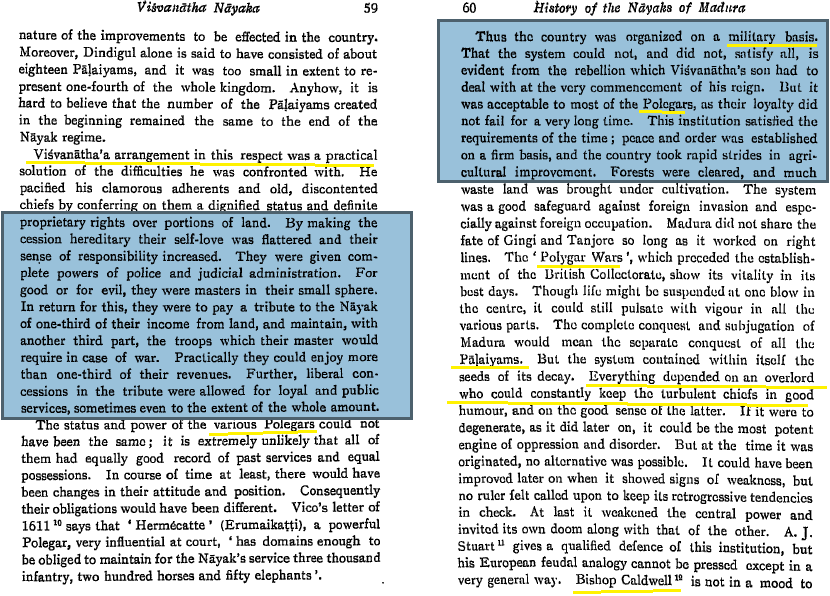
A variation of this was no doubt in function at the Kandy court.
An additional note on Madurai: Contrary to Kautilyan shenanigans in the Arthasaastra, the Pradhani was not a position appropriate for Pandits. Indeed, the story of the original Dalavay (Chief Prefect/Shogun) and his origin is of particular interest.
Kandy is famous among Buddhists today for the Temple of the Tooth. The Kandy Nayaks can be credited with reviving and preserving the Bauddha ways of the island in the wake of baleful colonial influence.
Conclusion
 [3]
[3]
Many European colonial powers have overly large maps showing not only political influence but coastlands that the inland Indian powers never recognised. The advantages of superior sea power and naval tactics aside, not all of this was fake. The portuguese frequently converted fisherman and then claimed them and their villages as subjects & territory of the portuguese king (until an invariable salutary defeat by Madurai cavalry here or Tanjore cavalry there, disabused them of such notions).
Nevertheless, patrolling each an every patch of coastal territory is a tall order for any society, particularly inland powers who are being simultaneously invaded by the most successful cavalry armies on the planet. When this is joined by the most technologically impressive naval powers on the planet, any indigenous inland power is near sunk—especially when both foes field advanced artillery. And yet despite this, not only Vijayanagara, but many of its smaller successor states were successful at not only resisting these colonial powers, but in decisively defeating them.
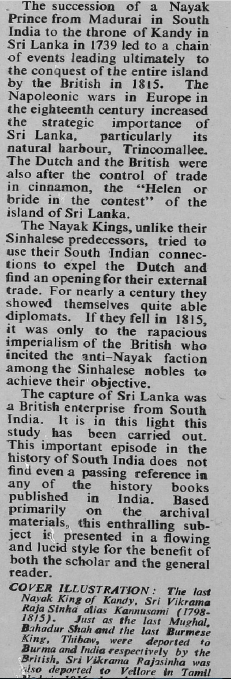
Madurai-tributary Travancore famously defeated and drove the Dutch from India via the Battle of Colachel. What is particularly impressive is that they did this on their own, with no European ally. The Pusapati of Vizianagaram defeated the French via the british (an understandable, albeit, fatal decision). But more fortuitously, after defeating the Dutch in multiple battles, the the Telugu Nayak Kings of Kandy drove them out with their british allies.
The Dutch proved to be less cruel but more greedy and subtle than the portuguese, causing the Nayaks to ally with the brits to eject the Dutch. However, the british proved most cunning of all, and immediately set about subverting Telugu Nayak rule by bribing Sinhala aristocrats to perpetually revolt. This was compounded by an occasional Telugu dynasty pretender seeking to usurp power. In the end, it proved too much even for the redoubtable, albeit violent, last king of the Telugu Nayaks of Kandy.
For all the criticisms of the Madurai Nayaks and their progeny in Kandy, the general opinion of them remains more objective and generous.
References:
- Sharma, R.S. The History of the Vijayanagar Empire. Hampi: Prakasan. 1978
- Aiyar.R., Sathyanatha, Ed. S.Krishnaswami Aiyangar. History of the Nayakas of Madurai. Oxford. 1924
- Gopalakrishnan, S. The Nayaks of Sri Lanka. Madras: New Era Publ. 1988