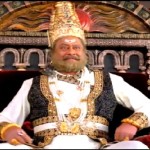
The Kakatiyas stand as a colossus at the centre of the Telugu identity. At once feted as native and unifying, they remains controversial for the competing caste claims that colour the Andhra body politic.
The quandary as to whether the Kakatiyas belong to the Soodhra caste as asserted by historians today, or the Kshathriya varna as evidenced by numerous other records is eclipsed only by the matter of whether they belong to the modern Telugu sub-regions of Telangana or Andhra Pradesh.
We will examine and resolve both questions in this article.
Dynasty
When and how does a dynasty become native or indigenous? This is a question that has plagued Indian history, particularly colonial indologists. Well, the first criterion is whether or not there are roots in the native civilization. The second is whether these lineages then practice the native culture & religion. Next is whether the dynasty identified itself as such. Lastly, there would be questions about whether they were recent transplants or hailed from the region for centuries.
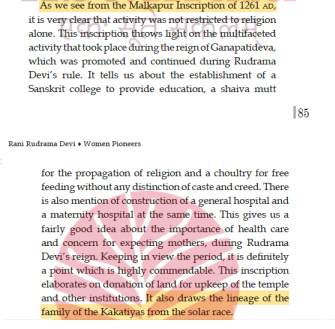
The Kakatiya dynasty met all four factors. In fact, their indigeneity itself was predicated on their alleged inscriptions asserting they hailed from the fourth varna. As we have demonstrated, ACP has remained dedicated to dissolving casteist revisionism of history. This means minimising discussion of caste/kula/samudhaaya, but also clearly clarifying and enunciating the actual caste amidst caste appropriation controversies. We have done so when non-brahmin extraction was appended to obvious brahmins like Palkuriki Somanatha, and when brahmin appropriation of non-brahmin figures like Baddenaalso occurred. We have also seen non-brahmin Rajputsappropriating the Soodhra Mauryas. The Kakatiyas are a curious case of non-brahmin sudra Nayakasappropriating the non-brahmin kshathriya Raaju dynasty called Kakatiyas.
What is the basis for this bold assertion? The Kakatiyas themselves.
Origin
The origin of the Kakatiya dynasty (Kaakatheeya) is traced to Kakati-devi.
“the Telugu work Kridabhiramamu mentions that the images of two goddesses Kakti and Ekavira were set up in the fort of Warangal. Kakati was believed to be one form of Durga.” [3, 59]
It is not known where precisely Kakati-pura was, however there are numerous theories.
Indeed, this is re-iterated by the famous Simhasana Dvatrimsika of King Vikramaditya.
“Guhila was mortified by his father’s words…Unobserved by anyone, he left home that very night and went away to the province of karnata…On the way he passed through the province of Andhra. It was a land enriched by the Kaakati kings with treasures accumulated in their victorious campaigns. Here the Godavari flowed through seven streams into the sea. This river, also called Gautami, the purifier of the world, springs from the matted hair of the god Siva, and forms in this place a holy ford know as Ushna Teertha, or Hot Spring.” [9, 131]
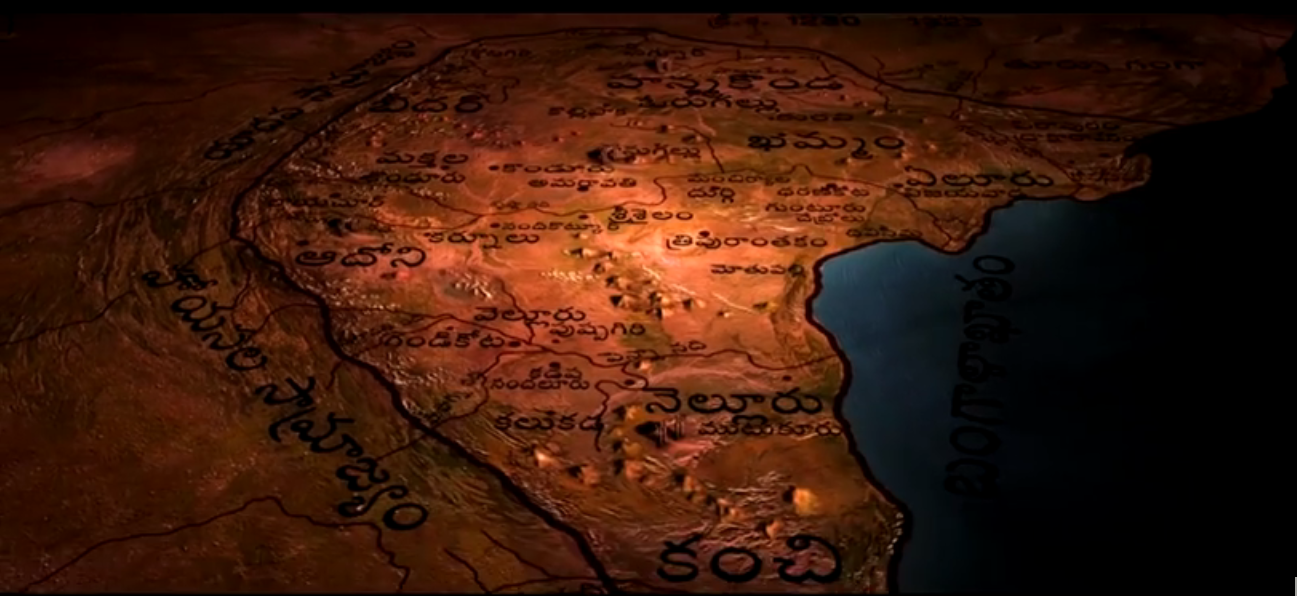
As one can see here, even the early medieval work on Vikramadityaacknowledges that the entire Telugu province was referred to as Andhra. The outset for the Kakatiyas was quite intimidating. It was in this environment that they had to breakout and make headway:
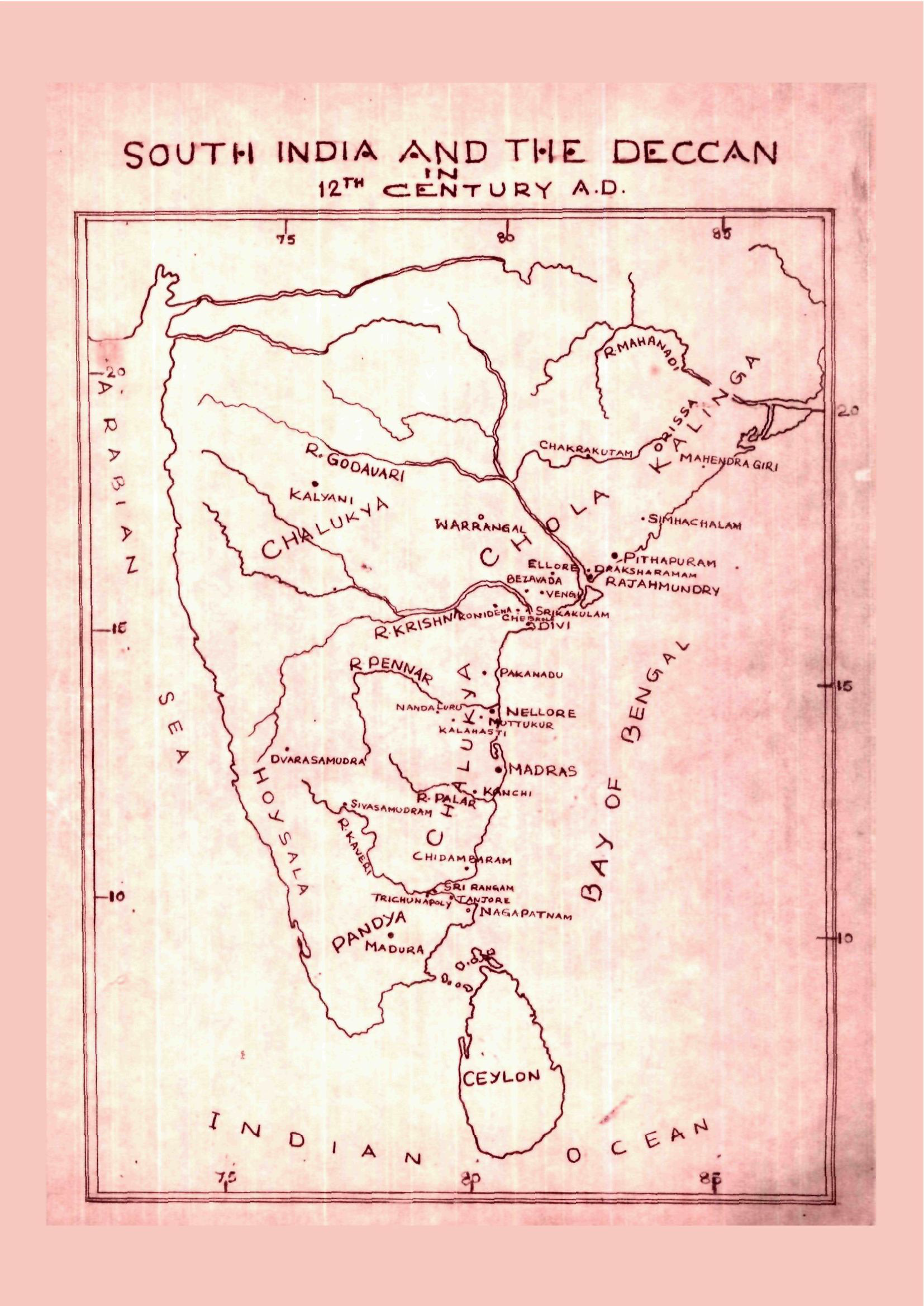
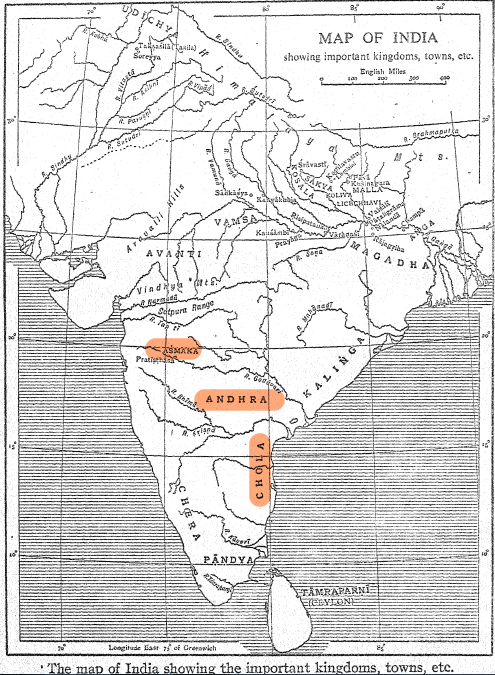
The pan-Telugu state nature of Andhra desa was obvious in this period. The Kakatiyas were, thus, wedged between Maharashtra’s Asmaka desa in the West, and Choladesa to the South.
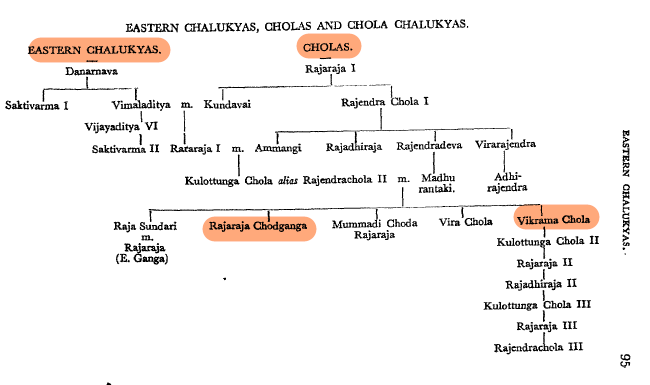
The rise and dominance of the Cholas in Aandhra was inextricably linked with the Eastern Chalukya Dynasty. It is for this reason they are often referred to as the Chalukya Cholas.
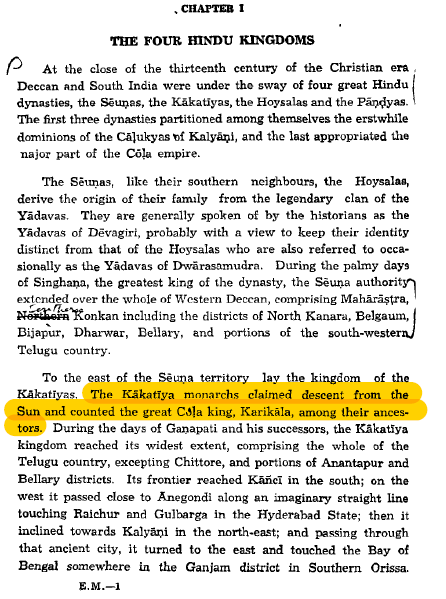
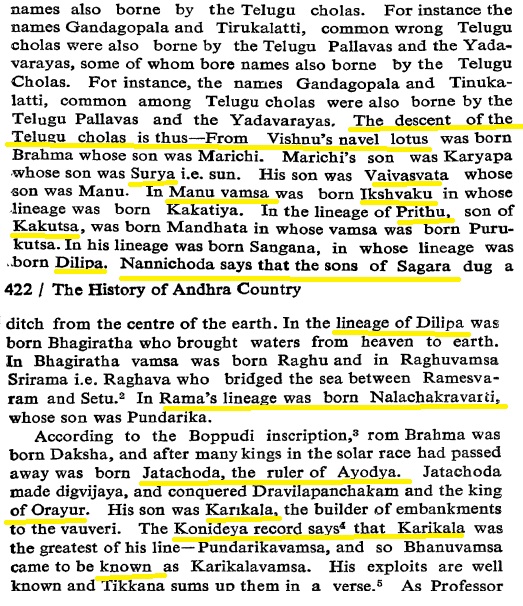
One of the persistent assertions regarding the Kakatiyas is that Durjaya is misunderstood as a tribal ancestor rather than the Chola desa descendant that traditional sources assert he was. Other than stray references, the Kakatiyas have historically been considered a Suryavanshi Kshathriya dynasty, from the Karikala line.
This gothra is maintained today among Aandhra Kshathriya Raajus, and their descendants can be found in Chattisgarh (often caucusing with the Rajput community). One can see that multiple sources attest to the Sooryavamsa Kshathriya origins of the Kakatiya dynasty. Nannechoda himself makes reference to this.
Having resolved the matter of provenance and province, one may now delve into the antecedents and descendants of the grand Kakatiyas.
Vamsa Vrksha (Genealogy)
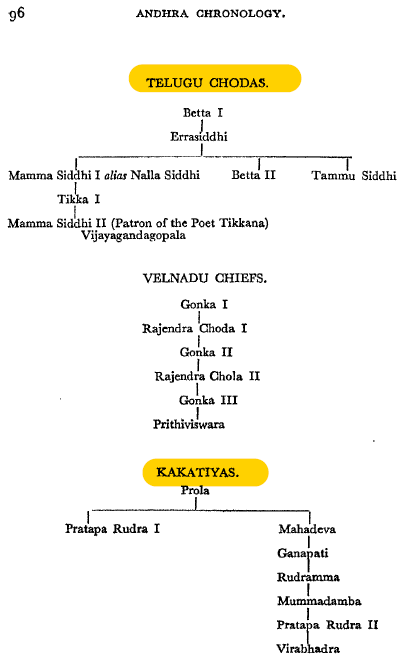
The dynasty of the Kakatiyas is said to commence with various commanders and vassal lords (mahamandeshvaras). The first of this was Venna, and he in turn was followed by Gunda I, Gunda II, and Gunda III.
“Gunda III was a contemporary of the Rashtrakuta ruler Krishna II and assisted him in his Vengi campaign. He was killed at the battle of Niravadyapura (Nidadavolu) by Irimarti Ganda, younger son of Chalukya Bhima….sometime between A.D.890 and 900.” [3, 59]
However, starting with Erra, the family attained the status of feudatory rulers (rauta). The Rashtrakutas elevated them to the rulership of Koravi (in Khamma district) and Manukota (Mahbubabad). [3, 59]
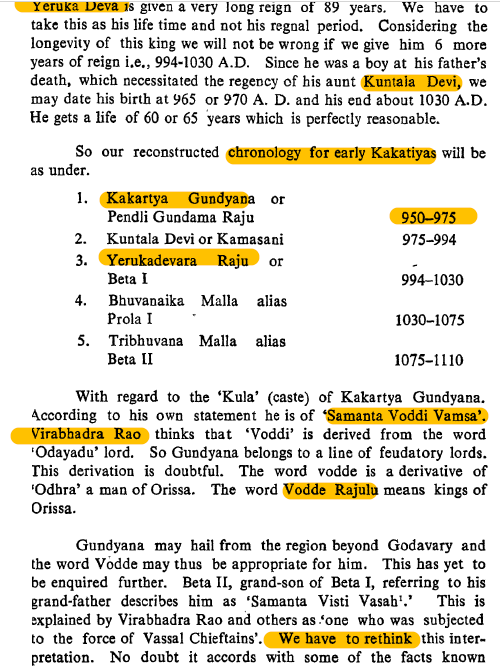
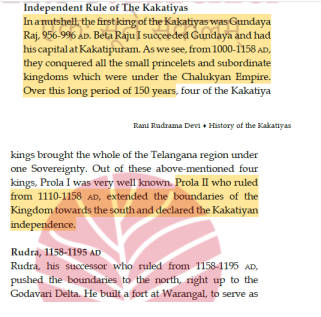
Erra was then followed by Beta, though little is known about this ruler. He would be succeeded by Gunda IV, also known as Pindi Gunda, or Kakastya Gunda. He was the feudal king of Koravi in the year 950 CE. Due to the civil war in the Eastern Chalukya kingdom, this Kakatiya would feature in it and render valuable assistance to Danarnava, who mentions him in the Mangalla edict of 956 CE. However, one Chalukya upheaval begat another, and the Western Chalukya dynasty now overthrew the Rashtrakuta overlords of the Eastern one. With that, Gunda IV declared his independence, and the Kakatiyas came in to their own right ~973 CE. [3, 60]
However, fortune did not favour him, and he was slain in battle against the Chalukyas. His son Garuda Beta (Beta II, more commonly referred to as Beta I) succeeded him, but was in a pitiable position. His relative, Viriyala Erra, had a wife (Kamavasani) who championed his cause at the Western Chalukya court, securing for him the Anumakonda visaya. It was from here that the Kakatiyas would rebuild their eyrie from which they would long defy their challengers during the middle ages.
Garuda Beta acknowledged the suzerainty of the Western Chalukyas in 1000 CE and set about reviving the dynasty from disaster. He ruled from 1000-1052. With his general, Recherla Brahma, he attacked the Chola capital of Kanchi. His deeds are recorded only in the Sanigaram inscription of 1051 CE.
Beta’s son Prola I succeeded him, and is the first to issue independent coinage. This would set the stage for the eventual surge of the Kings of Anumakonda. [3, 61]
Grand Kakatiyas
The question as to whether or not a polity is a kingdom or an empire is one that remains debated on social media. Every rinky-dinky raajya seeks to be aggrandised to empire, and every enemy of an empire seeks to minimise it to a mere kingdom or even tribal collection. Consistency, nevertheless, remains crucial to classification. At the time of their reign, the Kakatiyas abutted the larger Seuna Yadava kingdom of Maharashtra, the comparable Hoysalas of Karnataka, and the smaller Pandyas of Tamil Nadu. As a result, referring to the Kakatiyas of this era as Imperial or their polity as an empire is not exactly proportionate.
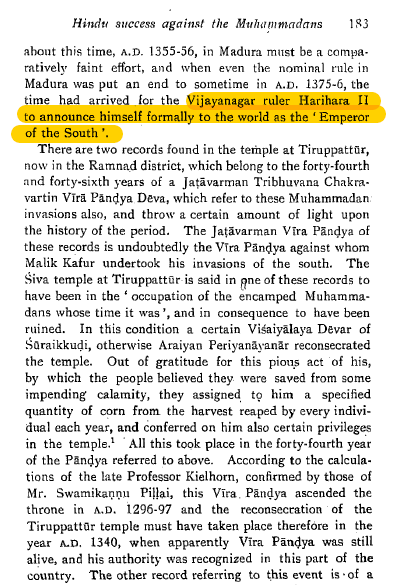
An empire typically rules/ruled over multiple countries (3 or more desas), with numerous sub-ethnicities/tribes under its sceptre. In the subcontinental context, a Pan-India domain is the most logical start for this sobriquet. One may expand this beyond, but also minimise it to control of one cardinal direction. Indeed, Vijayanagara emperors were referred to as ‘Lords of the South’, making their natural rivals, Odia Gajapathis, as ‘Lords of the East’. As mentioned recently, the North-South divide is primarily of post-medieval & modern-making. There were not 2 Indies, but 5 Indies (Uttara, Dakshina, Poorva, Paschima, & Madhyadesa). Thus, rulership of 1 or more of theseIndies is the natural benchmark before branding a king an emperor.
Although the Kakatiyas did have vassal kings/sub-kings and did rule over the entire Aandhra country, that itself does not an empire make. They themselves are typically referred to as Bhupala (protector of the Earth) and not (Samraat/Samraaja). However, they were not a small kingdom either, so they were not merely Raajas, but Maharaajas. Thus, true to the modern atelier, the term Grand Kakatiya is best attested to the sovereign rulers of Andhra desa who threw off the yoke of their erstwhile imperial suzerains, the Western Chalukyas.
Regardless of technicalities, these sovereigns certainly were imperialists, in the sense that they actively aspired to aggrandise their holdings and advance through the ranks of sovereignty.
Prola
Beta
Durga
Prola II
Rudradeva
Mahadeva
Ganapathi Deva
Rudrama Devi/Rudra Deva II
Prataparudra Deva
Virabhadra (s/o of Prataparudra))
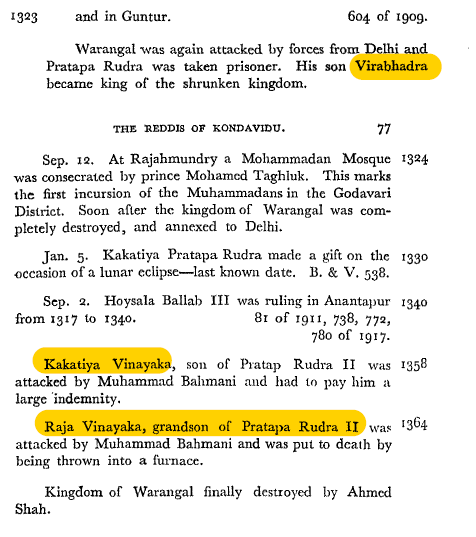
Vinayaka Deva (grandson of Prataparudra.Kaakatheeya Dynasty ends in 1364)
Prola I
The dynasty proper is said to commence with Prola. His exploits included loyally serving alongside his liege-lord, Somesvara I Trailokyamalla against the Nagas of Chakrakota and Silharas. Satisfied with this service, “Someswara I made permanent the grant of Anumakonda visaya to the Kakatiyas. He allowed Prola I to issue independent coinage” and permitted him to expand the fief to Vemulawada, Gunasagaram and Kadparti. Prola I took the title Arigaja Kesari and developed numerous irrigation tanks, such as the eponymous one at Kesamudram. [3, 61]
Beta
Prola was succeeded by Beta III (dubbed Beta II). He would rule from 1076 to 1108 CE, and his inscriptions would be found from Anumakonda to Kazipet. He assisted Vikramaditya VI in the Western Chalukya Civil War, and was rewarded with Sabbimandalam (Karimnagar) and Mudigonda (Khamam). Interestingly, Paramara Jaggadeva was feudatory of the Chalukyas, and contested the gifting of his region (Sabbimandalam) to the Kakatiyas. Beta nevertheless beat back the attack by the Paramaras.
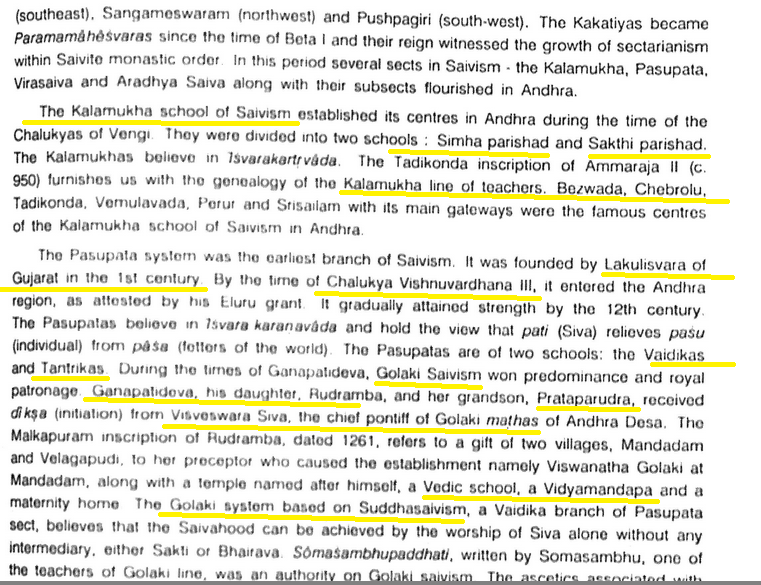
He is considered the first of the Kakatiyas to formally initiate as a Paasupatha Saiva, under Rameshvara Panditha, a Kalamukha from Srisailam. As a result, he constructed the Siva temple of Anumakonda as well as the suburb of Sivapuri, adjacent to it. [3, 62]
Durga
Among the lesser known rulers, Durga was the eldest son of Beta. He was crowned in 1108 and ruled for only 6 years. He augmented the grants to Rameshvara Panditha. Durga did help administer the kingdom as Yuvaraaja, taking the title Chalamartiganda (title of the Velanati Cholas). His reign ended in unclear circumstances and he was replaced by his brother Prola II.
Prola II
The Second Prola ruled from 1116-1157. He pressed his claims over Durga’s son, though invariably granting him asylum. In the subsequent civil war at Kalyani, Prola II vouchsafed the rightful successor of Vikramaditya, named Someshvara III. Despite support from Manthrakoota (Manthena), the rebel prince Tailapa was defeated with Prola II’s help at Kandooru. In maintaining his loyalty to Somesvara III and his successor Jagadekamalla II, Prola II gained the Western Chalukya’s favour. This would help the Kakatiya’s gain strength and consolidate.
Prola II married Muppamamba, sister of Durgaraja of Natavadi. His 5 sons were Rudradeva, Mahadeva, Harihara, Ganapati and Durgaraja. He died in battle fighting Chodayaraja of the Kota vamsa. [3, 63]
Rudra Deva I
After Prola II came Rudra Deva I, also called Prataparudra I, in 1158. As the eldest son, he ruled for 37 years, and declared himself fully independent of any suzerain. He drove out the remaining non-Telugu rulers of Andhra desa and prioritised its unification. He defeated Tailapa III, when there was a Chalukya attempt to reclaim Andhra.
The subsequent civil war in the Chalukya empire, which included a 3rd claimant on the part of Kalachuri Bijjala Deva, furthered the ambitions of Rudra Deva. Nevertheless, the former did instigate the feudatory Medaraja against the latter. An army was sent with Bijjala’s son Maitangi, resulting in a dual threat against Rudra. He managed to defeat this formidable combination, though Medaraja did not agree to the terms imposed. Another battle was fought, but he was defeated and escaped into the jungles across Godavari. Polavasa town was taken, and Rudradeva’s minister Vellaki Gangadharam was placed as vassal-ruler of the town.
Rudradeva then drove Bijjala all the way back to Kalyanakataka itself. However, his goal was the unification of Andhra only, and the Karnata attempt to reimpose itself on Andhra was put paid. Rudradeva then rounded out his conquests incorporating modern Zaheerabad, Nalgonda (Kandooru), and Mahboobnagar (Palamooru). The Telugu Choda Bheema was then evicted from Vardhamanapura, and Kandooru added to the Kakatiya domain. At Panagal, Udaya Choda gave his daughter Padmavati as part of a marital alliance to Rudradeva. The irrigation tank at Panagallu called Rudrasamudram commemorates this. Rayalaseema was also added. [3, 65]
At the invitation of princedoms and petty kingdoms of Coastal Andhra, Kakatiya Rudra began annexing and subordinating large parts of it. Dharanikota’s ruler was made vassal, and Nadendla added also. This ultimately reduced the power of the Velanadu Chodas.
However, the most significant event, no doubt, was the Palnati Yuddham. Rudra I intervened at the behest of Nalagama, and his armies assisted Nayakuralu. This further weakend the position of the Velanadu Chodas.
At this point the aging Rudradeva had to face politics further west. Though his wife Annaladevi made an inscription at Draksarama in 1168, it is not clear whether he could fully incorporate it. The Western Chalukyas attempted to return, but were vivisected by the Seunas in the North and the Hoysalas in the South. Seuna Jaitugi then took advantage of Rudradeva’s involvement in Coastal Andhra politics to then invade from the west. Rudradeva fell fighting this invasion, and he was succeeded by his brother Mahadeva. [3, 66]
“Rudradeva was a multifaced personality–a warrior statesman and a patron of art and literature. Through his skill in arms he was able to repulse the attacks of Bijjala, Jaitugi and suppressed the numerous feudatories in Telangana and Guntur. He was a statesman of high order and correctly analysed the political situation of the time”. [2, 67]
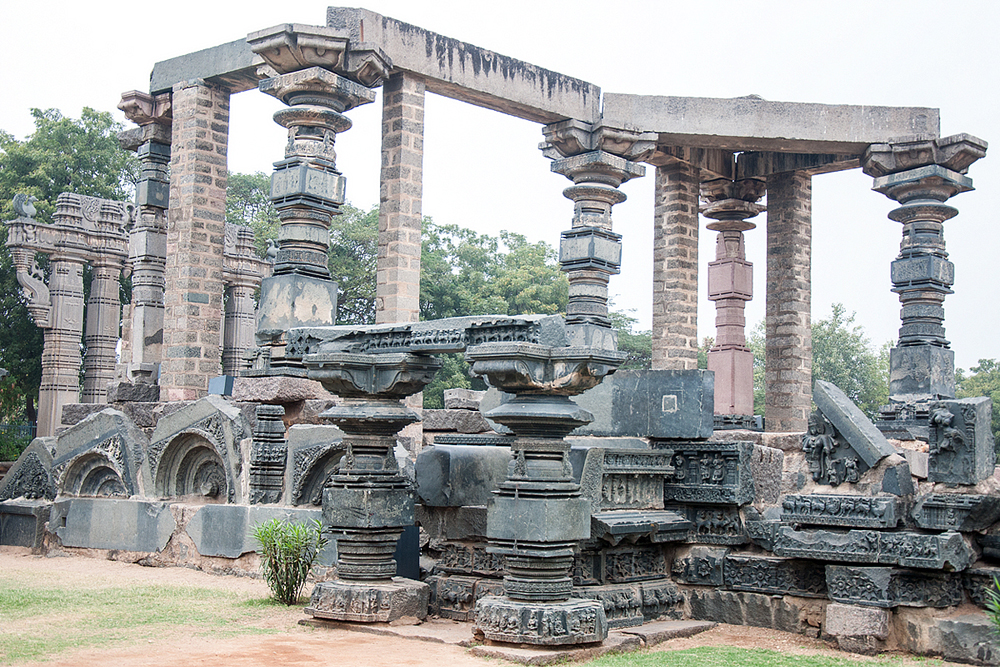
Kakatiya Rudra I was a supporter of art and literature and oversaw the construction of the Rudreshvara temple (1000 pillar) at Anumakonda. Notably, it is he who is credited with shifting the capital from Anumakonda to the famed Warangal (Ekasilanagara). The fort therein and the suburb of Panukantivaada are stated to be his contributions. He gave patronage to the aforementioned Palkuriki Somanath and authored the sanskrit work Nitisara. [3, 67]
Mahadeva
Mahadeva was certainly overshadowed by the achievements of his illustrious elder brother. He nevertheless sought to make a name for himself by investing the formidable fortress-capital of the Seunas–Devagiri.
Unfortunately for Mahadeva, this endeavour ended with his demise. His son Ganapati Deva, who had been taken hostage following Rudradeva I’s defeat, was released in the Seuna hopes of pacifying the Maharashtra-Andhra frontier. [3, 67]
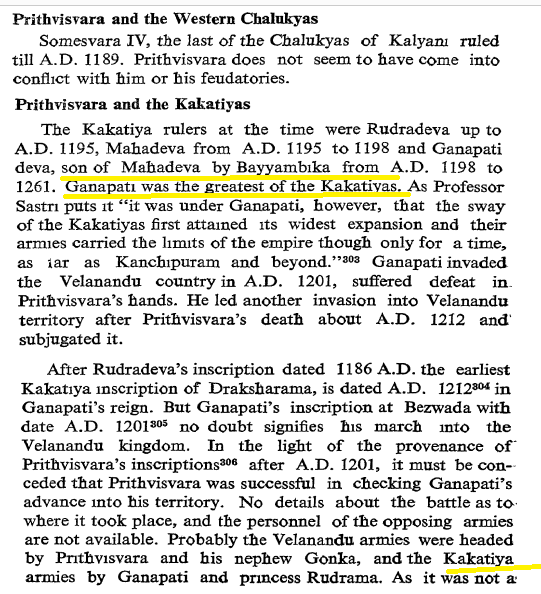
Ganapathi Deva stands as the highpoint of the polity. He was the great unifier of the Andhras, long divided since the days of the Satavahanas. Released by the Seunas Yadavas after the fall of Mahadeva, this next Kakatiya ruled from 1199-1262 CE. [3, 67]
Ganapathi Deva was the son of Mahadeva and Bayyambika.
Raja Mahadeva’s son Prince Ganapati accompanied his father on campaign to the Seuna Yadava kingdom of Maharashtra. When the King was killed outside the walls of Devagiri (later Daulatabad), the Prince was captured and held prisoner. The effect on the Kakatiya Kingdom was chaos, as feudatories declared independence and the government became rudderless. However, the loyal general Recherla Rudra crushed the revolts and ruled as regent until Ganapati Deva was released in 1202.
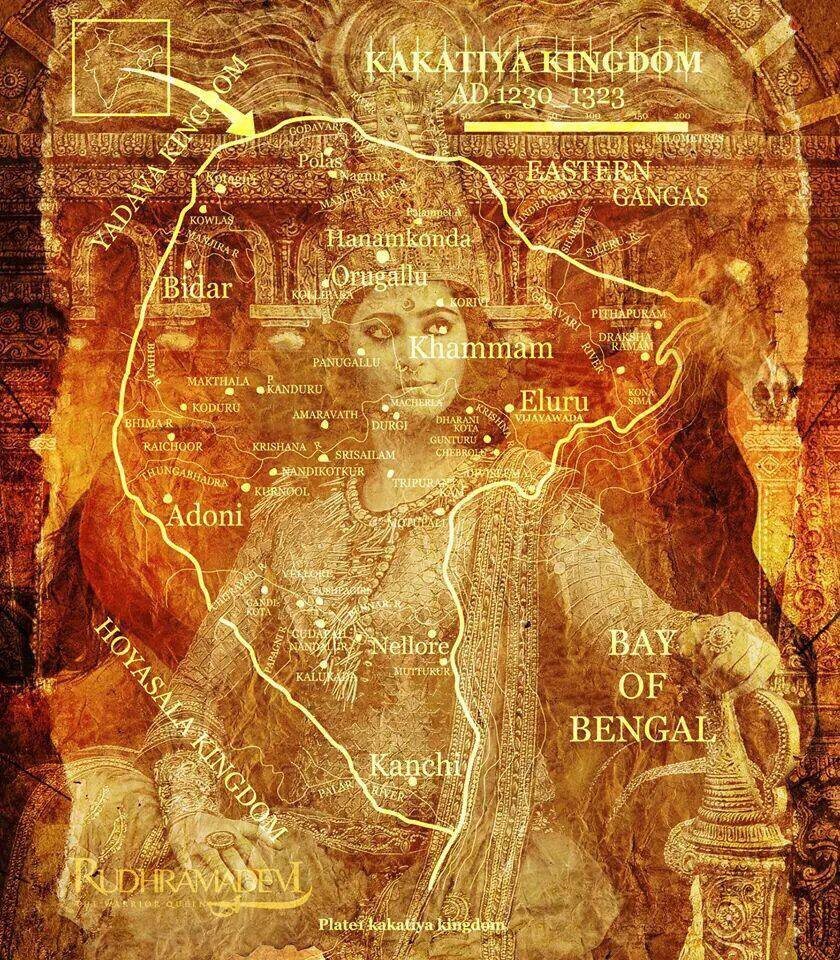
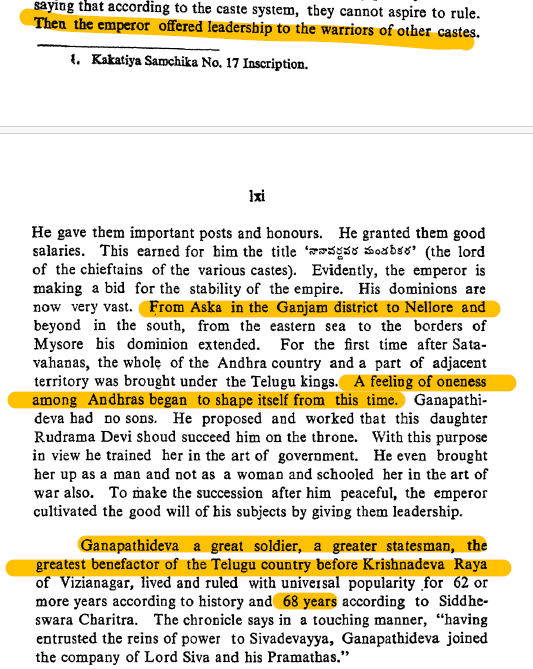
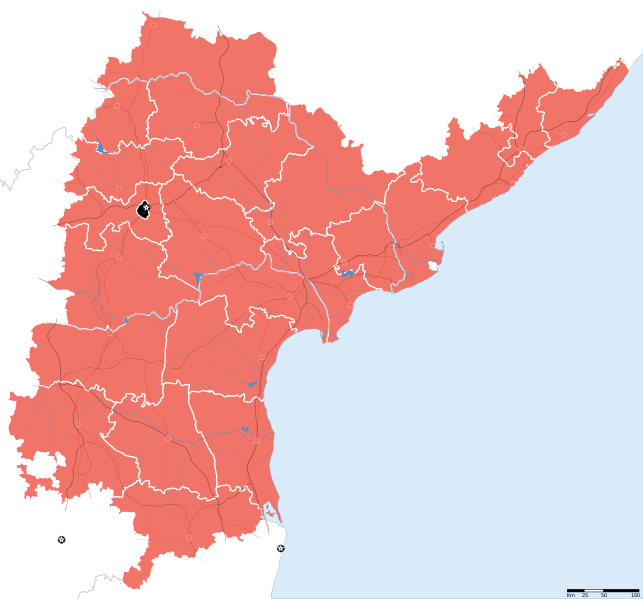
With respect to the military domain, he extended Kakatiya rule from Telangana to all of united Andhra Pradesh reaching as far as Chintamani in Karnataka’s Kolar District and Asika in Odisha’s Ganjam District.
Ganapati Deva re-asserted control over Velanadu and Diviseema. He reduced the Telugu Cholas of Konidena and the princes of Addanki to submission. His armies then defeated the Kalingas and annexed Vengi. Other localities in Odisha and Bastar are reputed to have come under his control due to the exploits of his lieutenants. His armies marched as far as Aska (Berhampur). [3, 69]
His greatest achievement was the conquest of Nellore (in 1228 CE) after a famous battle. In a spectacular victory over the combined forces of the Cholas, Seunas, & Karnatas, Ganapati Deva convincingly demonstrated Kakatiya power and restored the dynasty’s prestige—taking it to new heights.
Ganapati Deva is generally credited with expanding it as fortress capital and Rudramba for completing it. Indeed, the artistry of the city’s architecture shows a balance of the granite masculinity of the walls with the artistic sensibility of a woman. 77 Nayaks commanded 77 towers in defense of the capital of the Telugus. The main fort had 45 towers and was spread out over 19 kms.
Nellore
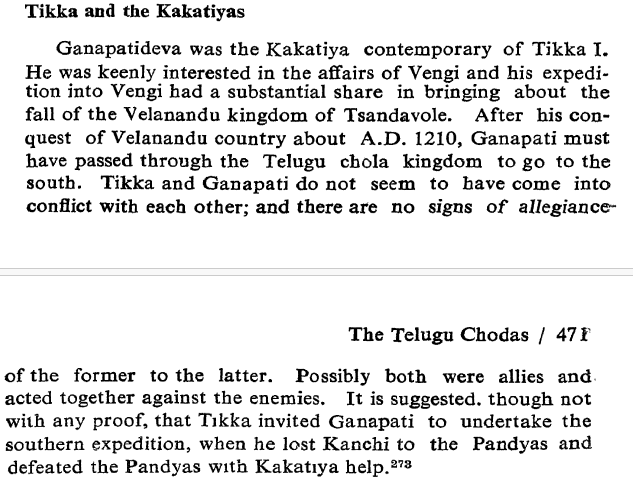
Tikka I is prominent for the early interaction with Ganapathi Deva Kakatiya. He retained his independence in this era, and though there was no allegiance as of yet, there remained the stirrings of an alliance.
While Allutikka would later declare independence, Manumasiddha III would feature as feudatory to Ganapathi Bhupala of the Kakatiya Great Kingdom. Notably, Tikkana Somayaji would feature as the ambassador to the Court of Warangal, on behalf of the ruling Nellore Chola.
Kakatiya Ganapati Deva’s only major loss came against the Pandyas. The aged King’s forces were defeated at Kanchi. Before he could make another attempt to wipe out the stain of defeat he passed away.
Before his samadhi, however, in an innovative move, he anointed his daughter Rudramadevi as successor. Through a Vedic ceremony (Putrika) she was given the status of a male, Rudramba became Queen-regnant, and her husband Chalukya Veerabhadra, Prince-Consort. Interestingly, both of Ganapati Deva’s daughters would be ruling Queens, Rudramba and Ganapamba. [3, 70]
Ganapathi Deva had marital ties with Kota, Kolanu/Induluruis, Gudimetlas, and Natavadis. He himself married Naramamba and Peramamba, princess of the Pinochoda Diviseema line. Their brother was Jayapa Senani, initially governor of Diviseema. Ganapathi’s sister Melamba was married to Rudraraja of Madhira. And Chalukya Veerabhadra was the son of Vengi Chalukya ruler Indusekhara of Niravadhyapuri.
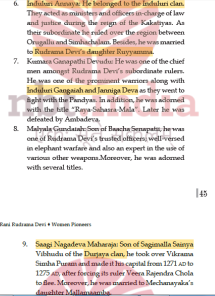
Kakatiya Ganapati Deva was undoubtedly the greatest of his line. He unified all of Andhra, established the Abhaya Saasana (guaranteeing port safety & ending key customs duties). Gangaya Sahini ( a Kayastha) was his Chief of Cavalry, Jaya Senapathi (Durjaya Chola) his Chief of Elephantry, and Recherla Rudra dubbed Kakatirajya Sthaapanacharya (for his regency). The first clear elevation of the sat-sudra naayaka castes was apparent in his time, with reverberations in the revolutions and liberation wars to follow. [3, 70] Ramappa, Ghanapuram, Parakala are all irrigation tanks credited to him.
Despite his greatness, Ganapati Deva made some administrative changes that one would deem highly contrary to Varnashrama Dharma, with repercussions to even today’s body politic:
“Ganapatideva was the greatest ruler of the Kakatiya dynasty. ..Till his time the village accountants (karnams) belonged to the Viswa Brahmins (goldsmith) caste. As they used to interfere in religious and political disputes Ganapatideva removed them and appointed brahmins in their place. The brahmins so appointed came to be known as Niyogi brahmins. Till recently the Niyogi brahmins functioned as karnams in most of the Andhra villages, especially in the coastal region.” [3, 70]
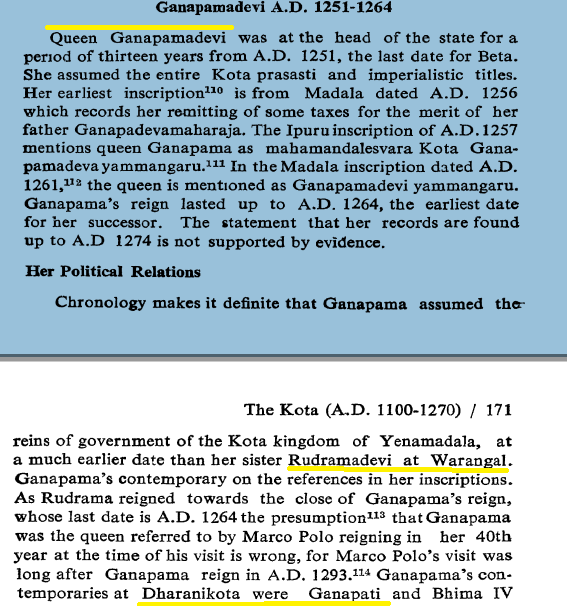
Rudrama Devi’s rule from 1262-1289 C.E. is replete with a litany of accomplishments.
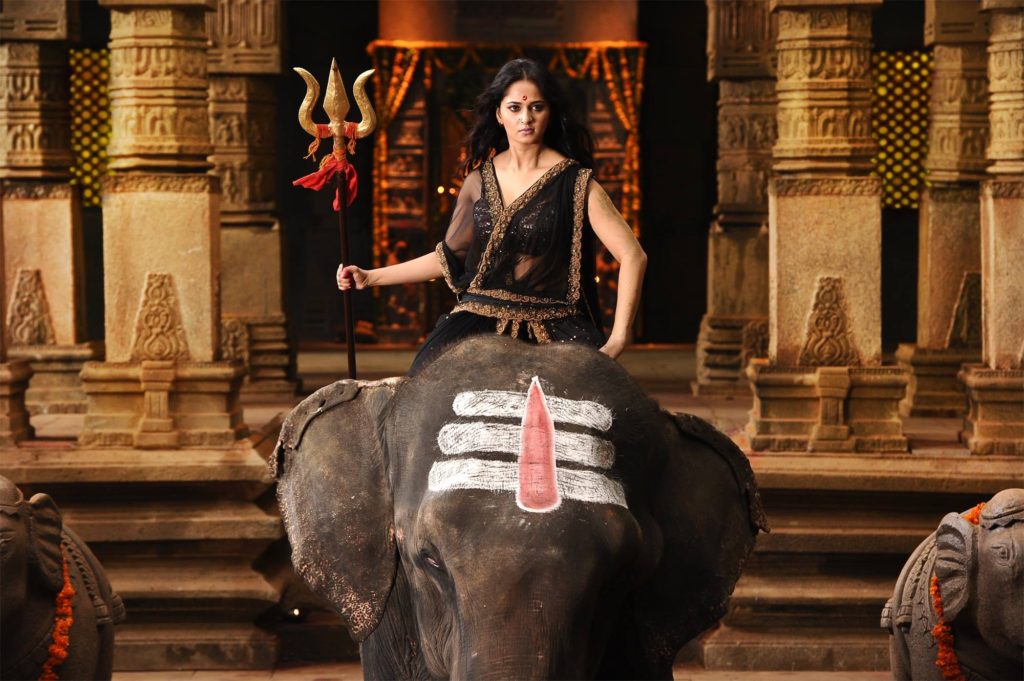
Born Princess Rudramba to King Ganapati Deva, she was the first and only ruling Queen of the Kakatiya dynasty and one of united Andhra’s greatest rulers.
Per Rudrama Devi inscriptions, Ganapati Deva’s only defeat at Battle of Muttukur. Though invasion tide by Sundara Pandya was stopped, territory in Tamil Nadu was lost, and Great Kingdom was shaken. Regardless, the redoubtable Queen soon consolidated her rule.
While there was originally a mutiny in the ranks of some of her nobles, her loyal generals were able to rally around her and secure her claim against the rebellious Murari and Harihara Deva. These loyalists include Janniga, Prasaditya, and Malyala Ganda. Later, the famous Gona Gana became an effective lieutenant as well.
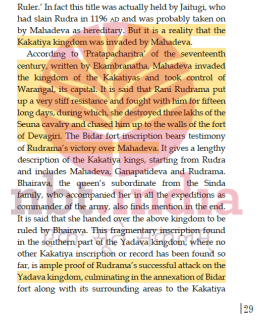
The first of them was tackling the bitter rivals of the Kakatiyas, the Yadavas of Devagiri. Their king Mahadeva had a casus belli in the sheltering of his co-claimant to the throne, Prince Samrapani, who had been made a governor of the Kakatiya kingdom’s many fiefs. The Seuna (Yadava) king declared war and attacked Kakatiya territory, eventually laying siege to Warangal itself. The courageous Rudrama Devi sallied forth from her citadel and routed the Yadavas. She eventually chased them back to Mahadeva’s territory. Bidar (Bedadakota) was annexed.
Next, the Queen had to face off against the Ganga ruler of Odisha, Bhanudeva I. The Odias had taken advantage of Kakatiya troubles to march on Vengi. Rudramba sent Kakatiya forces under Pathi and Proli Nayaka, who inflicted a defeat on the invaders.
The rebel Amba Deva cleverly schemed against Rudrama Devi by establishing friendly political relations with the rival Yadava and Pandya dynasties. He then isolated the loyal Kakatiya vassal Ganapati and removed him from Nellore as well as another Ganapati (Sripati) from Gurajala, annexing the latter to his rebel kingdom.
The indomitable Rudrama Devi could not brook such defiance and, despite her advanced years, personally led the expedition against him. Tragically, both she and her general Mallikarjuna Nayaka lost their lives in this disastrous prong of the campaign against Amba Deva. Nevertheless, true to the spirit of this great Queen of Andhra, she attained a glorious death in battle, worthy of every true Kshatriya/Kshatrani.
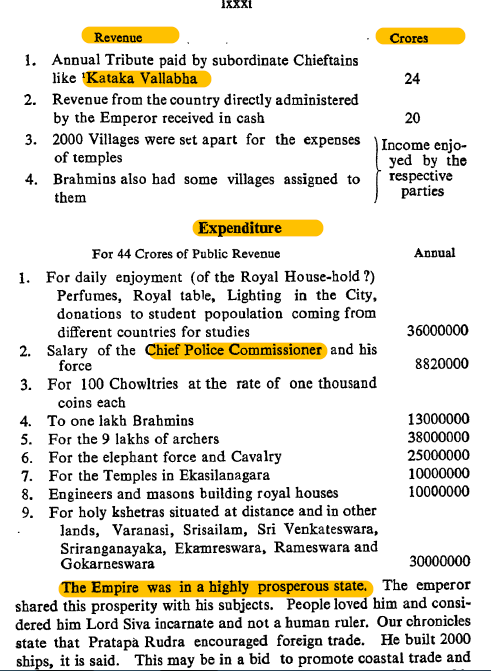
She was a brilliant administrator, noble ruler, and warrior Queen. After her victory over the Yadavas, she took the title Rajagaja kesari (which had also been held by her illustrious father). Visitors such as Marco Polo spoke of her enlightened rule, happy subjects, and palace’s splendor. Though being groomed for military exploits and statecraft, Rudramba is not remembered as a patron of the arts, the unique Kakatiya style of sculpture is nevertheless traced to her reign.
Like her father, Rudrama Devi also had only her daughters, but towards the end of her rule, her grandson, the famous Prataparudra II, was ready to take over the reigns of power. The son of Rudrama’s youngest daughter and the minister-noble Induluri Annaya, the Andhra Pratap had been groomed to become a capable warrior-general and King.
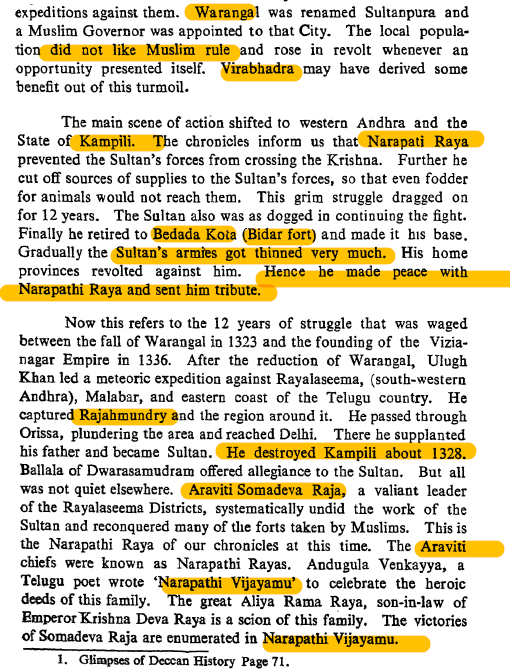
The best known of all the Kakatiyas, Prataparudra II is also controversially considered its last. In many ways, he was also the most heroic, having to face off against the mighty Delhi Turkics, who had by now taken all of Northern India, save Odisha. From Warangal, he would long defy the sulthaans.
Though the Kakatiyas trace their origin and rise to the modern Telangana region, Prataparudra called himself Andhradesadeeswara, as he viewed himself as the protector of India’s historic Andhra region (which included modern TS state).
In fact, historically, the word Andhra traditionally meant Telugu, and the lord of the Telugu land put up a spirited defense against the alien Turks.
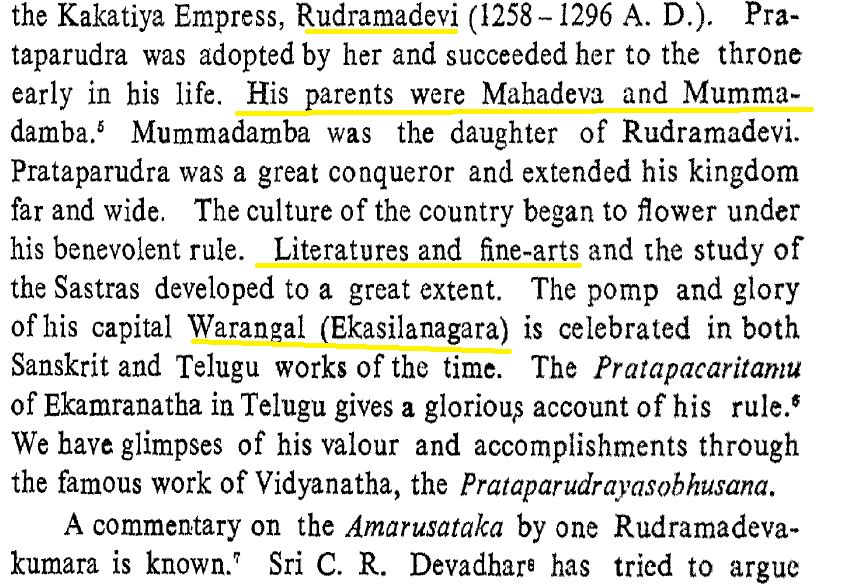
The son of Queen Rudramba’s daughter, Mummadi devi & the Kakatiya nobleman Mahadeva, Pratapa Rudra Deva II ascended the throne in 1289 following Rudrama Devi’s glorious battlefield death against the rebel Ambadeva.
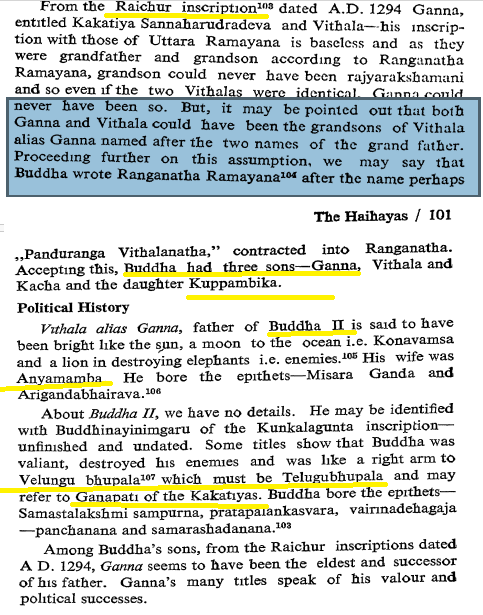
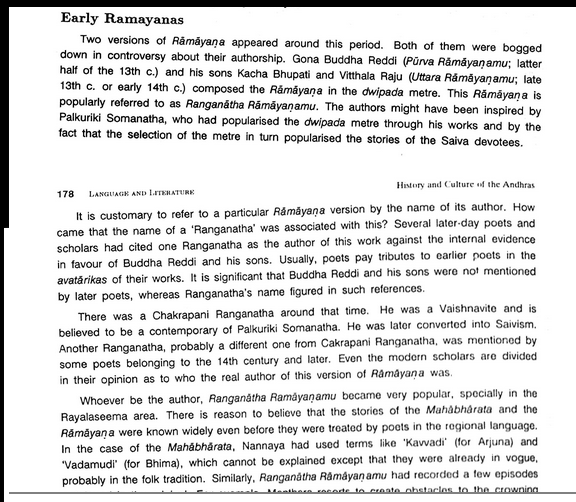
Aided by the neighboring Seuna and Pandya kingdoms, Amba Deva continued to defy Kakatiya power in southwestern Andhra. With a three pronged attack, Prataparudra surrounded the rebel and brought him to justice. His lieutenant Gona Gannayya (son of Gona Buddha of Ranganatha Ramayana fame) took the forts at Adoni, Tumbalam, Raichur, Mamuva, and Haluva. Indeed, the entire Raichur-doab, which would later feature centrally in the Vijayanagara-Bahmani Wars, came under the Kakatiyas.
Following this, King Prataparudra engaged in a series of administrative reforms. He promoted a number of Padmanayakas to Nayak status, and they would play a role in the fates of the Telugus in the centuries to come.
First Delhi-Kakatiya War
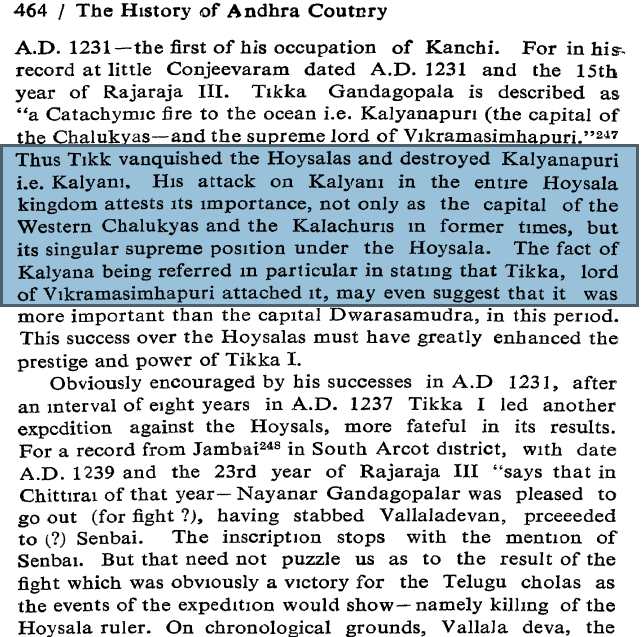
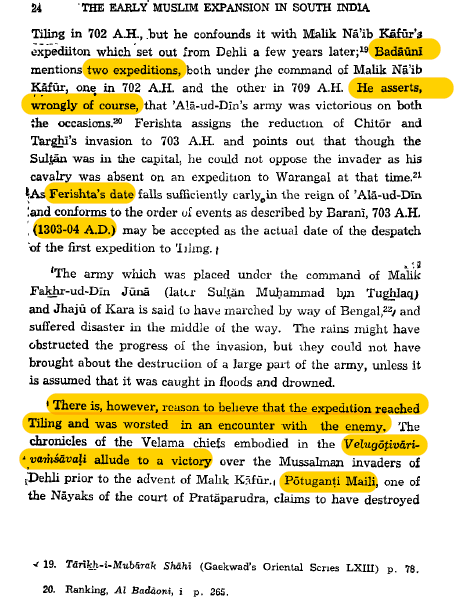
Alauddin Khilji’s unauthorised humbling of the Seunas of Devagiri in 1296 had been done half through stealth and half through trickery (he passed himself off as a horse trader, and his 12,000 cavalry army as ‘product for sale’, which laid siege to the unprepared capital-fort by surprise). However, Khilji sent an army in full force against the Kakatiyas, and it tasted Telugu steel first hand, being worsted in 1303.
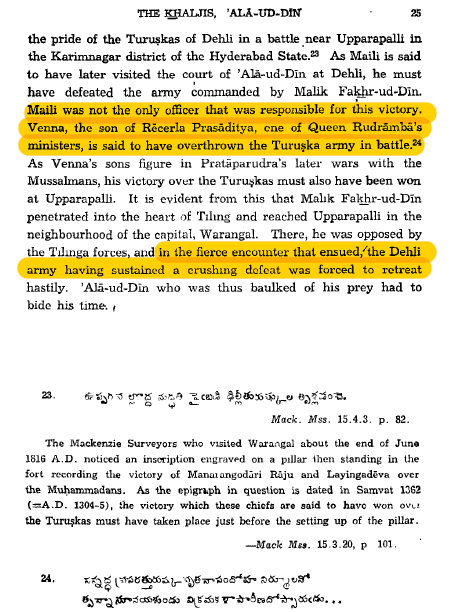
Under the command of Jauna Khan (the future Sultan Mohd. bin Tughluq), Khilji’s soldiers advanced into the Kakatiya kingdom via backroad routes in Odisha. The Turk army of Delhi was completely defeated by Prataparudra’s forces (led by his generals Venna and Maili) at the Battle of Upparapalli(Karimnagar district, Telangana State). It is said that Prataparudra had been giving refuge to the dethroned, and tragically ill-lucked Chaulukya King of Gujarat–demonstrating the solidarity of India’s Dharmic Kings.
Second Delhi-Kakatiya War
The stupidity of the Seuna ironically named Ramachandra led to Devagiri’s co-option by Delhi. This Yadava king of Maharashtra generously aided Khilji, who was eager to remove the ignominious blot of his prior defeat to Prataparudra, in his second war against the Kings of Andhra. Some accounts call this the 3rd, recording another defeat of Turkics in 1304. Nevertheless, in 1309, another attempt was made.
Due to the infamous Turk advantage in cavalry, reputed to be 100,000 horse against the Telugu 20,000, the Kakatiya king fought a defensive war. The outer wall of Warangal was so strong that balls from catapults would bounce off of it. The defenders of Andhranagari pummeled the Delhi invaders with stones, arrows, daggers, and naptha. This relentless assault from the front was compounded by cavalry attacks from the side and rear, led by the valiant Vinayaka deva and assisted by the loyal Telugu nayaks. A frustrated Turkic army then began to commit atrocities in the vicinity.
Appalled and distraught at such wanton cruelty contravening the laws of civilized warfare (and faced with a difficult, increasingly crowded situation in the keep), Prataparudra requested peace terms, and was compelled to part with the bulk of his treasure, including the legendary Kohinoor diamond (mined in Golconda). Perhaps he deemed being a nominal tributary a necessary evil to prevent further misery from being inflicted on his subjects.
Third Delhi-Kakatiya War
At the first opportunity , the Kakatiya King ceased payments and rebelled against Delhi in 1316. The 3rd expedition to Warangal was led by Khusrau Khan (a Hindu convert-slave general—like Kafur—who would himself later lead a short-lived coup against the Turks) in 1318. Lesser known and difficult routes were used to catch Prataparudra unprepared, as he was campaigning to restore his authority in southern Andhra. Not much is known beyond the unreliable accounts of central asian Chroniclers, but he apparently deemed it prudent to accept terms and resume making payments.
Fourth Delhi-Kakatiya War
The Fourth War was a testament to the valor of Prataparudra and the furious resistance against a foe that outmatched him in size. He again ceased payments and asserted his independence in 1320, leading to invasion in 1321-22.
The Telugus led repeated cavalry raids against the circumvallating Turk forces. This battle of attrition continued for 6-8 months, with the redoubtable defenders resisting with all their might. The 77 bastions of Warangal were redoubtably manned by 77 commanding Nayaks. When rumors spread in Ulugh Khan’s camp of a change in Delhi, dissension in the ranks provided the Kakatiya King with precisely the opportunity for which he was looking.
Veera Rudra sallied out heroically and personally routed Khan’s forces with his cavalry charge. The retreating enemy would scarcely make it back with 10 men after the terrible defeat inflicted on him by the Telugus. To the credit of the Odias, the Dharmic King Bhanudeva II of Odisha sent a contingent to help defend Warangal.
Fifth Delhi-Kakatiya War & Sack of Warangal
Alas, the fates conspired against the united Kingdom of the Andhras. Due to Turkic control of the kingdom of Devagiri (renamed Daulatabad), Ulugh Khan was able to raise a new army with alarming speed (4 months). He surprised Prataparudra in 1323 and laid siege again to Ekashila nagari. The exhausted and under-supplied Kakatiya forces had not been expecting renewed invasion so soon (they should have had a better intelligence network…) and had distributed much of their provisions to the civilians, who had suffered great deprivation in the previous siege. The investment continued for 5 months. Despite the valiance of Prataparudra, his nayaks, and the Telugu soldiers, their exhausted defense was eventually overcome by the large and better supplied force of the Tughluq Turks.
The Aadavoni fort (Adoni of Vijayanagara fame) was constructed by him as was the fortress of Golkonda (either by him or a predecessor).
Aftermath
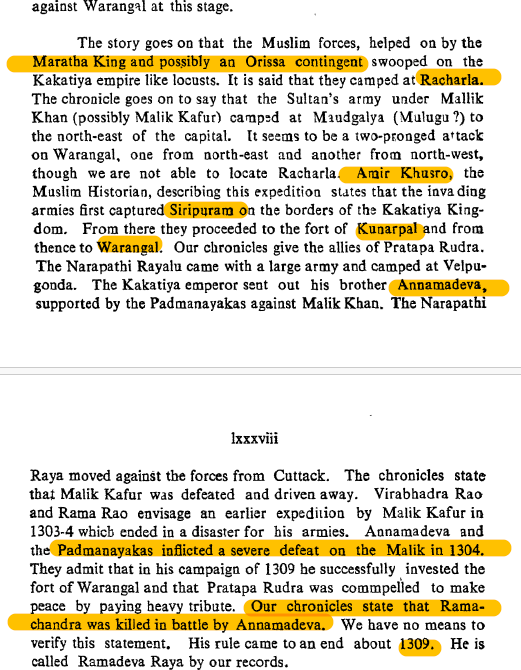
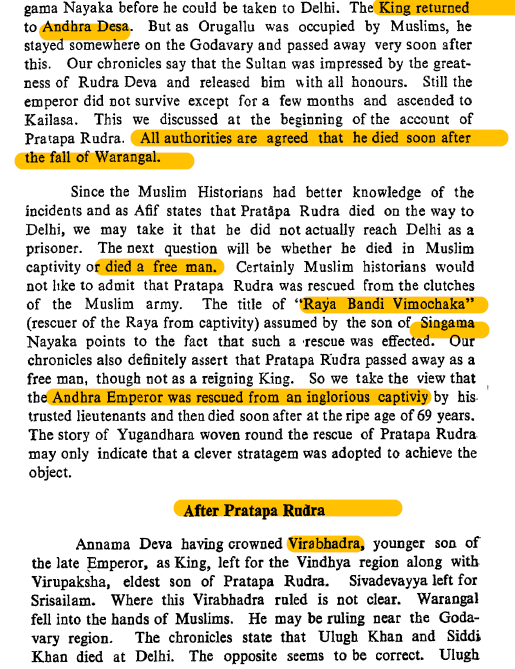
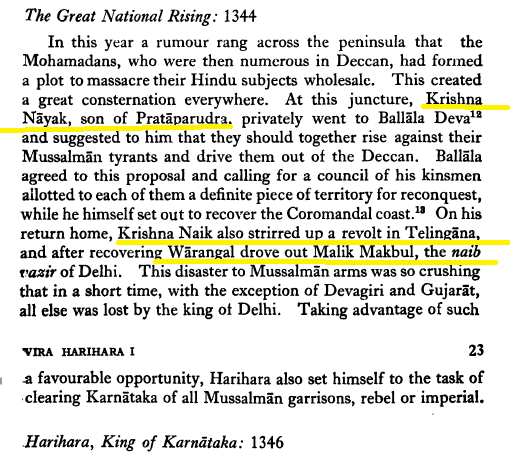
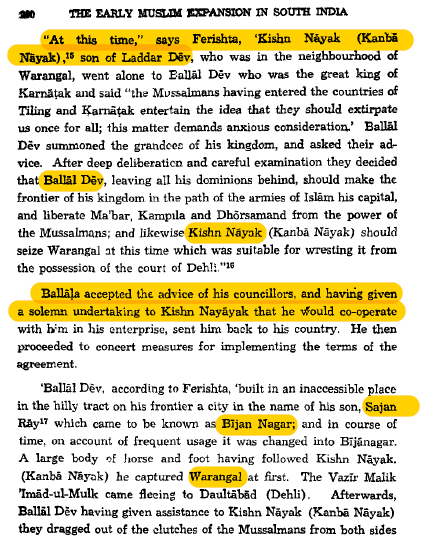
There is no doubt that Warangal fell finally after 5 furious wars (some say 7, with 4 Kakatiya victories to 3 defeats). The 7 walls of Ekasilanagara (3 have been excavated so far) finally fell to mamluk manjaniks in 1323. However, questions remain about how quickly Warangal was retaken in the Great Andhra Confederacy’s Liberation War. By 1326, the fires of rebellion were lit and successful within a decade. But who led it? Modern accounts assert Prola & Krishna Musunuri. Others contradict, adumbrating that the Kakatiyas themselves lingered.
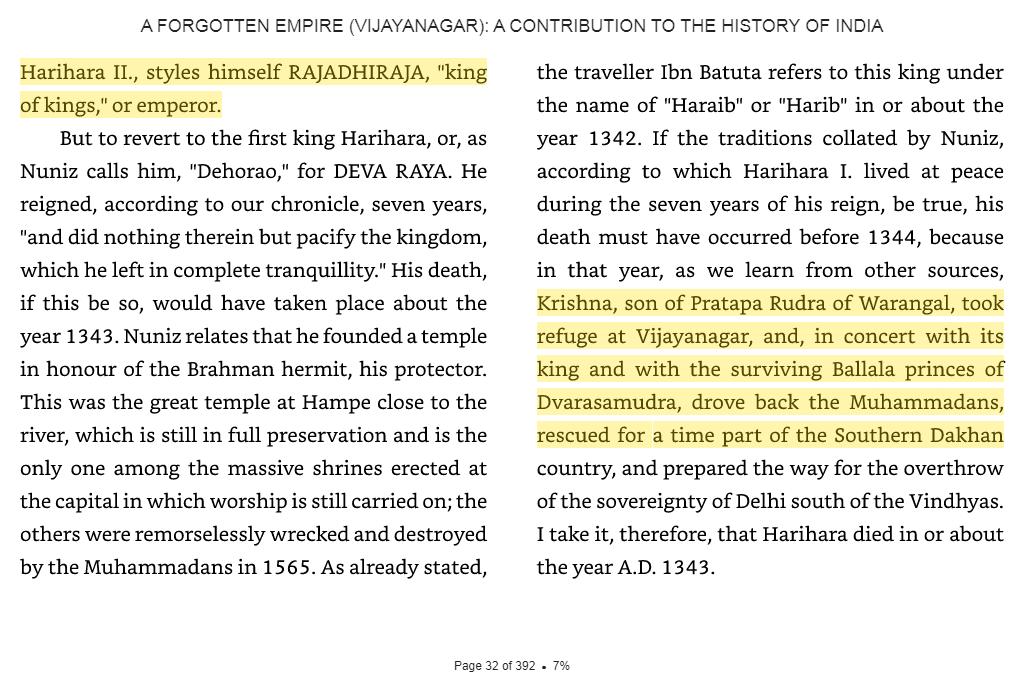
The social engineer story of Prataparudra IIbeing captured and sent North (suiciding at the Narmada) may in fact not be true, as he and his descendants are said to have continued to the resist from Rekapalli, and yes, the aforementioned Chattisgarh. Inscriptions from the dynasty and Prataparudra’s son and grandson are noted (suppressed?) even today, and end around 1360 CE. Thus, leaving aside the caste origins of the heroic dynasty (the least important matter here), it is apparent that the Kakatiyas continued to resist even after the fall of Warangal in 1323. Its retaking in 1336 is credited to the greatMusunuri Nayaks, but the much of this account is at variance with the inscriptions and even mention in Turkic chronicles.
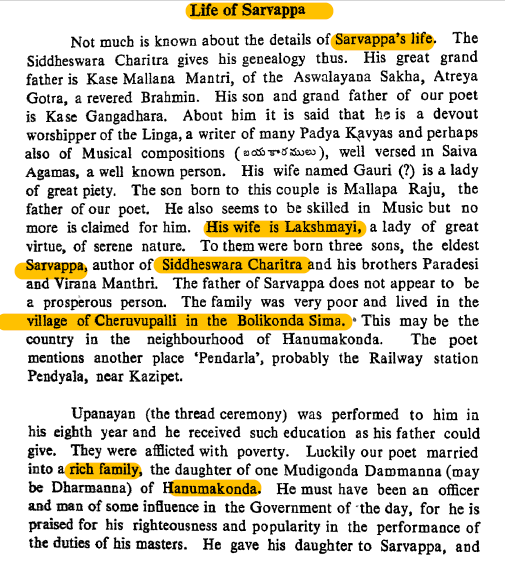
Kakatiya rule: 956 CE-1323. Sovereignty from ~1000. Suzerainty from ~1158 CE. The most commonly known account of this period was the Rudriya/Prataparudra Yasobhusana by Vidyanatha. However, another source also provides profound insight into the period. Siddhesvara Charitra also known as Kaakatheeya Charithra/Siddha Mahathmyam, was written by Kase Sarvappa.
Though mostly credible and comprehenisve, Prathaapa Charithra tells a fantastical story. It claims Warangal fell in 5th war due to Reddi Naayak treachery (they had previously revolted at Gandikota). It compared Prathaaparudra to Visaalaaksha and said the delhi turk requested his pardon and sent him back.
Nevertheless, it is more likely that for different reasons, Prathaaparudra II died a free man. He was rescued by the son of Singama Nayaka on the way to Delhi captivity. He died soon after with his Queen Vishaalaakshi joining him,
The Narapathi Raajas were said to be the family of either the Sangamas or Araveeti Somadeva, and they received Kaakatheeya princesses in marriage.
Siddhesvara Charithra asserts that Prathaaparudra had moslem vassals and prisoners.
There are contradictions between current indology and official Telugu chronicles, which assert victory in the 4th war. It is said that Odisha joined the turks against Warangal (conflicts with current narrative) and that Ramachandra seuna was slain by Induluri Annadeva outside the walls of Ekasila. Much intelligence gathering had been done with the help of the seuna slave.
Epilogue
There remains controversy over whether the Kakatiyas were immediately succeeded by a group of Nayaks known as the Musunuris, or whether Krishna Nayak himself was the son of Kakatiya Prataparudra. Early accounts (both primary and secondary) are near unanimous in asserting that Prataparudra had a number of sons, notably Veerabhadra & the later Krishna.
Valiant Vinayaka Deva was teh grandson of Pratapa Rudra II, and considered to be the son of Krishna Nayaka. His passing in 1364 is the conclusion of the dynasty.
The lineage of the dynasty, therefore, should perhaps proceed more as so: Yerukadeva/Beta I then Bhuvanika Malla/Prola I then Tribhuvana Malla/Beta II then Rudra I then Mahadeva then Ganapathi Deva then Rudrama Devi then Prathaapa/Rudra II then Vinayakadeva.
The Kakatiya Charithra even mentions the story of the Nripathi being married to one of the daughters of Prataparudra II. This only lends credence to the assertion that Gangadevi of Madhura Vijayam fame was a Kakatiya princess herself. If this is indeed true, then there can be no better reification of the claim that Vijayanagara’s founders hailed from Andhra. This would, after all, be a veritable passing of the torch. The Great Telugu Liberation War that would ultimately fragment into the competing Reddi and Rachakakonda kingdoms, would nevertheless find its true heirs in the Emperors of Vijayanagara. That is the most appropriate way to conclude the history of the Telugu state’s most favourite dynasty.
Having covered the Kakatiyas in great depth, it is time for a summary of this great dynasty. The Lords of Kakatipura, Hanumakonda, and Orugallu rose to near Imperial heights, before crashing down in a blaze of glory. Their cultural stamp, however, will remain for all time.
“Kakatiya empire was shattered into a number of small principalities. Most of their Vas-sals declared independence. The Padma Nayakas of Rachakonda, the Rayas of Vijanagaram, the Reddy’s of Kondaveedu, the Manchikonda Nayakas of Korukonda, the Koppula chiefs of Pithapuram were among those who declared independence. All these new chiefs who were lovers of fine arts patronized the artists of music and dance.” [4, 26]
“Pratapa Veeraganga Raju of the Surabhi family was praised being as endowed with skill in six arts and a scholar in musi-cology. Krishnadeva of the Tala family of Pottapi was described as the very moon raising over the ocean of music. Both of them belonged to the 14th century. Chalukya Visweswara who was given ‘Kavyaalankaara Cuudaamani’ in dedication was described as one who was learned in music and literature. He belonged to the 15th century. The first Devarayalu was praised as the ocean of music.” [4, 26]
Telugu Culture is an integral Part of Indic Civilization, as the ancient and medieval Aandhra desa was and is an integral part of Bhaaratha varsha. To study periods, and even individual dynasties, requires more than just 140 characters. Just why is this dynasty so beloved, and indeed, seared in the minds of Telugus, on both sides of the Polavaram? Here is why:
Cultural Contribution of the Kakatiyas
The Cultural Contribution of the Kakatiyas cannot be minimised. They were the singularly most impactful dynasty on the culture of the Andhras and on the Telugu language. From art & architecture,to music & literature, to the unification & defining of Andhra identity itself, the ‘Lords of Kakati-pura’ were of singular importance the history of the region.
Art & Architecture
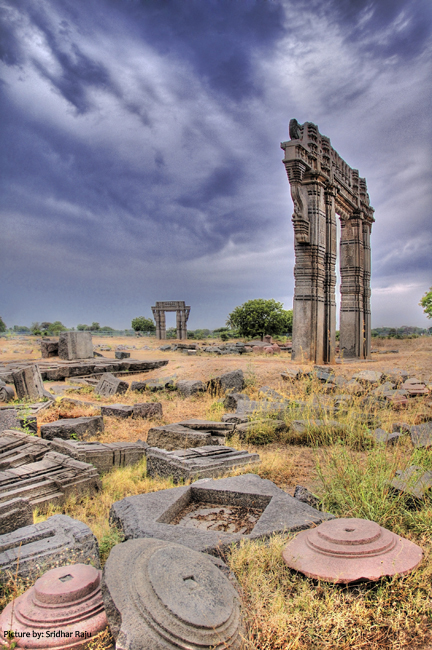
“The Kakatiyas were great builders of temples…The Ramappa temple and the Pillalamarri temple are the greatest works of art. The four majestic gateways in the fort of Warangal testify to the genius of the Andhra artists of Warangal. The Kakatiya capital Warangal was known as the Andhra Mahanagara. No other city in Andhra had such a distinction.” [3,80]
Architecture of Warangal and the Kakatiyas in general followed traditional Silpa/Agama works such as Mayamata, Manasara, Vastu Vidya of Viswakarma, and Karanagama. Building materials were primarily granite, sandstone, and periodically limestone. The concept of Torana previously received great patronage among Buddhists, and it reached its zenith at Warangal with its keerthi-toranas (4 in number). The Ramappa Temple, constructed during his reign, is testament to his contribution outside the capital, and the Svayambhunatha Temple and Keerthi Torana (gateways) testament to architectural splendour within.
“Important among these constructions are the thousand pillar temple at Warangal, the Ramappa gudi or Rudreswaralayam at Palampet and the Swayambhu Lineswaraswamy temple inside the Warangal fort. The Ramappa temple was built by Recherla Rudradeva, chief of Army and minister of Ganapati Deva in 1213 AD. This temple is of great importance to our study of Nrtta Ratnavali.” [10,Xiv]
In many ways, Ganapathi Bhupala’s era was the most architecturally & culturally significant.
“During the reign of Ganapati Deva, 1198-1261 AD there was an all round development. We find some inscriptions to show that commercial activities even with foreign countries were at the peak. During his time, Vira Saiva sect of Saivism was prominent in Andhra desa. This is also substantiated by the evidences from Palnati Vira Charitra and other works. This is the time to which great Saiva poets like Palkuriki Somanatha” [10, xiv] came into prominence.
“Kakatiyas have been the second major dynasty of the Andhra region after the Satavahanas. They made a lasting contribution not only to the political history, but also in protecting and promoting various sculptural and religious aspects during that time. The above verse indicates that their kingdom spread upto Bay of Bengal in the east, Srisailam in the south, the Malyavanta Mountains in the north and Kalyani in the west. Historians believe that this dynasty started with Prolaraju-I 1050 AD and lasted up to Prataparudra who ruled the kingdom between 1290-13[26] AD. “[10 , ix]
“Inscriptional evidences help us in understanding, religious, political, economic and social conditions of that period. The Kakatiya period also produced many Sanskrit and Telugu scholars whose works reflect the glory of that time…In the Prataparudriyam of Vidyanatha it is said that a goddess Kakati was the presiding deity of their dynasty after whose name the dynasty was known.” [10, ix]
It is said that a great Chithrashaala (or painting hall) existed with wondrous works of portraiture.
“There are historical evidences to show that Kakatiyas were originally followers of Jainism but they remained staunch propagators of Saivism in a later period. Ganapati Deva’s rule is also marked by constructions of exquisite sculptures.” [10,Xiv]
“There were several temples built during his time at Pillalamarri, Warangal, Kondaparti, etc he is also attributed with the renovation of the Warangal fort. The popular arches of Warangal are also attributed to his time.” [10,xv]
Irrigation works
In the arid Rayalaseema & Telangana regions, irrigation works were not only a matter of agricultural importance, but also of human survival.
“The Kakatiya period witnessed great development in agriculture. This was made possible as the Kakatiya rulers bestowed great attention in building numerous irrigation works, like lakes, tanks, wells, etc. Among the famous irrigational works constructed by them were the Ramappa and the Parkhal lakes. Prataparudradeva ordered reclamation of vast jungle tracts in Rayalaseema, especially in Kurnool district.” [3, 81]
“Kakatiyas have ruled for about 300 years from 11th to 14th centuries and left an indelible mark on the cultural history of peninsular India. They patronized several poets, artistes and sculptors. They were benevolent rulers who contributed enormously in the field of construction and irrigation technology.” [10, V]
Music & Dance
The contribution of the Kakatiyas to Song & Dance is best attested to by one of their own lieutenants. Jaya Senapathi was a Durjaya Telugu Chola who wrote Nrtta Ratnavali, Geetha Ratnavali and Vaadhya Ratnavali.
“After the twelfth century, the Andhra country came under the rule of Kakatiya kings. During the Kakatiya rule, royal courts and temple institutions liberally patronized Music and Dance. “ [4, 24]
“The most outstanding literary work of the Kakatiya period is Mahaabhaaratam by Tikkana. A number of new ideas not found in the original Sanskrit Mahaabhaaratam were included in this Telugu version by Tikkana. They reflect some of the contemporary conditions and beliefs – for instance – – – “Brihannala explaining his skill in dance to king Virata refers to Andhra dance forms like Dandalaasaka, Kundali, Preenkhana and Pe:rini. In Mahaabhaarata original while narrating ‘Kiichakavadha’ the words ‘Nartanasaala, Nartanaagaaram, Nartanagriham and Nartanaalayam’ were used to denote the spot where dance was taught and practiced. Tikkana rendered these words into Telugu as Naatyamandapam, Naatyasaala, Naatyamandiram, Nrittasaala and Sangiita Nilayam. “ [4, 25]
Of course, the aforementioned Jaya Senapathi of the Durjaya Chola line feature prominently.
“Kakatiya king Ganapathi Deva had a minister, Gundaamatya who was well-versed in the science of dance. His disciple was Jayapa, the scholar commander of the Kakatiyas and an au-thority on dance and music. Royal courts were centers of dis-cussions on various topics of culture and also display of per-forming arts. Veturi Prabhakara Sastry informs that in the court of King Pratapa Rudra there used to be a scholar, Veerabhallata who determined certain aspects and practices in the science of dance.” [4, 25]
There were numerous accomplished narthakis in the kingdom.
“Kriidabhiramam unveils a number of cultural aspects in vogue during the period of Kakatiyas. Some space in it was devoted to provide an account on Machal Devi, the great dancer of the time. She was a recipient of honour by king Pratapa Rudra. The other dancers mentioned are – Gaandharvi, Madana Rekha, Kamamanjari, Madhumaavati, Madaalasa, Chinnipoti, Kriidaabhiramam had also described the orchestra of Bavanees (Baindla), Jakkula purandhri paata, Akkala Nrityam, Gondli Nrityam of Mailarabhatas, the Murdhaabhinayam of Goraga damsel, Cindu Nrityam, Pushpagandhika Nrityam and the Laasyabhinaya. All these make out the society at the time of Kakatiyas an enlightened of fine arts.” [4, 26]
Perhaps the best epitaph for the samskrthika legacy of the Kakatiyas was done by an historian who specialised in the succeeding one.
“the Kaakateeyaa dynasty has contributed immensely to the enrichment of culture in Aandhradesa. They extended patronage to scholars, poets, musicians, sculptors, artists of many forms of art. The inscriptions give us ample evidence of the Kaakateeyas patronage to artistes. The Pillalamarri inscription, mentions houses constructed for temple singers, percussion artistes and dancers. The Paanagallu inscription also makes a mention that musicians and dancers received contributions.” [10, xiii]
Literature
Despite all this, it is in literature that we find the most lasting legacy of the Kakatiyas.
“The contribution of Kakatiyas who ruled for more than 200 years is enormous. In fact, writers of history of Telugu literature call the period 1100-1350 AD as Kakatiya era. The role of Vira Saivism in the history of Telugu literature is of great importance. This is the time when we find the Desi Chandas or regional prosody in the then literature.” [10,Xv]
“The trinity of Vira Saiva poets, Sripati, Mancana and Mallikarjunapanditaradhya, lived during. Nannecoda’s Kumarasambhavam was written during this time. Palkuriki Somanatha who authored Basavapurana, Panditaradhya Carita, Vrsadhipa Satakam also belongs to this time (1190-1250 AD). Somanatha is also known for his scholarship on various aspects of music, dance and prosodic patterns like gadya, ragada, udaharana, astaka etc. “ [10,xv]
Learned Pandiths were not the only scholars. Many aristocratic vassals and feudatory-kings featured in the long list of literary contributors.
“ Yathavakkula Annamayya who composed Sarveswara Satakam, a pioneering work lived during this period. Baddena, otherwise known as Bhadrabhupala, one of the feudatories of Ganapati Deva authored the Niti sastra muktavali and the famous Sumati Satakam.” [10,Xv]
“There are several other poets like Vemulavada Bhimakavi, Marana, Bayyana, Ketana, Sivedevayya etc. but two most popular writers of this time are Gona Buddha Reddi, who authored the Ranganatha Ramayana. History tells us that Tikkana of the Telugu trinity of poets, who authored fifteen cantos of Telugu Mahabharata in fact read them all to Ganapati Deva.”[10, Xv]
“There are also some Sanskrit poets like Virabhallata, Vidyanatha, Ramadiksita and others. There are anecdotes about some Dravidian poets who had association with some literary personalities during the Kakatiya period. Kamban who authored the Tamil Ramayana is said to have composed a poem ‘Navalar aritai’, appreciating Oruganti Rudrakavi. There are other instances of Kumara Saraswamit and Tattva Prakasa mentioning Kakatiyas in their works.” [10,Xv]
Atharvanacharya was a Jain grammarian, and he belongs to the Kakatiya era. [14, 23]
Telugu Works
Tikkana’s Nirvachanottara Ramayana, Matri Bhaskara’s Bhaskara Ramayanamu, Gona Buddha Ranganatha Ramayana, Marana’s Markandeya Puranamu, Sumati Satakam, Niti Sastra, and Muktavalu by Baddena, Palkurki Somanatha’s Pantiaradhya Charitra and Basava Puranamu, Nannechoda’s Kumara Sambhavam, Ketanas’ Dasakumara Charitra.
There are numerous works of Telugu traced to this period, the most famous of which is the Ranganatha Ramayana. Through attributed to Gona Buddha Reddi, it is more likely that Gona Buddha was a Kalachuri feudatory instead.
Nevertheless, the Andhra Mahabhaarathamu remains the most celebrated. ”Tikkana, the court poet of Manumasiddi II of Nellore, completed the translation of the fifteen cantos (parvas) of Mahabharata into Telugu at Warangal. He sent there to persuade Ganapatideva to help his patron Manumasiddi who had been driven out of his kingdom by his kinsmen. The other work of Tikkana was Nirvachanottara Ramayana…The popular work Bhaskara Ramayanamu which is attributed to Mantri Bhaskara belonged to this period. Gona Buddha Reddi, a feudatory of Rudradeva, was the first to translate the Ramayana into Telugu by about A.D. 1250. The work is known as Ranganatha Ramayana. Marana, a disciple of Tikkana wrote Markendeya Puranamu. The immensely popular works Sumati Satakam is attributed to Baddena, a Telugu Choda king of the Kakatiya period. His other work is Niti Sastra Muktavali. Palkurki Somanatha was the author of the two Saivite works Panditaradhya Charitra and Basava Puranamu. The other important Telugu works belonging to the Kakatiya period include Nannechoda’s Kumara Sambhavam, Ketanas’ Dasakumara Charitra, Manchana’s Keyurabahu Charitra.” [3, 80]
“Sanskrit works
The Kakatiya rulers extended patronage to Sanskrit also. Satkalyamalla wrote Udatta Raghava Kavyam and Niroshtya Ramayana in Sanskrit. Jayapa Senani was the author of Nritya Ratnavali, Gita Rantavali and Vadya Ratnavali. Rudradeva, the first of the Imperial Kakatiyas, was the author of the Sanskrit work called Nitisara. Yayati Charitramu, a Sanskrit drama, is attributed to Prataparudra.” [3, 80]
Indeed, Sanskrit literary works provide us with profound insight into the historical events of the period. Although a work of poesy, the Prathaaparudhreeya (Prataparudra Yasobhooshana) contains much historical date.
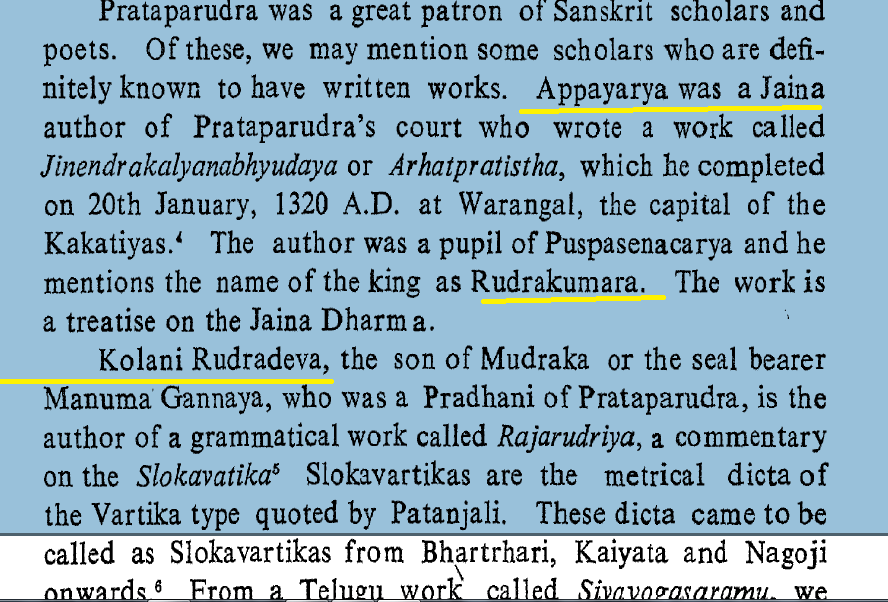
“One of the most important works mentioned during this period is Prataparudra Yasobhusana, an alankara sastra authored by Vidyanatha in praise of his patron, Prataparudra (1296-1323). We also find some Jain works under their patronage like Jinendra Kalyanabhyudaya of Appayarya. Another most important Sanskrit writer during that time is Gundaya bhetta who authored a commentary on the advaita text, Khanda Khadya. There are also many unnamed and named epigraphic poets during this time.”[10, xvi]
“The two predominant contributions both in Sanskrit and Telugu literature only show the existence and continuity of different forms of fine arts under their patronage. Most of the works in Telugu literature like Panditaradhya Caritra during that time invariably mention different forms of desi dance prevalent during that time.Palkuriki Somanatha in Panditaradhya Caritra gives an extensive list of various forms. We find these very desi forms were dealt with more scientifically by Jayana. Interestingly we also find Sangita Ratnakara of Sarngadeva who belongs to about the same period as that of Jayana’s period, describing most of these forms.” [10,xvi]
Legacy
Perhaps most controversial about the Kakatiyas is not their origin, but rather, their legacy. Many often wonder what the roots of the Vijayanagara Empire were. There are many reasons to assert that they can be found in Ekasila-nagara itself.
Vijayanagara
“In South-western Andhra or present Rayalaseema, the lead was taken by Harihara and Bukka. Their original home was Warangal where they worked as minister and treasurer, respectively of Prataparudra, the Kakatiya ruler. They fled from Warangal when it was besieged by Muslims. They went over to Kampili. In 1327 Kampili was captured…”[3, 97]
“Andhra Origin
As against the Karnataka origin, there is the theory of Andhra origin propounded by historians like K.A. Nilakanta Sastri, N. Venkataramanayya, M. Rama Rao and others. Venkataramanayya based his arguments on the following acts:
2) The literary works like Rajakalanirnaya, Vidyaranya Kalajnana, Vidyaranya Vrittanta state that Harihara and Bukka were the officers of the Warangal ruler and they fought against the Hoysalas.
3) The crest of the Vijayanagara empire and its administrators bore close significance to that of the Kakatiyas
“K.A. Nilakanta Sastri rejects the Karnataka origin by stating thus:
‘A critical study of the epigraphy has made it clear that Vijayanagar owed its origin to Telugu chieftains and not to subordinates of the Hoysalas as has sometimes been thought. From the above it is evident that Vijayanagar owes its existence to the valour and foresight of the Telugu chieftains. As a matter of fact it was the Telugus who freed greater part of South India”[3, 99]
Administration
A polity the size of the Kakatiya Kingdom necessitated a strong system of adminstration. In fact, the there are questions about whether it should be termed a “kingdom” or an “empire”. We are more reticent in the use of grandiose terminology, unlike the hyperbolic historians of our time. The term empire is best reserved for an All-India agglomeration, or at the very least, one of the 5 Indies/Division: North, South, East, West, & Central. The Maurya Empire was certainly All-India, naturally making Chandragupta & Ashoka titular emperors.
The Vijayanagara Empire managed the entire South, making it another such natural candidate for the term. ‘Lord of the South’, was in actuality, one of their titles.
The Kakatiya Kingdom however was more modest. Though it ruled all of Aandhra desa, and portions of Vidarbha, Karu Nadu, Dravida desa, Kalinga, and even Bastar, it didn’t amount to an entire direction. The Kakatiyas had approximately even rivals in the Seuna Yadavas, Hoysalas, and Pandyas. Ganapati Deva, himself the ruler of polity at its peak extent, was termed only Bhupala, rather than the more Imperial Samraat/Maharaajaadhiraaja. Though they had sub-kings in Nellore and elsewhere, and numerous feudatories, these were styled merely Raaja or at best Maharaaja. The Kakatiyas ruled a Grand Kingdom, but a kingdom is indeed what it is best termed.
“The empire, for the purpose of administrative convenience was divided into territorial units called Nadus. The important nadus were Anumakonda Nadu, Sabbi Nadu, Kamma Nadu, Palli nadu, Vegi nadu, Vela Nadu, Visuru Nadu, Paka Nadu, etc.
These in turn were further divided into sthalams, which were groupings of 20, 18, or 16 villages. Within this were karanams (accountants), tirparis (surveyors), and sunkaris (tax collectors), based on agricultural produce potential. “[3, 78]
That they ruled the entire Andhra desa is obvious from their inscriptions. Kosta, Telangana, and Rayalaseema are all neologisms. The original political units and territorial divisions are as follows:
Earlier known as visayas, the ancient divisions of Andhra were later called ‘nadus’.
Though most Telugus today are familiar with the sub-regions of Andhra (Rayalaseema, Telangana, & Kosta) there are 8 Historical territories (nadus) within Historical Andhra Desa. These are as follows:
“Vengi Nadu, the territory between the Godavari and the Krishna [some consider this to be the original homeland of the Telugus, with a capital at Rajamahendri]
Muliki Nadu, beginning with the Kadapa District and extending to [Karnataka]
Pottapi Nadu, from Kadapa to Penneru
Renadu [also known as Maanaadu], Kurnool District
Palnadu, West of Guntur
Paakanadu, the coastal tract from Nellore to Krishna”
Kammanadu
Velanadu
It should also be mentioned that the exact geographic limits would vary over time as kingdoms rose and fall. They were more expansive during the time of the Kakatiyas who ruled over all of Samaikya Andhra, which gives us additional units [3,78]:
Anumakonda Nadu (around Warangal & Hanumakonda)
Sabbi Nadu (present day Karimnagar/Elagandala district)
Visuru Nadu
Palli Nadu
Ayija Nadu
Gondala Nadu
Mingala Nadu
Kanduru Nadu
Kusala Nadu
Neravadi Nadu
Pongali Nadu
Karu Nadu
Some accounts give us as many as 20 Nadus for all of old united Andhra.
These regions all have featured significantly in the history of Andhra.
Commerce
Local commerce was driven by the local association (samayam), with the market (Peta) serving as the commercial centre. Motupalli was merely the most famous among many important ports, such as Krishnapatnam and Machilipatnam.
Exports included: “Andhra carpets, textiles, diamonds, spices, carpets, etc in exchange they sold, horses, silk, glass, etc. Tax [import duty] known on as Revu Sunkam was levided on the imports and exports [ekkumati-diggumati]” [3, 79]
“The gold coins were known as Gayanam or Mada. The silver coins were known as Rukalu. Ten Rukalu were equivalent to one Mada. Copper and lead was used for small coinage like Podduga Paduka and Visam which were respectively half, one-fourth and one-tenth of Ruka. Each coin carried the legend Rajagajakesari or Rajyagajakesari and the varaha emblem.” [3, 79]
Having provided a deeper overview of the origin and history and geography of historic Trilinga desa, one can now survey our beloved mother tongue of Telugu in detail.
Conclusion
The impact of the Paasupatha Saampradhaaya cannot be minimised in motivating the mass-mobilisation of Telugu society against foreign invaders. This can and will be examined in a later piece, but this version of Saivism ensured not the rigid equality of Basava (no doubt noble and inspirational, though probably utopic), but rather a general egalitarianism and dignity of labour. Unlike the Dalits/Panchamas of the North, who groaned under the stultifying elitist Puritanism (of mostly Yavana Pandit Mlecchas, by the way) styled “jatiwad!”, there was still a general concept of a common society (whatever the caste differences) that allowed Telugu society to throw off the yoke of foreign rule time and again. It is only once it was broken and exhausted (and riven by internal rivalries) that colonisers were able to consolidate.
The root of that of course is again concocting dynastic histories and origins. A truthful recounting will ensure that people are clear on duties and privileges, which will reduce rivalries, and allow a place for everyone. Those who wish to rule must initiate as kshathriyas. Those who are merely provincial gentry(country/lesser aristocracy) should not try to independently rule or replace the ruling class. The mistakes of the Velama Rachakondas—possibly motivated by Siddesvara’s account of the Paakanaati Reddi Raajas—are illustrative here. The Kakatiya Maharaajas were noble men and women who fought with bravery and cleverness against more powerful foes, and defeated them time and again—deploying popular support to the hilt.
In addition, Dhaarmikas need to get out of the habit of privileging and lending more credence to the “historical” accounts of foreign invaders over their own native/indigenous accounts of history. Part of this is the doing of koopastha-manduka casteist poets hyperbolic styled as“Rishis!! And Bhoodevas!!” as they shamelessly and sycophantically praise their foreign masters and modern paymasters. Such swine deserve mrthyudhand (or at the very least having their tongues pulled for knowingly calumnying our kings). Indology/Archaeology may indeed be a foreign import/contribution, but as Pandit Chelam has proven, colonisers have utilised this to concoct fake history and conflate Chandra Gupta I with Chandragupta Maurya (eliminating 1200 years of history).
Similarly, even “objective” third parties like Robert Sewell were aghast at the exaggerations of Ferishta. Not only he, but even Portuguese and british chroniclers routinely run anathema/defamation of their opponents—even today with that one-eyed wretch rushdie’s vicious libel against vijayanagara’s princess. They take special pleasure in creating “cuck” situations when they themselves are the inventors of the “cuck” chair. It is long past time that digital dharmrakshaks (who overuse and misuse the insult “cuck”) understand the concept of in-group/out-group, which all other people do. It is not that we must become denialist about “Jodha Bai”/Heera Kunwari—such events did occur. It is that we must be extra suspicious when reading enemy accounts of our own history, as seen against Mewar and of course Vijayanagara, which all accounts except Ferishta, deny that a princess was ever given to the bahmanis. This historical masochism must end, not just with respect to women but with respect to men.
The debased glee with which the humiliation of Prataparudra II, by all accounts a brave and formidable foe to foreign invaders, pervades sepoy historians is truly a sight to behold. For years, most of us unquestioningly accepted it. But now, there are not 1 or 2, but 3 accounts (including that of a Sikh military historian) who assert that Prataparudra II was rescued from capture, and continue to fight on until 1326.
The glory of the Kakatiyas must not be dimmed or extinguished, just as the unity of Telugus and ancient Andhra desa must not be denied.
Amid a state of churn spanning both the Telugu states, the Kakatiyas remain more relevant than ever before. After all, the very claim of Telugus to the land of Telangana (increasingly being dubbed “Hyderabad state” by those allegedly nationalist Sanghis) indicates that everything old truly is new again. It is one thing for minority language groups to preserve their distinctiveness within a city, it is another thing to attempt to aggrandise their holdings to oppress the majority in a colonial apartheid state called “Rayala-Telangana” or worse “nizam Hyderabad”.
The sooner slumbering Telugus (who more than slaked their thirst for materialism and cinema) wake up, the better. Identity wars are meant to change culture. People who simultaneously are allergic to the word Aandhra but nevertheless stake claim to the Kakatiyas (who titled themselves “Andhreshvara”) should look up the meaning of the phrase “cognitive dissonance”.
Andhra and Telugu mean the Same Thing
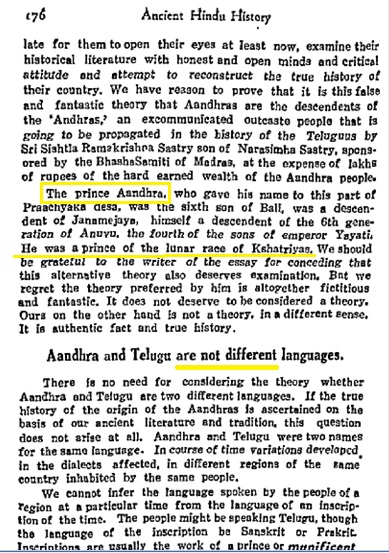
First and foremost, it is critical to reassert that that Andhra and Telugu mean the same thing. In the present time, there has been much (purposeful) confusion of the terms and treacherous parties have sought to restrict the word Andhra only to Coastal Andhra. In reality, Andhra, Trilinga Desa, and Telangana all refer to the land of the Telugus or the speakers of the Andhra Bhasha.
Second, people must understand that the rightful claim to this land belongs to the Telugu people. Otherwise, partition rules apply to those who take issue with Telugu and the republic of India. The Kakatiya Dynasty merely cemented and underscored the all Andhra claim to the land originally known as “Andhra Desa” dating back to Andhra Nripathi himself. From the Satavahanas to the Vishnukundins onward, the Telugu people have traditionally resided in this land and have made it their own. The Kakatiya Kingdom took this cultural-sphere to its collective zenith.
Lastly, it is high time Andhras got off their duffs and did something useful for society. Merely eking out a living and feeding your face in front of the idiot box is not going to result in a cultural revival. The Kakatiya dynasty’s legacy was one of hard work and cultural unification. It is that very task that stands before all of us today.
Jai Kakatiya!Jai Telugu Thalli! Jai Visaalaandhra!
References:
The History of Andhra Country, 1000 A.D.-1500 A.D. B.Yashoda Devi. Gyan Publ.1933
The History of Andhra Country, 1000 A.D.-1500 A.D.Vol.II. B.Yashoda Devi. Gyan Publ.1933
Rao, P.R. History and Culture of Andhra Pradesh. New Delhi: Sterling. 1994
Bai, Kusuma K. Music-Dance Forms And Musical Instruments during the Period of the Nayakas.
Sastri, K.A.Nilakantha. A History of South India. New Delhi: Oxford. 2015
Aiyyangar, S. Krishnaswamy. Ancient India. Madras: S.P.C.K. Depository. 1911
Modali, Nagabhushana Sarma, Ed. Mudigonda Veerabhadra Sastry. History and Culture of the Andhras. Hyderabad: Telugu University. 1995
Ramesam, V. Andhra Chronology (90-1800 A.C.). K.Mahadevan. Mylapore. 1946